Types of Saws: What Each One Does and Which to Buy First
Learn the different types of saws, what each one does best, and which saw to buy first. A practical guide with honest buying recommendations for beginners.
Reader-supported: we may earn a commission when you buy through links on this page, at no extra cost to you. How we research
We don't run a test lab. For each guide we compare manufacturer specs, warranty terms and owner reviews, then match models to specific jobs and budgets. We say when a pick is a trade-off, and every product has cons listed.
As an Amazon Associate, HomeBuildLab earns from qualifying purchases. Read our full affiliate disclosure.

If you walk into a hardware store and browse the saw aisle, you'll see dozens of options. Circular saws, jigsaws, miter saws, reciprocating saws, band saws, and a half dozen hand saws all compete for your attention. Understanding the different types of saws and what each one actually does is the first step toward building a useful tool collection instead of a random pile of metal.
Here's the truth that tool manufacturers don't want you to hear: you don't need most of these saws. I've been building things for a long time, and I still only reach for four or five saws regularly. In my opinion, a beginner can handle 90% of home improvement projects with just two or three well-chosen saws. The key is knowing which types of saws solve which problems, so you buy the right tool for the job instead of the shiniest tool on the shelf.
This guide covers every common saw type, from basic hand saws to specialized power saws, explains what each one does best, and ends with my personal recommendation for which saw you should buy first. I believe this is the most practical breakdown of saw types you'll find.
Quick Picks: Which Saws to Buy, in Order
Short on time? Here's the buying order this guide recommends, with the model I'd pick for each. Details are near the end.
- Best First Saw: DeWalt DWE575SB circular saw. Handles crosscuts, rip cuts, and plywood for under $200. Check price|Review
- Best Second Saw for Trim and Framing: Metabo HPT C10FCG2 miter saw. Fast, repeatable angle cuts for under $150. Check price|Review
- Best for Remodeling and Demolition: DeWalt DCS382B reciprocating saw. Cuts through walls, framing, and pipe. Check price|Review
- Best for Curves and Cutouts: DeWalt DW317K jigsaw. Variable speed and tool-free blade changes make it easy to learn on. Check price|Review
Compare our picks
4 picks- Best First SawDeWalt DWE575SB 15-Amp 7-1/4" Circular Saw
DeWalt · Corded (120V) · 8.8 lbs
Users who want the lightest, deepest-cutting corded circular saw available
$140.99Amazon price as of Oct 7, 4:05 PM EDTProduct prices and availability are accurate as of the date/time indicated and are subject to change. Any price and availability information displayed on Amazon.com at the time of purchase will apply to the purchase of this product.
View on Amazon - Best Second Saw for Trim and FramingMetabo HPT C10FCG2 10" Compound Miter Saw
Metabo HPT (formerly Hitachi) · Corded · 24 lbs
DIYers and beginners who need a functional miter saw without a large investment
$111.95Amazon price as of Oct 7, 4:05 PM EDTProduct prices and availability are accurate as of the date/time indicated and are subject to change. Any price and availability information displayed on Amazon.com at the time of purchase will apply to the purchase of this product.
View on Amazon - Best for Remodeling and DemolitionDeWalt DCS382B 20V MAX XR Reciprocating Saw
DeWalt · Cordless (20V MAX, battery sold separately) · 5.73 lbs (bare tool)
DIYers and contractors who want strong performance without the Milwaukee premium
$159.00Amazon price as of Oct 7, 4:05 PM EDTProduct prices and availability are accurate as of the date/time indicated and are subject to change. Any price and availability information displayed on Amazon.com at the time of purchase will apply to the purchase of this product.
View on Amazon - Best for Curves and CutoutsDeWalt DW317K 5.5-Amp Top-Handle Jig Saw Kit
DeWalt · Corded (120V) · 6.2 lbs
Beginners who want a simple, dependable corded jigsaw for learning and everyday projects
$138.00Amazon price as of Oct 7, 4:05 PM EDTProduct prices and availability are accurate as of the date/time indicated and are subject to change. Any price and availability information displayed on Amazon.com at the time of purchase will apply to the purchase of this product.
View on Amazon
Hand Saws
Hand saws are powered by you, not electricity. They're inexpensive, portable, and quiet. I think every homeowner should own at least one, even if you have a full power tool collection. Batteries die. Cords don't reach. Sometimes you just need to make one quick cut.
Crosscut Saw
The crosscut saw is the classic hand saw most people picture when they hear "saw." It has a wide, tapered blade with teeth designed to cut across the wood grain. Modern crosscut saws typically have hardpoint teeth that stay sharp for years without sharpening.
Best for: General-purpose cuts in dimensional lumber, quick cuts when pulling out a power tool isn't worth the setup, and situations where you need portability over speed.
Price range: $10 to $30 for a quality model. The Stanley FatMax and Irwin Universal are both solid choices.
Hacksaw
A hacksaw uses a thin, replaceable blade stretched in a C-shaped metal frame. The fine teeth (typically 18 to 32 teeth per inch) are designed to cut metal, plastic, and PVC pipe. You won't use it for wood, but you'll reach for it every time you need to cut a bolt, trim a threaded rod, or shorten a pipe.
Best for: Cutting metal tubing, bolts, threaded rod, PVC pipe, and thin metal stock.
Price range: $10 to $25 for the frame. Replacement blades cost a few dollars per pack.
Coping Saw
A coping saw has a thin, narrow blade held in a deep U-shaped frame. The blade can be rotated to follow tight curves, making it essential for cutting cope joints in trim work. When two pieces of molding meet at an inside corner, a coped joint looks cleaner and lasts longer than a simple miter joint. That's where this saw earns its keep.
Best for: Coping baseboard and crown molding joints, cutting tight curves in thin stock, and detailed craft work.
Price range: $10 to $20. Replacement blades are inexpensive and widely available.
Japanese Pull Saw
Japanese pull saws cut on the pull stroke instead of the push stroke, which allows a thinner blade. A thinner blade removes less material (narrower kerf), requires less effort, and produces cleaner cuts. The ryoba style has crosscut teeth on one side and rip teeth on the other, making it a versatile choice for beginners.
Best for: Precision hand cuts, flush-cutting dowels and plugs, trim carpentry, and fine woodworking where saw control matters more than speed.
Price range: $15 to $40 for a quality pull saw. Gyokucho, Suizan, and Z-Saw are popular brands.
Power Saws: Portable
Portable power saws are the workhorses of home improvement. You carry them to the workpiece, not the other way around. These are the saws most beginners should focus on first.
Circular Saw
The circular saw is the single most versatile power saw you can own. A spinning disc blade cuts through lumber, plywood, MDF, and (with the right blade) even metal and masonry. It handles crosscuts, rip cuts, bevel cuts, and plunge cuts. Paired with a straightedge or speed square, a circular saw can do much of what a table saw and miter saw do, just with more setup time.
Most circular saws use a 7-1/4" blade that cuts through standard 2x lumber in a single pass. Cordless models (typically 18V or 20V) have caught up to corded saws in power for most tasks, and the freedom from a cord is a genuine upgrade for jobsite work.
Best for: General framing, cutting plywood and sheet goods, deck building, and just about any cut where portability matters. If you could only own one power saw, this is the one. I'd pick a circular saw over any other single tool for a beginner's first purchase. Our how to choose a circular saw guide breaks down the specs that matter most.
Key specs to watch: Blade size (7-1/4" is standard), bevel capacity (45 degrees minimum), and whether the blade is on the left or right side (left-blade gives right-handers a better view of the cut line).
Price range: $60 to $200 for corded models, $100 to $300 for cordless (tool only). The DeWalt DWE575SB and Milwaukee M18 Fuel are both popular choices.
If you want a deeper comparison of corded and cordless options, see our guide on corded vs cordless circular saws. You can also compare the circular saw against other saw types in our circular saw vs table saw and miter saw vs circular saw breakdowns.
Jigsaw
A jigsaw uses a short, thin blade that moves up and down (reciprocates) to cut curves, circles, and irregular shapes that no straight-cutting saw can handle. It's the go-to saw for cutting sink openings in countertops, trimming curves in plywood, and making interior cutouts without cutting in from an edge.
Jigsaws accept a wide variety of blades for wood, metal, laminate, and tile. Orbital action settings let you balance cutting speed against cut smoothness. Higher orbital settings cut faster but leave a rougher edge.
Best for: Curved cuts, interior cutouts (like outlet boxes in drywall or sink holes in countertops), and detail work in thin to medium-thickness stock.
Key specs to watch: Stroke speed (SPM), orbital action settings, blade change mechanism (tool-free is worth it), and dust blower.
Price range: $40 to $180 for most models, with premium options like Festool reaching $400+. Personally, I prefer the Bosch JS470E as a mid-range choice for its smooth orbital action and reliability.
For a detailed comparison, check our jigsaw vs reciprocating saw guide and our roundup of the best jigsaws.
Reciprocating Saw
The reciprocating saw (often called a Sawzall, which is actually a Milwaukee brand name) is the demolition king. A long blade extends from the front of the saw and cuts with an aggressive back-and-forth motion. It's designed for rough, fast cuts, not precision work.
Swap in the right blade and a recip saw chews through wood, nails, metal pipe, drywall, plaster, tree roots, and pretty much anything else that needs to come apart. During a kitchen remodel, it's the tool that tears out old framing, cuts nailed-together lumber apart, and removes old plumbing.
Best for: Demolition, remodeling tear-out, cutting nail-embedded wood, pruning large tree limbs, and any rough cut in tight spaces.
Key specs to watch: Stroke speed (2,500 to 3,000 SPM is typical), stroke length (1-1/8" to 1-1/4"), and variable speed trigger.
Price range: $50 to $200 for corded, $100 to $400 for cordless kits. The Milwaukee M18 Fuel Sawzall consistently leads reviews.
See our best reciprocating saws roundup for specific model recommendations.
Track Saw
A track saw (also called a plunge saw) is essentially a circular saw that rides on an aluminum guide rail. The blade plunges into the material from above instead of entering from the edge, which allows you to start cuts anywhere on a panel. An anti-splinter strip on the track produces near-perfect edges with zero tearout.
Track saws excel at breaking down full sheets of plywood with furniture-grade edge quality. They also produce dead-straight long rip cuts without the need for a table saw. The trade-off is cost: a track saw system (saw plus rails) typically runs two to three times more than a standard circular saw.
Best for: Breaking down sheet goods with clean edges, straight long cuts in plywood and MDF, and anyone who needs table-saw-quality rip cuts without the floor space for a table saw.
Key specs to watch: Track length (55" is standard, with extensions available), plunge depth, dust collection efficiency, and anti-splinter strip compatibility.
Price range: $300 to $700 for the saw-and-track system. Makita, Festool, and DeWalt are the primary players. The Makita SP6000J offers strong performance at a more accessible price point than Festool.
Power Saws: Stationary and Benchtop
These saws stay in your workshop (or on your jobsite) and deliver the precision that portable saws can't match. You bring the workpiece to the saw, not the other way around.
Miter Saw
A miter saw (sometimes called a chop saw) holds a circular blade on a hinged arm that you pull down through the workpiece. The workpiece sits against a fence, and the saw pivots left and right to make angled (miter) cuts. Compound miter saws also tilt for bevel cuts. Sliding compound miter saws add a sliding action that dramatically increases crosscut capacity.
The miter saw is the fastest, most accurate tool for repetitive crosscuts and angle cuts. If you're installing baseboard, crown molding, door trim, picture frames, or building a deck, a miter saw makes those cuts in seconds with clean, repeatable accuracy. What I like most about a miter saw is how much time it saves once you get into trim work or framing.
Best for: Trim work, framing crosscuts, angle cuts for molding and frames, and any repetitive crosscutting task.
Key specs to watch: Blade size (10" or 12"), slide vs. non-slide, single vs. dual bevel, positive miter stops, and crosscut capacity.
Price range: $100 to $400 for entry-level to mid-range, $400 to $1,000+ for premium sliding compound models. The DeWalt DWS779 and Makita LS1219L are popular mid-range and high-end options.
See our best miter saws roundup and table saw vs miter saw comparison for help choosing.
Table Saw
The table saw is the centerpiece of a serious woodworking shop. A circular blade protrudes through a flat table surface, and you push the workpiece through the blade. The fence keeps cuts parallel, and the miter gauge handles crosscuts and angle cuts. No other tool rips lumber as accurately or handles sheet goods, dados, and joinery as efficiently.
Table saws come in several sizes: benchtop (portable, 8-1/4" or 10" blade), jobsite (portable with stands), contractor (semi-stationary), and cabinet (heavy, precise, and permanent). I recommend a jobsite table saw like the DeWalt DWE7491RS for most home workshops. It offers the best balance of portability, precision, and price.
Best for: Ripping lumber to width, cutting sheet goods, dados, rabbets, tenons, and virtually any straight-line cut in a workshop setting.
Key specs to watch: Rip capacity (24" to 32"+ for jobsite saws), fence quality (this matters more than motor power), blade size, dust collection port, and miter gauge quality.
Price range: $250 to $600 for jobsite saws, $600 to $1,500 for hybrid saws, $1,500 to $5,000+ for cabinet saws.
Our best table saws roundup and table saw buying guide cover this topic in depth.
Band Saw
A band saw uses a continuous loop of toothed metal blade that rides on two large wheels inside a housing. The thin blade moves in one direction (downward through the table), which makes it ideal for cutting curves, resawing thick boards into thinner stock, and cutting irregular shapes in thick material.
Unlike a jigsaw (which also cuts curves), a band saw handles thick hardwoods with ease and keeps cuts perpendicular to the table surface. Resawing, where you slice a thick board into thinner pieces, is a task only a band saw performs well. It's also quieter and safer than most other power saws because the blade pushes the workpiece down onto the table instead of kicking it back at you.
Best for: Cutting curves in thick stock, resawing boards into thinner pieces, cutting irregular shapes, and general-purpose workshop cuts.
Key specs to watch: Throat depth (distance from blade to frame), resaw capacity (maximum height), blade guides (bearing vs. block), and motor power.
Price range: $175 to $500 for benchtop models, $500 to $1,500 for floor-standing models, $1,500+ for professional-grade units. The WEN 3962T and Rikon 10-3061 are popular starting points.
For more details, check out our best band saws guide and our band saw vs scroll saw comparison.
Scroll Saw
A scroll saw is a specialty saw built for intricate, detailed cuts in thin material. A short, thin blade moves up and down through a small table, allowing you to cut tight curves, sharp corners, and interior cutouts (by threading the blade through a drilled hole). Think of it as the precision instrument where a band saw is the workhorse.
Scroll saws are the tool of choice for fretwork, wooden puzzles, marquetry, decorative signs, and ornamental woodwork. They're not designed for thick stock or fast cutting. If you're building furniture or doing home improvement, you probably don't need one yet. But if you're drawn to craft and detail work, a scroll saw opens up projects no other tool can handle.
Best for: Intricate fretwork, puzzle making, decorative signs, inlay and marquetry, and detailed craft work in thin stock (typically under 2" thick).
Key specs to watch: Blade type (pin-end vs. plain-end; plain-end is more versatile), throat depth, variable speed control, and vibration dampening.
Price range: $125 to $300 for entry-level to mid-range, $300 to $800+ for premium models. The DeWalt DW788 is a popular choice. The WEN 3921 offers good entry-level value.
Read our best scroll saws roundup for specific recommendations.
Outdoor and Specialty Saws
These saws serve more focused purposes. You won't need them for general woodworking, but they're essential for the tasks they're designed to handle.
Chainsaw
A chainsaw uses a toothed chain that loops around a guide bar to cut through wood rapidly. They're built for felling trees, cutting firewood, clearing storm damage, and bucking logs. Chainsaws come in three power types: gas, battery (cordless), and corded electric.
Gas chainsaws deliver the most power and unlimited runtime but are heavier, louder, and require fuel mixing and more maintenance. Battery chainsaws are lighter, quieter, and nearly maintenance-free, making them the better choice for most homeowners. I believe battery-powered chainsaws have improved enough that they're now the right call for most residential yard work. Corded electric models are the cheapest but limited by cord reach.
Best for: Felling trees, cutting firewood, clearing storm damage, limbing, and bucking logs.
Key specs to watch: Bar length (14" to 20" covers most homeowner needs), power source (gas, battery, or electric), chain speed, and anti-vibration features.
Price range: $100 to $250 for battery-powered, $150 to $500+ for gas-powered, $60 to $150 for corded electric.
See our best chainsaws roundup for model-by-model recommendations.
Pole Saw
A pole saw is a small chainsaw blade mounted on the end of an extendable pole (typically 8 to 12 feet). It lets you prune high branches from the ground without climbing a ladder. Like chainsaws, pole saws come in gas, battery, and corded electric versions.
Battery-powered pole saws are the best choice for most homeowners. They're light enough to hold overhead for extended periods, produce less vibration than gas models, and don't tether you to an outlet. Gas models offer more power for thick branches but are heavier and more fatiguing to use overhead.
Best for: Pruning tree branches 10 to 15 feet high, trimming overhead limbs, and maintaining yard trees without a ladder.
Key specs to watch: Reach (total length with pole extended), bar length (6" to 10"), weight (critical since you're holding it overhead), and power source.
Price range: $80 to $200 for battery-powered, $150 to $350 for gas-powered, $50 to $120 for corded electric.
Our best pole saws guide covers the top models across all power types.
Tile Saw (Wet Saw)
A tile saw (also called a wet saw) uses a diamond-coated blade and a continuous stream of water to cut through ceramic, porcelain, and stone tile cleanly without cracking. The water cools the blade, reduces dust, and lubricates the cut. If you're doing a bathroom remodel, kitchen backsplash, or any tiling project, a tile saw is the right tool.
Tabletop models handle most DIY tiling projects. They're compact, relatively affordable, and produce clean cuts in ceramic and porcelain tile. For large-format tiles, stone, or professional volume, a sliding-table or bridge-style tile saw provides more cutting capacity and precision.
Best for: Cutting ceramic, porcelain, and stone tile for bathroom, kitchen, and flooring projects.
Key specs to watch: Blade size (7" for most DIY work, 10" for larger tile), cutting length, water delivery system, and table size.
Price range: $80 to $350 for tabletop DIY models, $400 to $1,500+ for professional bridge saws. The Ridgid R4021 and DeWalt DWC860W are popular mid-range picks.
Check our best tile saws roundup for detailed recommendations.
All These Types of Saws: Which Should You Buy First?
This is the question every beginner asks after learning about all these types of saws, and I always give the same answer. Start with a circular saw. It's the most versatile power saw you can own. With a good blade and a straight edge, a circular saw crosscuts, rip cuts, bevel cuts, and even makes plunge cuts. It costs a fraction of a table saw, takes up zero floor space, and goes wherever the work is.
Your second saw depends on your projects:
- Doing trim work, framing, or building furniture? Add a miter saw. The speed and accuracy for repetitive crosscuts and angle cuts are worth the investment.
- Remodeling or doing demolition? A reciprocating saw tears through walls, old framing, and plumbing like nothing else.
- Cutting curves or making interior cutouts? A jigsaw handles shapes and curves that straight-cutting saws can't.
- Setting up a dedicated woodworking shop? A table saw becomes the centerpiece. Once you have one, every other cut gets faster and more accurate.
- Doing yard work and tree maintenance? A battery-powered chainsaw or pole saw handles pruning and storm cleanup.
Avoid the temptation to buy specialty saws before you need them. A scroll saw, band saw, track saw, or tile saw is a great tool, but only when you have a specific project that demands it. Build your collection around the work you actually do, not the tools you think you should own.
Common Beginner Questions
Can one saw do everything?
No, but a circular saw comes closest. It can technically make most of the cuts that a miter saw and table saw make, just with more setup time and less precision. For a beginner, a circular saw plus a Japanese pull saw covers a surprising range of projects.
Are cordless saws as powerful as corded?
For most saw types, modern brushless cordless tools match corded performance in typical home improvement tasks. The exception is sustained heavy-duty cutting: ripping thick hardwood on a table saw or using a reciprocating saw for hours of demolition. In those cases, corded tools still have the edge because batteries eventually run out. For occasional use, cordless wins on convenience.
How much should I spend on my first saw?
Budget $100 to $200 for a quality circular saw (corded or cordless tool-only). That range gets you a reliable brand-name tool from DeWalt, Milwaukee, Makita, or Bosch. Avoid the cheapest no-name options (under $40) because they often have sloppy fences, weak motors, and poor blade quality. Also avoid overspending on a premium saw before you know what kind of work you'll be doing most.
Do I need a miter saw if I have a circular saw?
Not immediately. A circular saw with a speed square makes accurate 90-degree and 45-degree crosscuts. But once you're cutting trim, framing walls, or making repeated angle cuts, a miter saw saves enormous time and produces more consistent results. Most people add a miter saw as their second or third power saw.
Which Saw to Buy First: Our Picks in Buying Order
These picks follow the buying order above: a circular saw first, then the saw that matches your projects. Each one is a beginner-friendly model at a sensible price, not the most expensive saw in its category. If you're torn between your first two, our miter saw vs circular saw comparison helps, and our jigsaw vs reciprocating saw breakdown covers the other common toss-up.
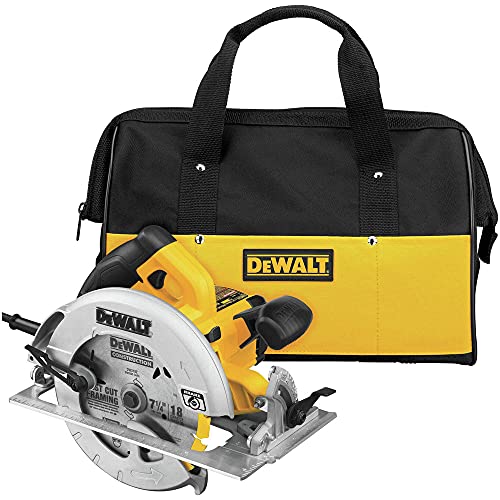
DeWalt DWE575SB 15-Amp 7-1/4" Circular Saw
Best for: Users who want the lightest, deepest-cutting corded circular saw available
- Brand
- DeWalt
- Type
- Corded circular saw
- Power
- Corded (120V)
- Voltage
- 120V, 15 Amp
- Weight
- 8.8 lbs
$140.99Amazon price as of Oct 7, 4:05 PM EDTProduct prices and availability are accurate as of the date/time indicated and are subject to change. Any price and availability information displayed on Amazon.com at the time of purchase will apply to the purchase of this product.
What we like
- Lightest 15-amp corded saw at 8.8 lbs
- Deepest cutting depth at 2-9/16"
- Electric brake and 57-degree bevel
- No battery platform to commit to
Watch out for
- No LED light or laser guide
- Needs an outlet or extension cord
- No carrying case
This is the circular saw I'd buy as your first power saw. It lands right in the $100 to $200 range from the FAQ above, and it comes from a brand-name maker with a solid track record. At 8.8 lbs, it's the lightest 15-amp saw in our best circular saws roundup, which makes it easier to control while you learn.
It's corded, so there are no batteries to buy and no platform to commit to yet. You get an electric brake, a 57-degree bevel, and the deepest cut in its class for crosscuts, rip cuts, and plywood.

Metabo HPT C10FCG2 10" Compound Miter Saw
Best for: DIYers and beginners who need a functional miter saw without a large investment
- Brand
- Metabo HPT (formerly Hitachi)
- Type
- 10" single-bevel compound miter saw
- Power
- Corded
- Voltage
- 120V, 15 Amp
- Weight
- 24 lbs
- Warranty
- 5-year limited
$111.95Amazon price as of Oct 7, 4:05 PM EDTProduct prices and availability are accurate as of the date/time indicated and are subject to change. Any price and availability information displayed on Amazon.com at the time of purchase will apply to the purchase of this product.
What we like
- Budget price with a 5-year warranty
- Light at 24 lbs
- 40-tooth blade and 9 positive miter stops included
Watch out for
- Single bevel only
- Non-sliding design limits cuts to 2x6
- Basic dust bag
If your projects involve trim, framing, or furniture, a miter saw is the next buy. This one makes repeatable crosscuts and angle cuts fast, and it sits firmly in budget territory. It's also light enough at 24 lbs to carry out to the driveway or deck.
It's a basic single-bevel, non-sliding saw, so it cuts up to 2x6 lumber and you'll flip boards for opposite bevels. For a first miter saw, that's a fair trade. Unlike most budget saws, it ships with a 40-tooth carbide blade, so it's ready for basic trim right away. For more options, see our best miter saws roundup.

DeWalt DCS382B 20V MAX XR Reciprocating Saw
Best for: DIYers and contractors who want strong performance without the Milwaukee premium
- Brand
- DeWalt
- Type
- Cordless reciprocating saw
- Power
- Cordless (20V MAX, battery sold separately)
- Voltage
- 20V MAX
- Weight
- 5.73 lbs (bare tool)
- Size
- 16.27" x 4.15" x 7.125"
$159.00Amazon price as of Oct 7, 4:05 PM EDTProduct prices and availability are accurate as of the date/time indicated and are subject to change. Any price and availability information displayed on Amazon.com at the time of purchase will apply to the purchase of this product.
What we like
- Up to 3,200 SPM for fast cutting
- Light at 5.73 lbs for a full-size saw
- Runs on the large DeWalt 20V MAX platform
Watch out for
- Battery and charger sold separately
- Shorter 1-1/8" stroke than Milwaukee
- No orbital action
If you're tearing out a bathroom or cutting through old framing and pipe, this is the saw for it. The brushless motor runs at up to 3,200 SPM, and at 5.73 lbs it's easier to hold at awkward angles than most full-size models.
It's sold as a bare tool, so budget for a DeWalt 20V MAX battery and charger if you don't have one. Those batteries also run DeWalt drills, jigsaws, and outdoor tools. Compare it with other models in our best reciprocating saws roundup.

DeWalt DW317K 5.5-Amp Top-Handle Jig Saw Kit
Best for: Beginners who want a simple, dependable corded jigsaw for learning and everyday projects
- Brand
- DeWalt
- Type
- Corded top-handle jigsaw
- Power
- Corded (120V)
- Voltage
- 120V, 5.5 Amps
- Weight
- 6.2 lbs
- Warranty
- 3-year limited
$138.00Amazon price as of Oct 7, 4:05 PM EDTProduct prices and availability are accurate as of the date/time indicated and are subject to change. Any price and availability information displayed on Amazon.com at the time of purchase will apply to the purchase of this product.
What we like
- Variable speed up to 3,100 SPM with 4 orbital settings
- Tool-free, lever-action blade changes
- 3-year limited warranty from a major brand
- Includes a contractor bag for storage
Watch out for
- Heavier than compact jigsaws at 6.2 lbs
- No LED light to illuminate the cut line
- Needs an outlet or extension cord
If you need to cut curves, sink cutouts, or shapes that straight saws can't handle, this is an easy jigsaw to learn on. The variable-speed trigger runs from 0 to 3,100 SPM, so you can start slowly and keep the blade on your line, then speed up once the cut is established.
Four orbital settings let you trade smoothness for speed: setting 0 for clean cuts in plywood and laminate, settings 1 to 3 for faster, more aggressive cuts in rough lumber. The keyless lever-action blade clamp makes blade swaps quick, and the shoe bevels from 0 to 45 degrees. It's corded, so like the circular saw pick above, there's no battery platform to commit to.
Final Thoughts
Understanding the different types of saws is really about understanding the different types of cuts. Straight cuts, curved cuts, angle cuts, rough cuts, and precision cuts each have a saw that handles them best. I think the good news is that you don't need all of them to get started.
A circular saw handles the broadest range of tasks for the lowest investment. From there, let your projects guide your purchases. If you keep wishing you could make faster crosscuts, get a miter saw. If you're tearing out a bathroom, get a reciprocating saw. If you want to start serious woodworking, invest in a table saw.
The worst mistake isn't buying the wrong saw. It's buying too many saws before you learn to use the ones you have. If I were starting over with an empty shop, I'd buy a circular saw, then a miter saw, and I'd hold off on everything else until a specific project demanded it. Start with one or two, learn them well, and add tools as your skills and projects grow. Every one of the types of saws covered in this guide has a clear purpose. Match the tool to the task, and you'll build smarter from day one.
Affiliate Disclosure
This post contains affiliate links. As an Amazon Associate, HomeBuildLab earns from qualifying purchases at no additional cost to you. Learn more
Prices shown are from Amazon at the time indicated and may change. The price and availability on Amazon.com at the time of purchase apply.
Sam Hartwell
Sam Hartwell edits HomeBuildLab's tool reviews and home improvement guides. Every pick starts with manufacturer spec sheets, warranty terms, parts availability and owner feedback, then gets matched to a specific job and budget. Guides list the trade-offs plainly and get updated when models change or go out of stock.
Keep reading: Saws
All saws guides → Comparison
Saws
Table Saw vs Track Saw: Which is Better for Sheet Goods?
Table saw vs track saw: which one handles plywood better? I compare cut quality, safety, price, and portability so you can pick the right saw for your shop.
Updated
 Comparison
Saws
Table Saw vs Miter Saw: Which Do You Actually Need First?
Table saw vs miter saw: I compare cut types, versatility, safety, portability, and price so you can pick the right first saw for your home workshop in 2026.
Updated
 Comparison
Saws
Miter Saw vs Circular Saw: Key Differences That Actually Matter
Miter saw vs circular saw: which one should you buy first? I compare accuracy, portability, cut types, and cost so you pick the right saw for your projects.
Updated
 Comparison
Saws
Jigsaw vs Reciprocating Saw: Picking the Right Blade for the Job
Jigsaw vs reciprocating saw: one cuts curves with precision, the other tears through walls. Learn which saw fits your projects and when you need both.
Updated
 Comparison
Saws
Circular Saw vs Table Saw: The Right First Saw for Beginners
Circular saw vs table saw: which one should you buy first? I compare cost, portability, precision, and safety to help beginners pick the right first saw.
Updated
 How-To
Saws
Jigsaw Blade Types Explained: How to Pick the Right One for Every Cut
Not sure which jigsaw blade types you need? This guide covers blade materials, TPI ratings, and tooth geometry so you pick the right blade every time.
Updated
The HomeBuildLab newsletter
New guides and tool deals worth knowing about
One short email when we publish or update a buying guide. No spam, unsubscribe anytime.