How to Choose a Circular Saw: A Buyer's Guide
Learn how to choose a circular saw that fits your projects and budget. I break down blade size, power, drive type, and the features that actually matter.
Reader-supported: we may earn a commission when you buy through links on this page, at no extra cost to you. How we research
We don't run a test lab. For each guide we compare manufacturer specs, warranty terms and owner reviews, then match models to specific jobs and budgets. We say when a pick is a trade-off, and every product has cons listed.
As an Amazon Associate, HomeBuildLab earns from qualifying purchases. Read our full affiliate disclosure.

Knowing how to choose a circular saw can save you hundreds of dollars and years of frustration. This is the one tool that belongs in every workshop, garage, and job truck. But walk into any home improvement store and you will find dozens of models across wildly different price points, blade sizes, and power configurations. It is easy to overspend on features you do not need, or worse, buy a saw that cannot handle the work you have planned.
Here is the truth most buying guides will not tell you: the best circular saw for a weekend deck builder is not the same saw a framing carpenter needs. I wish someone had told me that before I bought my first one. Your projects, your budget, and even which hand you favor should all drive the decision. A budget corded sidewinder can outperform a cordless model that costs several times as much if your work keeps you near an outlet. A compact 6-1/2 inch saw might serve you better than the industry-standard 7-1/4 inch if you are mostly cutting trim and sheet goods.
After comparing dozens of models, this buying guide walks you through every decision that matters. By the end, you will know exactly which blade size, power source, drive type, and features match your work. If you already know what you want and just need a recommendation, check out our best circular saws roundup for specific model picks.
Quick Picks: The Right Circular Saw for Your Work
Already know how you'll use it? Start here. Each pick is covered in detail near the end of this guide.
- Best Overall: DeWalt DCS575B FLEXVOLT. Cordless with corded-level power for job sites and big projects. Check price|Review
- Best Corded: DeWalt DWE575SB. The lightest 15-amp saw with the deepest cut, for shop and garage work. Check price|Review
- Best Cordless for M18 Owners: Milwaukee 2732-20 M18 FUEL. Fast cuts and a rafter hook on the platform pros use. Check price|Review
- Best Budget: SKIL 5280-01. A 15-amp corded sidewinder for well under $100. Check price|Review
- Best Compact: Ryobi PSBCS01B. A 6-1/2 inch saw at about 5 lbs for sheet goods, trim, and overhead cuts. Check price|Review
Compare our picks
5 picks- Best OverallDeWalt DCS575B FLEXVOLT 60V MAX 7-1/4" Circular Saw
DeWalt · Cordless (FLEXVOLT 60V MAX, battery sold separately) · 8.2 lbs (bare tool)
Contractors and serious DIYers who want corded power without the cord
$279.00Amazon price as of Oct 8, 6:23 AM EDTProduct prices and availability are accurate as of the date/time indicated and are subject to change. Any price and availability information displayed on Amazon.com at the time of purchase will apply to the purchase of this product.
View on Amazon - Best CordedDeWalt DWE575SB 15-Amp 7-1/4" Lightweight Circular Saw
DeWalt · Corded (120V) · 8.8 lbs
Users who want the lightest, deepest-cutting corded circular saw available
$140.99Amazon price as of Oct 8, 6:23 AM EDTProduct prices and availability are accurate as of the date/time indicated and are subject to change. Any price and availability information displayed on Amazon.com at the time of purchase will apply to the purchase of this product.
View on Amazon - Best Cordless for M18 OwnersMilwaukee 2732-20 M18 FUEL 7-1/4" Circular Saw
Milwaukee · Cordless (M18 18V, battery sold separately) · 9.05 lbs (bare tool)
Professional contractors who need the highest-performing cordless circular saw available
Out of stock on Amazon right now
- Best BudgetSKIL 5280-01 15-Amp 7-1/4" Circular Saw
SKIL · Corded (120V) · ~8.7 lbs
DIYers and homeowners who want a capable circular saw without spending much
$69.00Amazon price as of Oct 8, 6:23 AM EDTProduct prices and availability are accurate as of the date/time indicated and are subject to change. Any price and availability information displayed on Amazon.com at the time of purchase will apply to the purchase of this product.
View on Amazon - Best CompactRyobi PSBCS01B ONE+ HP 18V Brushless 6-1/2" Circular Saw
Ryobi · Cordless (ONE+ 18V, battery sold separately) · ~5 lbs (bare tool)
DIYers who need a lightweight saw for overhead cuts, tight spaces, and general home projects
Out of stock on Amazon right now
Blade Size: 7-1/4 Inch vs 6-1/2 Inch
Blade size is the first fork in the road, and it determines what your saw can physically cut through.
7-1/4 Inch: The Industry Standard
The 7-1/4 inch blade size is the default for good reason. It cuts about 2-1/2 inches deep at 90 degrees, which means it handles 2x lumber (2x4s, 2x6s, 2x8s) in a single pass. At a 45-degree bevel, you still get roughly 1-7/8 inches of cutting depth.
If you are doing any framing, deck building, or general construction, this is the size you want. Replacement blades are everywhere, prices are competitive, and you will never find yourself wishing you had more capacity.
6-1/2 Inch: Lighter and More Nimble
A 6-1/2 inch saw cuts about 2-1/4 inches deep at 90 degrees. That still clears 2x lumber (which is 1-1/2 inches thick) at 90 degrees, but it leaves less margin on bevel cuts and can't match a 7-1/4 inch saw on thicker stock. Where this size shines is weight: a typical 6-1/2 inch cordless saw weighs around 6.8 pounds, compared to 9 to 11 pounds for a 7-1/4 inch model.
If your work is mostly sheet goods (plywood, MDF), trim, and the occasional 2x board, the smaller saw is easier to maneuver and causes less fatigue. It also draws less power from cordless batteries, giving you noticeably more cuts per charge.
The Verdict
For most people, I'd suggest the 7-1/4 inch saw as the safer bet. It can do everything the 6-1/2 inch can, plus handle thicker stock. Choose the 6-1/2 inch only if portability and weight are your top priorities and you rarely cut anything thicker than 2x lumber.
Corded vs Cordless: How to Choose a Circular Saw Power Source
This decision has changed more in the last five years than in the previous fifty. Modern brushless cordless saws have nearly closed the power gap with corded models, but "nearly" still matters depending on how you work.
Corded Circular Saws
A corded 15-amp saw delivers consistent, uninterrupted power. It never runs out of charge, and it costs significantly less than a comparable cordless setup. Budget corded saws start well under $100, with excellent mid-range and premium corded options (like the Makita 5007MG) costing a few times that.
The downside is obvious: you are tethered to an outlet. On a job site, that means extension cords, tripping hazards, and time spent managing cable. In a garage workshop, it barely matters.
Cordless Circular Saws
Cordless saws run on 18V to 60V lithium-ion batteries. A quality 5.0Ah battery provides roughly 250 to 350 cuts through standard 2x4 framing lumber. Higher-capacity batteries (6.0Ah or 9.0Ah) push that to 400 to 600 cuts. Charging takes 30 to 60 minutes depending on the charger.
The real cost of going cordless is not just the tool. A bare tool runs from about $100 to well over $200, but once you add two batteries and a charger, the total roughly doubles. If you are already invested in a battery platform (DeWalt 20V/60V, Milwaukee M18, Makita 18V LXT), the bare tool is a much easier buy.
For a deeper breakdown of the tradeoffs, read our full corded vs cordless circular saw comparison.
The Verdict
In my opinion, if you work in a shop or garage and want maximum power per dollar, go corded. If you work on job sites, value mobility, or are already on a battery platform, go cordless. Either way, do not buy the cheapest cordless saw just because it says "brushless" on the box. The battery and motor quality matter far more than the label.
Sidewinder vs Worm Drive (vs Hypoid)
The drive type determines the saw's shape, weight, torque, and blade orientation. This is where a lot of buyers get confused, so let us break it down simply.
Sidewinder (Direct Drive)
A sidewinder puts the motor directly in line with the blade using a spur gear. The blade sits on the right side of the saw (for most models), and the motor housing is compact. Sidewinders spin the blade faster, typically around 5,500 to 6,000 RPM, making them great for clean, fast cuts.
They are lighter (usually 7 to 10 pounds), less expensive, and require zero gear maintenance. For the vast majority of home projects and even most professional work, a sidewinder is all you need.
Worm Drive
A worm drive positions the motor behind the blade at a 90-degree angle, transferring power through worm gears. This produces more torque at a lower blade speed (around 4,500 RPM). The blade typically sits on the left side, giving right-handed users a better sight line to the cut.
Worm drive saws are longer, heavier (10 to 14 pounds), and the gears require periodic oil changes. They excel at plunge cuts, ripping thick lumber, and sustained heavy cutting. Professional framers on the West Coast and in the Midwest have traditionally favored worm drives.
Hypoid Drive
Hypoid saws (pioneered by Makita) are a refinement of the worm drive concept. They use finer-toothed hypoid gears that run cooler, transfer power more efficiently, and are sealed with permanent lubrication. You get the same torque advantage and rear-handle design without the oil maintenance.
The tradeoff is cost. Hypoid gears are expensive to manufacture, so these saws carry a price premium.
The Verdict
A sidewinder is the right choice for 90% of buyers. Personally, I've always reached for a sidewinder over a worm drive for home projects, and I've never felt limited by the power. If you do heavy framing or frequently rip thick hardwoods and want that rear-handle feel with maximum torque, consider a worm drive or hypoid. Just know that modern cordless rear-handle saws have largely matched the torque of traditional corded worm drives while weighing less.
Key Specs That Actually Matter
Once you have settled on blade size, power source, and drive type, these specifications separate a good saw from a great one. What I find most important is understanding which numbers on the spec sheet actually translate to better performance in your hands.
Amps (Corded) or Volts (Cordless)
For corded saws, 15 amps is the standard for full-size 7-1/4 inch models. Anything less and you will notice the saw bogging down in harder materials. For cordless, 18V to 20V handles most tasks. DeWalt's FlexVolt 60V and Makita's 36V (18V x2) platforms deliver power that rivals corded saws for demanding cuts.
RPM (No-Load Speed)
Most saws in this category spin between 5,000 and 5,800 RPM at no load. Higher RPM generally means cleaner cuts, especially in hardwoods and plywood. However, RPM drops under load, so a saw with a strong motor that maintains speed matters more than the number on the spec sheet.
Bevel Capacity
Every model tilts its base plate for angled cuts. Standard saws bevel to 45 degrees, but better models reach 50 to 57 degrees with positive stops at common angles (0, 22.5, and 45 degrees). Those positive stops save real time because you do not have to measure and lock the angle manually.
If you plan to cut rafters, stairs, or compound angles, look for a bevel capacity of at least 50 degrees. For general-purpose work, 45 degrees with positive stops is sufficient.
Weight
Weight matters more than most people think, especially for overhead cuts or long days of use. A lightweight 6-1/2 inch cordless saw might weigh 6.8 pounds bare. A full-size corded sidewinder runs 9 to 11 pounds. A worm drive can hit 13 to 14 pounds.
Heavier saws are not inherently better. If you will be working overhead (cutting roof sheathing, for example), every pound counts.
Cutting Depth
At 90 degrees, a 7-1/4 inch saw should cut at least 2-1/2 inches. Check the spec at 45 degrees too: you want at least 1-7/8 inches to handle beveled cuts through 2x material.
Features Worth Paying For (and Features to Skip)
Not every feature on a saw is equally useful. From what I have seen about what experienced woodworkers actually rely on, here is what is worth the extra money and what is marketing filler.
Worth It: Electric Brake
An electric brake stops the blade within two to three seconds after you release the trigger, instead of letting it coast for 10 to 15 seconds. This is both a safety feature and a productivity feature. You do not have to wait for the blade to stop before setting the saw down or making your next cut. Some job sites require electric brakes per OSHA regulations. On a saw you will use regularly, this feature alone justifies spending a little more.
Worth It: LED Cut Line Light
An LED light illuminates your cut line, which is surprisingly helpful when your body or the saw itself casts a shadow on the workpiece. It sounds minor until you are making finish cuts in a dimly lit room. Most mid-range and premium saws include this standard.
Worth It: Magnesium or Aluminum Shoe
The base plate (shoe) contacts your workpiece on every cut. Stamped steel shoes are cheaper but can bend over time and are prone to rust. A magnesium or aluminum shoe stays flat, resists corrosion, and slides more smoothly across the material. This is one of those "you get what you pay for" differences between a budget saw and a mid-range saw.
Worth It: Dust Port
A dust port (or dust blower) keeps sawdust away from your cut line so you can see what you are doing. It also lets you connect a shop vacuum for cleaner cuts indoors. Not glamorous, but extremely practical.
Skip: Laser Guides
Laser guides project a line onto your workpiece to show the cut path. In theory, this sounds useful. In practice, they are often inaccurate, hard to see in bright light, and add a point of failure. A sharp pencil line and a good sight line from the blade guard notch work better and cost nothing.
Skip: Onboard Blade Storage
Some saws include a clip to store a spare blade on the body of the saw. It adds weight and bulk for a feature you will use maybe twice a year. Keep your spare blades in a drawer.
Common Circular Saw Buying Mistakes
I think most buying regrets come from these mistakes. Avoid them and you will end up with a saw that actually fits your work.
Buying Too Much Saw
A 60V cordless rear-handle saw with a 9.0Ah battery is an incredible tool. It is also overkill for someone who cuts a few boards on the weekends. Be honest about your projects. A budget corded sidewinder or a mid-range 18V cordless saw handles the vast majority of home improvement work perfectly well.
Ignoring the Battery Platform
If you already own DeWalt 20V tools, buying a Milwaukee M18 saw means a second charger, a second set of batteries, and double the expense. I'd recommend staying within one battery ecosystem, which saves hundreds of dollars over time. If you are starting fresh, pick the platform first, then buy the saw.
Skipping the Blade Upgrade
Most saws ship with a general-purpose 24-tooth framing blade. It works, but it tears through plywood and leaves rough edges on crosscuts. Picking up an inexpensive 40-tooth or 60-tooth finishing blade transforms the quality of your cuts. Match the blade to the job: fewer teeth for fast ripping, more teeth for smooth crosscuts.
Not Adjusting Blade Depth
The blade should extend only about 1/4 inch below the bottom of the material you are cutting. Running the blade at full depth wastes energy, increases kickback risk, and produces rougher cuts. Adjusting depth takes five seconds and makes every cut safer and cleaner.
Forgetting About Left vs Right Blade Orientation
On a sidewinder, the blade typically sits on the right side of the motor. On a worm drive, it is usually on the left. This affects your sight line to the cut. Right-handed users often find left-blade saws easier to follow because the cut line is not hidden behind the motor. Try both configurations in-store before you buy if possible.
How a Circular Saw Fits Your Tool Collection
This is often the first power saw people buy, but it is worth understanding how it relates to other saws you might own or want to own.
If you are debating between a circular saw and a table saw, the circular saw is the more versatile starter tool for most people. A table saw excels at repeated rip cuts and precision work, but the portable saw handles framing, crosscuts, sheet goods, and rough carpentry with a fraction of the footprint and cost.
Similarly, a miter saw and a circular saw complement each other well. The miter saw is faster and more accurate for repetitive crosscuts and angle cuts (like trim work), while the portable saw handles everything else. Many experienced builders own both.
Circular Saw Picks for Every Situation
These picks follow the decisions in this guide: blade size, power source, and budget. All five are sidewinders, which is the right drive type for most buyers. For the full seven-saw comparison, see our best circular saws roundup, and if you're still deciding on power source, our corded vs cordless circular saw breakdown goes deeper.

DeWalt DCS575B FLEXVOLT 60V MAX 7-1/4" Circular Saw
Best for: Contractors and serious DIYers who want corded power without the cord
- Brand
- DeWalt
- Type
- Cordless circular saw
- Power
- Cordless (FLEXVOLT 60V MAX, battery sold separately)
- Voltage
- 60V MAX
- Weight
- 8.2 lbs (bare tool)
$279.00Amazon price as of Oct 8, 6:23 AM EDTProduct prices and availability are accurate as of the date/time indicated and are subject to change. Any price and availability information displayed on Amazon.com at the time of purchase will apply to the purchase of this product.
What we like
- Corded-equivalent power from the 60V FLEXVOLT system
- 57-degree bevel capacity
- Lightweight at 8.2 lbs for a full-size cordless saw
- Electric brake, LED light, and dust blower standard
Watch out for
- Battery and charger sold separately
- FLEXVOLT batteries are expensive
- No rafter hook
If you want the mobility of cordless without giving up corded power, this is the saw. The 60V FLEXVOLT battery drives a full 7-1/4 inch blade through framing lumber and sheet goods, and it weighs just 8.2 lbs bare.
It also has the features this guide says are worth paying for: an electric brake, an LED light, and a 57-degree bevel. The catch is cost. The saw is sold bare, and FLEXVOLT batteries are pricey on their own.
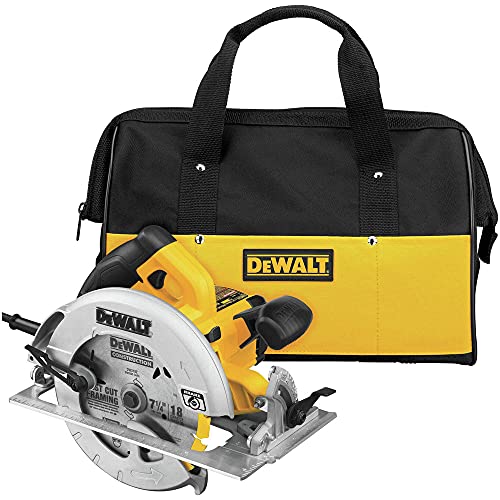
DeWalt DWE575SB 15-Amp 7-1/4" Lightweight Circular Saw
Best for: Users who want the lightest, deepest-cutting corded circular saw available
- Brand
- DeWalt
- Type
- Corded circular saw
- Power
- Corded (120V)
- Voltage
- 120V, 15 Amp
- Weight
- 8.8 lbs
$140.99Amazon price as of Oct 8, 6:23 AM EDTProduct prices and availability are accurate as of the date/time indicated and are subject to change. Any price and availability information displayed on Amazon.com at the time of purchase will apply to the purchase of this product.
What we like
- Lightest 15-amp corded saw at 8.8 lbs
- Deepest cutting depth at 2-9/16"
- Electric brake and 57-degree bevel
- Reinforced 10-foot cord
Watch out for
- No LED light or laser guide
- Aluminum shoe is less durable than magnesium
- No carrying case
This is the pick if you work near an outlet and want maximum power per dollar. At 8.8 lbs, it's the lightest 15-amp saw in our roundup, and its 2-9/16 inch cutting depth is the deepest.
You get an electric brake, a 57-degree bevel with positive stops, and a 10-foot cord for extra reach. At a mid-range price, it covers everything most shop and garage work will ask of it.
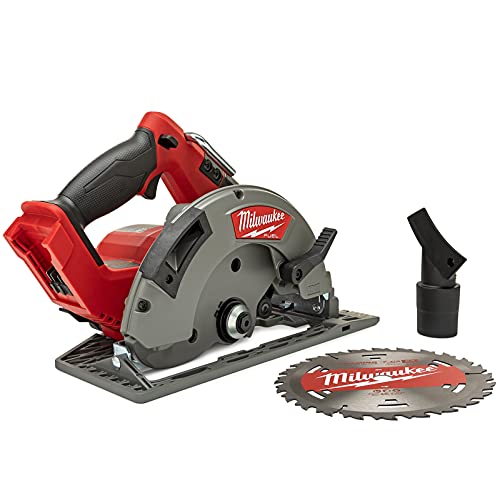
Milwaukee 2732-20 M18 FUEL 7-1/4" Circular Saw
Best for: Professional contractors who need the highest-performing cordless circular saw available
- Brand
- Milwaukee
- Type
- Cordless circular saw
- Power
- Cordless (M18 18V, battery sold separately)
- Voltage
- 18V
- Weight
- 9.05 lbs (bare tool)
Currently out of stock on Amazon. Other sellers or a restock may be listed there.
What we like
- Among the fastest cordless cutting you can buy
- Up to 750 cuts per charge with an HD12.0 battery
- Integrated rafter hook
- Shares batteries with 250+ M18 tools
Watch out for
- Heavy at 12+ lbs with battery
- Premium price, especially with a battery kit
- No positive bevel stops at 22.5 or 45 degrees
If you already own Milwaukee M18 batteries, this is the logical cordless saw. It runs at 5,800 RPM, matches 15-amp corded performance, and gets up to 750 cuts per charge on an HD12.0 battery.
It also has the rafter hook the DeWalt lacks, which framers appreciate. At over 12 lbs with a battery, it's better for job site work than overhead cuts.
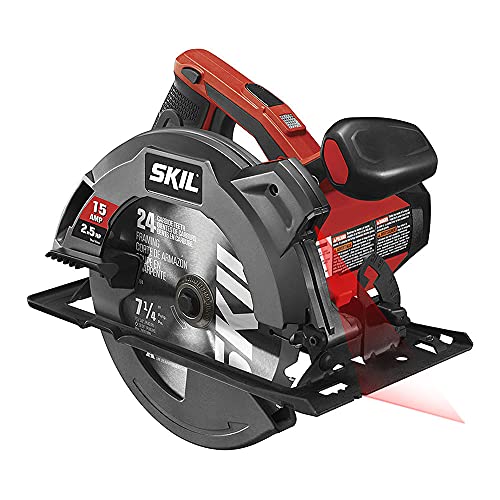
SKIL 5280-01 15-Amp 7-1/4" Circular Saw
Best for: DIYers and homeowners who want a capable circular saw without spending much
- Brand
- SKIL
- Type
- Corded circular saw
- Power
- Corded (120V)
- Voltage
- 120V, 15 Amp
- Weight
- ~8.7 lbs
$69.00Amazon price as of Oct 8, 6:23 AM EDTProduct prices and availability are accurate as of the date/time indicated and are subject to change. Any price and availability information displayed on Amazon.com at the time of purchase will apply to the purchase of this product.
What we like
- 15-amp motor at a budget price
- Laser guide helps beginners cut straight
- Carrying bag and carbide blade included
Watch out for
- No electric brake
- Depth adjustment uses a wrench
- Plastic build isn't made for heavy daily use
This is the budget corded sidewinder from the intro of this guide. For well under $100, you get a 15-amp motor, a laser guide, and a carbide blade. That's plenty for deck boards, plywood, and weekend projects.
The savings come from missing features. There's no electric brake, depth adjustment needs a wrench, and the plastic housing won't survive years of job site abuse. For occasional use, those trade-offs are easy to live with.

Ryobi PSBCS01B ONE+ HP 18V Brushless 6-1/2" Circular Saw
Best for: DIYers who need a lightweight saw for overhead cuts, tight spaces, and general home projects
- Brand
- Ryobi
- Type
- Compact cordless circular saw
- Power
- Cordless (ONE+ 18V, battery sold separately)
- Voltage
- 18V
- Weight
- ~5 lbs (bare tool)
Currently out of stock on Amazon. Other sellers or a restock may be listed there.
What we like
- About 5 lbs bare for fatigue-free cutting
- 2-1/4" depth still handles 2x lumber
- Works with 300+ Ryobi ONE+ tools
- Tool-free depth and bevel adjustments
Watch out for
- Fewer replacement blade options than 7-1/4"
- Slower 4,900 RPM
- Not built for heavy framing
If your work is mostly plywood, MDF, trim, and the occasional 2x board, this is the 6-1/2 inch saw this guide recommends. At about 5 lbs bare, it's roughly half the weight of a full-size saw, which makes a big difference overhead and on long cutting sessions.
It still clears 2x lumber at 90 degrees, and it runs on Ryobi's ONE+ batteries, the largest 18V platform. Skip it if you do heavy framing or cut thick hardwoods.
Final Thoughts
Learning how to choose a circular saw comes down to matching the tool to your actual work. I believe the decision is simpler than most guides make it. Start with blade size: 7-1/4 inch for versatility, 6-1/2 inch for lightweight portability. Pick corded if you work near outlets and want the best value, cordless if you need mobility or are already on a battery platform. A sidewinder handles nearly every job; reserve worm drive or hypoid models for heavy professional use.
Focus your budget on the features that matter: an electric brake, a solid shoe, and an LED light. Skip the gimmicks. And do not forget that an inexpensive blade upgrade often makes a bigger difference in cut quality than spending a lot more on the saw itself. Swapping blades is simple once you know the process. Our guide on how to change a circular saw blade walks you through it.
The right circular saw, paired with a sharp blade and proper technique, can do 80% of what a full shop of stationary saws can do. If I could only keep one power saw in my shop, this would be it. Choose wisely, and it will be the most-used tool in your collection for years to come. Ready to pick a specific model? Head over to our best circular saws roundup for our top recommendations at every price point.
Affiliate Disclosure
This post contains affiliate links. As an Amazon Associate, HomeBuildLab earns from qualifying purchases at no additional cost to you. Learn more
Prices shown are from Amazon at the time indicated and may change. The price and availability on Amazon.com at the time of purchase apply.
Sam Hartwell
Sam Hartwell edits HomeBuildLab's tool reviews and home improvement guides. Every pick starts with manufacturer spec sheets, warranty terms, parts availability and owner feedback, then gets matched to a specific job and budget. Guides list the trade-offs plainly and get updated when models change or go out of stock.
Keep reading: Saws
All saws guides → How-To
Saws
How to Make a Rip Cut with a Circular Saw: A Step-by-Step Guide
Learn how to make a rip cut with a circular saw using a guide, the right blade, and proper technique. Step-by-step instructions for straight, safe cuts.
Updated
 How-To
Saws
How to Change a Circular Saw Blade: Step-by-Step
Learn how to change a circular saw blade safely in minutes. Step-by-step instructions covering spindle locks, blade direction, and common mistakes to avoid.
Updated
 Comparison
Saws
Miter Saw vs Circular Saw: Key Differences That Actually Matter
Miter saw vs circular saw: which one should you buy first? I compare accuracy, portability, cut types, and cost so you pick the right saw for your projects.
Updated
 Comparison
Saws
Corded vs Cordless Circular Saw: When Cutting the Cord Makes Sense
Corded vs cordless circular saw: I break down power, runtime, cost, and portability so you can pick the right saw for your projects, budget, and workspace.
Updated
 Comparison
Saws
Circular Saw vs Table Saw: The Right First Saw for Beginners
Circular saw vs table saw: which one should you buy first? I compare cost, portability, precision, and safety to help beginners pick the right first saw.
Updated
 Top Picks
Saws
Best Circular Saws in 2026: Sidewinder and Worm Drive Picks Compared
I compared 7 circular saws from budget to pro-grade. Find the best circular saw for framing, woodworking, and DIY with honest picks for corded and cordless.
Updated
The HomeBuildLab newsletter
New guides and tool deals worth knowing about
One short email when we publish or update a buying guide. No spam, unsubscribe anytime.