How to Change a Circular Saw Blade: Step-by-Step
Learn how to change a circular saw blade safely in minutes. Step-by-step instructions covering spindle locks, blade direction, and common mistakes to avoid.
Reader-supported: we may earn a commission when you buy through links on this page, at no extra cost to you. How we research
We don't run a test lab. For each guide we compare manufacturer specs, warranty terms and owner reviews, then match models to specific jobs and budgets. We say when a pick is a trade-off, and every product has cons listed.
As an Amazon Associate, HomeBuildLab earns from qualifying purchases. Read our full affiliate disclosure.

Knowing how to change a circular saw blade is one of those skills every DIYer needs but nobody teaches you. I remember fumbling through my first blade swap, spinning the arbor nut the wrong direction for way too long before figuring it out. A dull blade doesn't just slow you down. It burns wood, kicks back unpredictably, and makes you push harder than you should. That's a safety problem, not just an inconvenience.
The good news: swapping a circular saw blade takes about five minutes once you know the process. Whether you own a corded or cordless circular saw, the steps are nearly identical. After looking at dozens of saw models, I can tell you the process is more universal than you'd expect. This guide walks you through the full process, from recognizing when your blade needs replacing to installing a new one correctly and safely.
When to Change Your Circular Saw Blade
Before you grab a wrench, make sure a blade change is actually what you need. I'd suggest checking whether the blade is just dirty before spending money on a replacement. Sometimes a dirty blade mimics a dull one. Try soaking your blade in an all-purpose cleaner and scrubbing the teeth with a nylon brush before buying a new one.
That said, here are the clear signs it's time for a new blade:
Burn marks on your cuts. If the wood shows dark scorch marks along the cut line, the blade teeth are creating friction instead of cutting cleanly. This is the most common sign of a dull blade.
You're pushing harder than usual. A sharp blade should glide through lumber with light, steady pressure. If you find yourself muscling the saw through a 2x4, the teeth have lost their edge.
Rough, splintered edges. Excessive tearout on crosscuts or fraying on plywood means the teeth are no longer slicing fibers cleanly. Compare the cut quality to what you remember from a fresh blade.
Chipped or missing teeth. Pull the blade off and inspect it visually. Carbide tips can chip if they hit a nail or screw. Even one missing tooth creates vibration and uneven cuts.
Unusual noise or vibration. Screeching, squealing, or excessive vibration during a cut all point to blade problems. Stop cutting and inspect immediately.
If you're cutting construction lumber regularly, expect to swap blades every few months. Finish carpenters working with hardwoods or plywood may need to change blades more frequently. Keep a spare on hand so you're never stuck mid-project.
Tools You'll Need
You don't need much. Here's the full list:
- Blade wrench. Most circular saws include one, often stored on the body of the saw near the motor housing or handle. If yours is missing, a standard wrench or socket that fits the arbor nut will work.
- New circular saw blade. Make sure it matches your saw's arbor size (usually 5/8 inch for standard 7-1/4" saws) and blade diameter. Check your owner's manual if you're unsure. If you need help picking the right saw specs, our how to choose a circular saw guide covers blade sizes and arbors.
- Work gloves. Circular saw teeth are sharp. Wear gloves when handling blades to avoid cuts.
- Flat work surface. A workbench or even a sturdy table gives you stability while you work.
That's it. No special equipment required. If you're shopping for a replacement blade, a 24-tooth blade handles general framing and ripping, a 40-tooth blade works well for all-purpose cutting, and a 60-tooth or higher blade delivers smooth crosscuts and finish work. More teeth means a smoother cut but a slower feed rate.
Step-by-Step: How to Change a Circular Saw Blade
Follow these steps carefully. Blade changes are straightforward, but skipping the safety steps can lead to serious injury.
Step 1: Disconnect the Power Source
This is non-negotiable, and I think it's worth repeating every single time. For corded circular saws, unplug the power cord from the outlet or extension cord. For cordless models, remove the battery pack completely. Don't just switch the trigger lock on and assume the saw can't start. Physically remove the power source before touching the blade.
Step 2: Locate the Blade Wrench and Spindle Lock
Find the blade wrench that came with your saw. On most models (DeWalt, Makita, Milwaukee, SKIL), it's clipped to the saw's body near the motor housing. The spindle lock button is typically on the top or side of the saw housing, near where the blade shaft enters the motor.
Step 3: Retract the Blade Guard
Lift the lower blade guard out of the way so you can access the full blade. Some people use a piece of scrap wood to hold the guard open, but holding it with your free hand works fine.
Step 4: Lock the Spindle and Loosen the Arbor Nut
Press and hold the spindle lock button, then rotate the blade slowly by hand until you feel the lock engage. The spindle lock prevents the blade shaft (arbor) from spinning while you loosen the nut.
With the spindle locked, place the blade wrench on the arbor nut (the bolt in the center of the blade). Here's where people get confused, and in my opinion, this is the trickiest part of the whole process: the arbor nut on most circular saws uses reverse threading. That means you turn the wrench in the same direction the blade spins to loosen it. On a standard right-hand (blade-right) circular saw, the blade spins counterclockwise, so you turn the nut clockwise to loosen it.
Once the nut breaks free, release the spindle lock and unthread the nut by hand. Set the nut and the outer washer aside where you won't lose them.
Step 5: Remove the Old Blade
With the arbor nut and washer removed, the blade lifts straight off the arbor. Note the inner washer (flange) that sits against the motor housing. This washer stays in place. Don't remove it unless it falls off on its own. Set the old blade aside, teeth facing away from you.
Step 6: Install the New Blade
Place the new blade onto the arbor, making sure the center hole lines up with the shaft and the blade sits flush against the inner washer. Check the blade direction carefully (see the next section for details). Most blades have a directional arrow printed on the face that should match the rotation arrow on your saw's blade guard.
Replace the outer washer, then thread the arbor nut back on by hand. Finger-tighten it first.
Step 7: Tighten the Arbor Nut
Re-engage the spindle lock and use the blade wrench to snug the arbor nut. You want it firm, about an eighth of a turn past finger-tight. Do not overtighten. What I find most important here is restraint: the blade's rotation naturally keeps the nut tight during use (that's why it's reverse-threaded). Cranking down too hard can strip threads or warp the washer.
Never use a power tool or impact driver to tighten the arbor nut. Hand-tightening with the included wrench provides more than enough holding force.
Step 8: Test the Blade
Lower the blade guard back into place and make sure it retracts and returns smoothly. Spin the blade by hand to confirm it rotates freely without wobbling or rubbing against the guard.
Reconnect the power source (plug in or insert the battery). Make a test cut on a piece of scrap wood. The saw should cut smoothly with minimal effort. If you hear scraping or feel vibration, disconnect the power and recheck your installation.
Which Way Does a Circular Saw Blade Go?
Blade direction trips up a lot of beginners, and installing a circular saw blade backward is more common than you'd think. I've seen this question come up constantly in forums and user reviews. Here's the simple rule:
The teeth at the front of the saw should point upward.
A circular saw blade cuts on the upstroke. The teeth rotate up through the bottom of the material and exit through the top. That's why circular saws produce a cleaner cut on the face-down side of the workpiece.
Most blades make this easy. Look for:
- A directional arrow printed or stamped on the blade. Match it to the rotation arrow on your saw's blade guard.
- Tooth orientation. If there's no arrow, look at the teeth at the front of the saw (closest to you when cutting). They should angle upward.
- Label placement. On blade-right saws (the most common type), the blade's printed label typically faces outward when installed correctly. On left-blade saws, the label faces inward.
If you install the blade backward, you'll know immediately. The saw will smoke, burn the wood, refuse to cut, and may try to push itself out of the cut. If that happens, stop, disconnect the power, and flip the blade.
Corded vs. Cordless: Any Differences?
The circular saw blade replacement process is virtually identical for both corded and cordless models. Both use a spindle lock, both use an arbor nut, and both require the same wrench technique.
The only practical differences:
- Blade size. Many cordless circular saws use 6-1/2" blades instead of the standard 7-1/4" found on most corded saws. Always match the replacement blade to your saw's diameter.
- Arbor size. Standard for both is 5/8", but verify before buying. Some compact cordless saws use a different arbor.
- Thin-kerf blades. Cordless saws benefit from thin-kerf blades, which remove less material per cut and require less battery power. If you're using a cordless saw, consider a thin-kerf option for longer runtime per charge.
Not sure which type of circular saw is right for you? Our corded vs cordless circular saw comparison breaks down the tradeoffs.
Common Mistakes to Avoid
Even experienced DIYers make these errors when they change a circular saw blade. From common user complaints, here's what to watch for:
Forgetting to disconnect the power. This is the most dangerous mistake on the list. A saw can start unexpectedly if the trigger is bumped. Always unplug or remove the battery before every blade change, no exceptions.
Installing the blade backward. Check the directional arrow every time. It takes two seconds and prevents a frustrating (and potentially dangerous) mistake.
Using the wrong blade size. A 7-1/4" blade won't fit a saw designed for 6-1/2" blades, and forcing it creates a serious safety hazard. Check your saw's specifications before purchasing.
Overtightening the arbor nut. Snug is enough. The reverse threading keeps the nut tight during operation. Overtightening can damage the arbor threads, warp the washer, or make the next blade change much harder.
Skipping the outer washer. The outer washer (flange) distributes clamping force evenly across the blade. Without it, the blade can wobble, vibrate, and produce poor cuts. Always reinstall both washers.
Not checking the blade guard. After installing a new blade, confirm the lower guard retracts and snaps back freely. A stuck guard is a safety issue that can cause kickback.
If you're looking for a new circular saw entirely, our best circular saws roundup covers top picks for every skill level and budget.
Recommended Blades by Task
Choosing the right replacement circular saw blade matters as much as installing it correctly. Here's a quick reference:
| Tooth Count | Cut Character | Best For |
|---|---|---|
| 24-tooth | Fast, aggressive cuts | Framing lumber, demolition, rough construction (the standard blade that ships with most saws) |
| 40-tooth | All-purpose sweet spot: clean enough for most projects, fast enough for production work | General replacement blade |
| 60-tooth | Smooth crosscuts and finish work | Trim, molding, plywood, any cut where appearance matters |
| 80-tooth | Ultra-smooth, nearly splinter-free (slower feed rate) | Hardwoods and melamine |
For most homeowners, I'd recommend a quality 40-tooth carbide-tipped blade (like the Diablo D0740A or Freud D0740X) as the best all-around replacement. I keep one of these in my saw most of the time. It handles rip cuts, crosscuts, and sheet goods without needing to swap blades for different tasks.
Compare our picks
2 picks- Best OverallDeWalt DCS575B FLEXVOLT 60V MAX 7-1/4" Circular Saw
DeWalt · Cordless (FLEXVOLT 60V MAX, battery sold separately) · 8.2 lbs (bare tool)
Contractors and serious DIYers who want corded power without the cord
$279.00Amazon price as of Oct 7, 7:17 PM EDTProduct prices and availability are accurate as of the date/time indicated and are subject to change. Any price and availability information displayed on Amazon.com at the time of purchase will apply to the purchase of this product.
View on Amazon - Best ValueMakita 5007MGA 7-1/4" Magnesium Circular Saw
Makita · Corded (120V) · 10.6 lbs
Woodworkers and contractors who want premium corded performance with magnesium durability
$264.00Amazon price as of Oct 7, 7:17 PM EDTProduct prices and availability are accurate as of the date/time indicated and are subject to change. Any price and availability information displayed on Amazon.com at the time of purchase will apply to the purchase of this product.
View on Amazon
Recommended Tools
Ready to buy? These are the top picks from our best circular saw guide.

DeWalt DCS575B FLEXVOLT 60V MAX 7-1/4" Circular Saw
Best for: Contractors and serious DIYers who want corded power without the cord
- Brand
- DeWalt
- Type
- Cordless circular saw
- Power
- Cordless (FLEXVOLT 60V MAX, battery sold separately)
- Voltage
- 60V MAX
- Weight
- 8.2 lbs (bare tool)
$279.00Amazon price as of Oct 7, 7:17 PM EDTProduct prices and availability are accurate as of the date/time indicated and are subject to change. Any price and availability information displayed on Amazon.com at the time of purchase will apply to the purchase of this product.
What we like
- True corded-equivalent power from 60V FLEXVOLT system
- 57-degree bevel capacity exceeds most competitors
- Lightweight at 8.2 lbs for a full-size 7-1/4" cordless saw
- LED light, electric brake, and dust blower standard
Watch out for
- No rafter hook (a common contractor complaint)
- FLEXVOLT batteries are expensive to add separately
- Battery and charger sold separately
- Some blade drift reported along straightedges
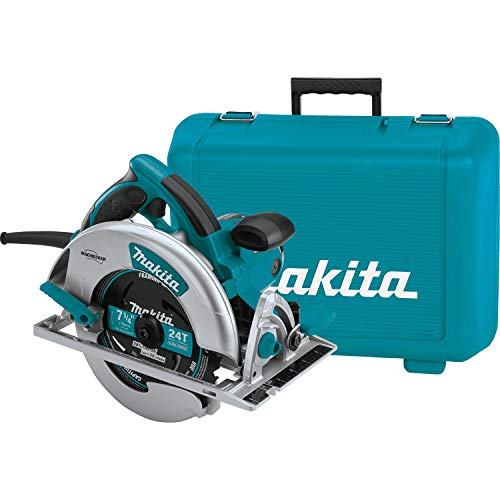
Makita 5007MGA 7-1/4" Magnesium Circular Saw
Best for: Woodworkers and contractors who want premium corded performance with magnesium durability
- Brand
- Makita
- Type
- Corded circular saw
- Power
- Corded (120V)
- Voltage
- 120V, 15 Amp
- Weight
- 10.6 lbs
$264.00Amazon price as of Oct 7, 7:17 PM EDTProduct prices and availability are accurate as of the date/time indicated and are subject to change. Any price and availability information displayed on Amazon.com at the time of purchase will apply to the purchase of this product.
What we like
- Full magnesium construction for durability and reduced weight
- Dual LED lights eliminate cut line shadows
- 56-degree bevel with three positive stops
- Electric brake and carrying case included
Watch out for
- Heavier at 10.6 lbs compared to the DeWalt DWE575SB (8.8 lbs)
- Aggressive sawdust dispersion (poor dust management)
- No laser guide
- Higher price than basic corded saws
Final Thoughts
Learning how to change a circular saw blade is a fundamental skill that keeps your saw cutting safely and accurately. I think it's one of the first maintenance tasks every new tool owner should learn. The entire process takes five minutes: disconnect the power, lock the spindle, swap the blade (teeth pointing up at the front), snug the arbor nut, and test. Once you've done it a couple of times, it becomes second nature.
Don't put off a blade change when you notice burn marks or rough cuts. Honestly, I used to let blades go way too long before swapping them, and the difference a fresh blade makes is night and day. A sharp blade is safer than a dull one because it requires less force, produces less kickback, and gives you more control over every cut. Keep a spare blade in your shop so you're always ready to swap.
Looking for your next circular saw upgrade? Check out our best circular saws roundup for top picks across every budget, or read our circular saw vs table saw comparison if you're thinking about expanding your workshop.
Affiliate Disclosure
This post contains affiliate links. As an Amazon Associate, HomeBuildLab earns from qualifying purchases at no additional cost to you. Learn more
Prices shown are from Amazon at the time indicated and may change. The price and availability on Amazon.com at the time of purchase apply.
Sam Hartwell
Sam Hartwell edits HomeBuildLab's tool reviews and home improvement guides. Every pick starts with manufacturer spec sheets, warranty terms, parts availability and owner feedback, then gets matched to a specific job and budget. Guides list the trade-offs plainly and get updated when models change or go out of stock.
Keep reading: Saws
All saws guides → How-To
Saws
How to Make a Rip Cut with a Circular Saw: A Step-by-Step Guide
Learn how to make a rip cut with a circular saw using a guide, the right blade, and proper technique. Step-by-step instructions for straight, safe cuts.
Updated
 Buying Guide
Saws
How to Choose a Circular Saw: A Buyer's Guide
Learn how to choose a circular saw that fits your projects and budget. I break down blade size, power, drive type, and the features that actually matter.
Updated
 Comparison
Saws
Miter Saw vs Circular Saw: Key Differences That Actually Matter
Miter saw vs circular saw: which one should you buy first? I compare accuracy, portability, cut types, and cost so you pick the right saw for your projects.
Updated
 Comparison
Saws
Corded vs Cordless Circular Saw: When Cutting the Cord Makes Sense
Corded vs cordless circular saw: I break down power, runtime, cost, and portability so you can pick the right saw for your projects, budget, and workspace.
Updated
 Comparison
Saws
Circular Saw vs Table Saw: The Right First Saw for Beginners
Circular saw vs table saw: which one should you buy first? I compare cost, portability, precision, and safety to help beginners pick the right first saw.
Updated
 Top Picks
Saws
Best Circular Saws in 2026: Sidewinder and Worm Drive Picks Compared
I compared 7 circular saws from budget to pro-grade. Find the best circular saw for framing, woodworking, and DIY with honest picks for corded and cordless.
Updated
The HomeBuildLab newsletter
New guides and tool deals worth knowing about
One short email when we publish or update a buying guide. No spam, unsubscribe anytime.