Corded vs Cordless Circular Saw: When Cutting the Cord Makes Sense
Corded vs cordless circular saw: I break down power, runtime, cost, and portability so you can pick the right saw for your projects, budget, and workspace.
Reader-supported: we may earn a commission when you buy through links on this page, at no extra cost to you. How we research
We don't run a test lab. For each guide we compare manufacturer specs, warranty terms and owner reviews, then match models to specific jobs and budgets. We say when a pick is a trade-off, and every product has cons listed.
As an Amazon Associate, HomeBuildLab earns from qualifying purchases. Read our full affiliate disclosure.

The corded vs cordless circular saw debate has shifted dramatically. Cordless circular saws have closed the power gap, and that's not marketing spin. In 2026, premium cordless models from DeWalt, Milwaukee, and Makita match their corded counterparts in RPM, cutting depth, and bevel capacity. A DeWalt FLEXVOLT 60V circular saw spins at 5,800 RPM and cuts 2-9/16 inches deep at 90 degrees. Those numbers are identical to (or better than) most 15-amp corded saws on the market.
But "can match corded performance" doesn't mean "should replace corded for everyone." I think corded circular saws still win in specific situations, and they cost significantly less when you factor in batteries. The real question isn't which type is better. It's which type is better for your projects, your workshop, and your budget. I've compared both types across every metric that matters, so here's how to decide.
Quick Answer: Corded vs Cordless Circular Saw
I'd pick a cordless circular saw if you value mobility, work outdoors or on jobsites, and already own batteries in a major platform (DeWalt 20V/60V, Milwaukee M18, Ryobi ONE+). The convenience of no cord is transformative once you experience it.
I recommend a corded circular saw if you need consistent power on a budget, work primarily in a garage or workshop near outlets, and don't want to invest in batteries and chargers. Corded saws deliver unlimited runtime for roughly half the total cost.
Compare our picks
2 picks- Best Corded Circular SawDeWalt DWE575SB 15-Amp 7-1/4" Lightweight Circular Saw
DeWalt · Corded (120V) · 8.8 lbs
Users who want the lightest, deepest-cutting corded circular saw available
$140.99Amazon price as of Oct 6, 1:38 AM EDTProduct prices and availability are accurate as of the date/time indicated and are subject to change. Any price and availability information displayed on Amazon.com at the time of purchase will apply to the purchase of this product.
View on Amazon - Best Cordless Circular SawDeWalt DCS575B FLEXVOLT 60V MAX 7-1/4" Circular Saw
DeWalt · Cordless (FLEXVOLT 60V MAX, battery sold separately) · 8.2 lbs (bare tool)
Contractors and serious DIYers who want corded power without the cord
$279.00Amazon price as of Oct 6, 1:38 AM EDTProduct prices and availability are accurate as of the date/time indicated and are subject to change. Any price and availability information displayed on Amazon.com at the time of purchase will apply to the purchase of this product.
View on Amazon
Key Differences at a Glance
| Feature | Corded | Cordless |
|---|---|---|
| Power (RPM) | 5,200 to 5,800 | 4,900 to 5,800 |
| Cutting Depth (90 degrees) | 2-7/16" to 2-9/16" | 2-1/4" to 2-9/16" |
| Runtime | Unlimited | 250 to 750 cuts per charge |
| Weight | 8.8 to 10.6 lbs | 5 to 9 lbs (bare), 8 to 12+ lbs (with battery) |
| Tool Price | Under $100 to about $250 | About $100 to $350 (bare tool) |
| Total Cost | Same as tool price (plug in and go) | Roughly double the bare tool price once you add a battery and charger |
| Portability | Limited by cord and outlet access | Work anywhere, no cords |
| Power Consistency | Constant from start to finish | Slight decline as battery drains |
When to Choose Corded
You're building on a budget. A corded circular saw like the SKIL 5280-01 costs well under $100 and delivers 15-amp power with a laser guide. A comparable cordless setup costs several times that once you add a battery and charger. If you're buying your first circular saw and don't already own batteries, corded saves you a lot of money.
You work near outlets. If your projects happen in a garage, basement workshop, or driveway, a 25-foot extension cord gives you all the reach you need. The cord is a minor inconvenience, not a dealbreaker.
You need all-day runtime. Framing a wall, ripping sheet goods for a full day of cabinet work, or cutting endless deck boards? Corded saws never run out of power. You won't stop mid-project to swap batteries or wait 40 minutes for a recharge.
You want maximum power consistency. Corded saws deliver the same RPM and torque on the first cut and the thousandth cut. Cordless saws maintain strong performance through most of a battery charge, but cutting power dips noticeably in the last 10-15% of battery life. For hardwoods and thick material, that consistency matters.
Best corded pick: I recommend the DeWalt DWE575SB (mid-range), the lightest 15-amp saw at 8.8 lbs with the deepest cutting depth at 2-9/16 inches. For budget buyers, the SKIL 5280-01 (under $100) delivers 15 amps and a laser guide at an unbeatable price.
When to Choose Cordless
You already own batteries. This is the single biggest factor. If you own DeWalt 20V/FLEXVOLT, Milwaukee M18, or Ryobi ONE+ batteries, buying a bare-tool cordless circular saw costs roughly $100 to $350 depending on the model. No additional battery investment needed. The math changes completely when you're already in an ecosystem.
You work on jobsites or outdoors. Roof work, deck building, fence repairs, tree house construction. Anywhere you'd need to run a 100-foot extension cord (or can't reach an outlet at all), cordless is the obvious choice. Dragging a cord across a roof isn't just inconvenient. It's a safety hazard.
You move between locations. Contractors who drive between jobs don't want to coil and uncoil extension cords at every stop. Grab the saw, grab a battery, start cutting. The time savings add up across dozens of jobsite visits.
You value lightweight handling. Compact cordless saws like the Ryobi PSBCS01B weigh just 5 lbs bare. Even full-size cordless saws (8 to 9 lbs bare) are lighter than most corded models when you're actually cutting, because corded saws drag a stiff power cord that adds resistance and weight during overhead and angled cuts.
Best cordless pick: Personally, I prefer the DeWalt DCS575B FLEXVOLT (sold bare), which delivers 5,800 RPM and 2-9/16 inches of cutting depth, matching or exceeding most corded saws. The FLEXVOLT batteries work with all DeWalt 20V MAX tools, making the battery investment serve your entire collection.
Head-to-Head Breakdown
Power
Modern cordless saws have effectively eliminated the power gap for standard cutting tasks. The DeWalt DCS575B (cordless) and the DeWalt DWE575SB (corded) both cut 2-9/16 inches deep at 90 degrees. Both handle 2x dimensional lumber, plywood, and hardwoods without complaint.
The difference shows up during sustained heavy cuts. A corded 15-amp motor pulls consistent wattage from the wall. A cordless motor draws from a depleting battery, and cutting performance drops as voltage sags under load. For occasional cutting (which describes most homeowners), you'll never notice. For all-day framing, you will.
Winner: Tie for most users. Corded for all-day heavy cutting.
Runtime
This one isn't close. Corded saws run as long as the outlet has power. Cordless saws deliver 250 to 750 cuts per battery charge depending on the battery capacity and what you're cutting. A high-capacity FLEXVOLT 9.0Ah battery provides roughly 339 cuts in 2x4 SPF lumber. That's plenty for most projects, but it's not infinite.
The real productivity question: do you own two batteries? With two batteries and a fast charger, you can rotate between them and cut nearly continuously. With one battery, you'll hit downtime.
Winner: Corded for runtime. Cordless is adequate for most single-day projects.
Portability
Cordless wins by a wide margin. No cord management, no extension cords, no hunting for outlets. You can cut on a roof, in a yard, on a ladder, or in the middle of a field. The freedom to cut anywhere without planning your cord routing is genuinely liberating.
Corded saws tether you to an outlet. A 10-foot saw cord plus a 25-foot extension cord gives you a 35-foot radius. That's fine in a workshop. It's limiting on a jobsite.
Winner: Cordless, decisively.
Weight
This category is more nuanced than it appears. Bare tool weights favor cordless: the DeWalt DCS575B weighs 8.2 lbs bare versus 8.8 lbs for the corded DWE575SB. But add a FLEXVOLT 9.0Ah battery and the cordless saw jumps to over 12 lbs.
Here's the catch: corded saws drag a power cord that creates resistance during cuts, especially overhead. That cord pull adds effective weight that doesn't show on a scale. In practice, the weight experience is roughly comparable for full-size models.
Compact cordless saws (6-1/2 inch blade) at 5 to 6 lbs are genuinely lighter than anything in the corded world. If weight is your top priority, compact cordless is the clear winner.
Winner: Compact cordless for lightweight use. Full-size models are roughly equal in practice.
Cost
Total cost of ownership is where corded pulls ahead significantly.
A corded setup: SKIL 5280-01 plus an extension cord. You're cutting for around $100 or less.
A cordless setup: DeWalt DCS575B bare tool, plus a FLEXVOLT battery, plus a charger. You're at several hundred dollars before you make your first cut.
If you already own batteries and a charger, the cordless bare tool price is the only cost that matters. That's why battery ecosystem matters so much in the corded vs cordless circular saw decision.
Winner: Corded on upfront cost. Cordless if you already own compatible batteries.
My Top Picks
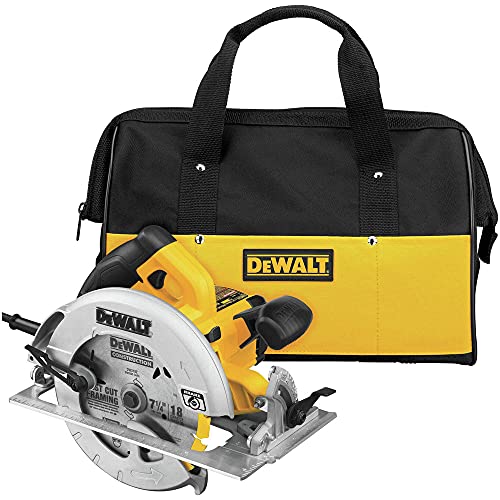
DeWalt DWE575SB 15-Amp 7-1/4" Lightweight Circular Saw
Best for: Users who want the lightest, deepest-cutting corded circular saw available
- Brand
- DeWalt
- Type
- Corded circular saw
- Power
- Corded (120V)
- Voltage
- 120V, 15 Amp
- Weight
- 8.8 lbs
$140.99Amazon price as of Oct 6, 1:38 AM EDTProduct prices and availability are accurate as of the date/time indicated and are subject to change. Any price and availability information displayed on Amazon.com at the time of purchase will apply to the purchase of this product.
What we like
- Lightest 15-amp corded saw at 8.8 lbs
- Deepest cutting depth at 2-9/16" for clean dimensional lumber cuts
- 57-degree bevel capacity is the widest for any corded saw here
- ToughCord system and 10-foot cord for durability and reach
Watch out for
- No laser guide for cut line reference
- 5,200 RPM is lower than 5,800 RPM competitors
- Aluminum shoe (less durable than magnesium over time)
What I like most about the DeWalt DWE575SB is that it's the corded saw to beat. At 8.8 lbs, it's the lightest 15-amp circular saw on the market, and its 2-9/16 inch cutting depth at 90 degrees is the deepest in its class. That combination means less fatigue and cleaner cuts through dimensional lumber, with enough depth to clear 2x material in a single pass every time.
The 57-degree bevel capacity with positive stops at 22.5 and 45 degrees gives you more angle range than most competitors offer. The electric brake stops the blade quickly after each cut, and the ToughCord system reinforces the cord at the connection point to prevent the most common failure mode for corded tools. A 10-foot cord (longer than the 6-8 feet on most corded saws) provides extra working room before you even reach for an extension cord.
At its mid-range price, this saw undercuts premium corded models while offering more cutting depth, less weight, and a wider bevel range. If you work near outlets and want reliable, consistent power without paying for batteries, I believe this is the one to get.

DeWalt DCS575B FLEXVOLT 60V MAX 7-1/4" Circular Saw
Best for: Contractors and serious DIYers who want corded power without the cord
- Brand
- DeWalt
- Type
- Cordless circular saw
- Power
- Cordless (FLEXVOLT 60V MAX, battery sold separately)
- Voltage
- 60V MAX
- Weight
- 8.2 lbs (bare tool)
$279.00Amazon price as of Oct 6, 1:38 AM EDTProduct prices and availability are accurate as of the date/time indicated and are subject to change. Any price and availability information displayed on Amazon.com at the time of purchase will apply to the purchase of this product.
What we like
- True corded-equivalent power from 60V FLEXVOLT system
- 57-degree bevel capacity exceeds most competitors
- Lightweight at 8.2 lbs for a full-size 7-1/4" cordless saw
- LED light, electric brake, and dust blower standard
Watch out for
- No rafter hook (a common contractor complaint)
- FLEXVOLT batteries are expensive to add separately
- Battery and charger sold separately
In my opinion, the DeWalt DCS575B delivers what every cordless circular saw promises but few actually achieve: corded-equivalent power in a cordless package. The FLEXVOLT 60V MAX system provides more energy than 18V or 20V platforms, and it shows in cutting performance. At 5,800 RPM and 2-9/16 inches of cutting depth, the performance numbers match or exceed most 15-amp corded saws.
The 57-degree bevel capacity with positive stops at 22.5 and 45 degrees provides more versatility than the standard 45-degree limit. The electronic brake stops the blade quickly after each cut, and the integrated LED light illuminates the cut line. At 8.2 lbs bare, it's lighter than most corded 15-amp saws. Up to 339 cuts per charge in 2x4 SPF lumber (with a 9.0 Ah battery) means you won't be swapping batteries constantly.
The FLEXVOLT batteries are backward compatible with all DeWalt 20V MAX tools, which means the battery investment serves your entire tool collection. If you're already in the DeWalt ecosystem or plan to build one, I think this is the cordless circular saw to buy.
Common Questions
Can a cordless circular saw really match a corded one?
Yes, for most cutting tasks. Premium cordless saws (DeWalt FLEXVOLT, Milwaukee M18 FUEL) match corded saws in RPM, cutting depth, and bevel capacity. The gap shows up during extended heavy-duty sessions where battery drain reduces cutting power. For framing a wall, building a deck, or cutting plywood for a project, you won't notice a performance difference.
How many cuts can I get per battery charge?
It depends on the battery and what you're cutting. A DeWalt FLEXVOLT 9.0Ah battery delivers roughly 339 cuts in 2x4 SPF lumber. A Milwaukee M18 HD12.0 battery provides up to 750 cuts. Hardwoods, wet lumber, and continuous rip cuts drain batteries faster than crosscuts in dry softwood.
Should I switch from corded to cordless?
Only if you have a reason. If your corded saw works fine and you mostly cut in your workshop, there's no performance benefit to switching. Switch if you're tired of cord management, need jobsite mobility, or are already invested in a battery platform and want the convenience. Don't switch just because cordless is newer.
Final Verdict: Corded vs Cordless Circular Saw
For most buyers in 2026, I believe a cordless circular saw is the better purchase, but only if you already own or plan to invest in a battery ecosystem. The DeWalt DCS575B FLEXVOLT (sold bare) is my top cordless recommendation. It matches corded power at 5,800 RPM with 2-9/16 inches of cutting depth, and FLEXVOLT batteries work across the entire DeWalt 20V/60V lineup.
If you want the best corded circular saw, the DeWalt DWE575SB is the one I'd pick. It's the lightest 15-amp saw at 8.8 lbs with the deepest cutting depth in its class. Pair it with an extension cord and you have a setup that will last years without ever thinking about battery life.
And if budget is the priority, the SKIL 5280-01 proves you don't need a premium budget to make accurate cuts. Fifteen amps, a laser guide, and a carrying bag for the price of a decent dinner out. It's the smartest entry point into circular saws, period.
The bottom line on the corded vs cordless circular saw decision: choose based on where you work, what batteries you own, and what you're willing to spend. The technology gap between corded and cordless has closed. The decision is about your workflow, not about power.
Affiliate Disclosure
This post contains affiliate links. As an Amazon Associate, HomeBuildLab earns from qualifying purchases at no additional cost to you. Learn more
Prices shown are from Amazon at the time indicated and may change. The price and availability on Amazon.com at the time of purchase apply.
Sam Hartwell
Sam Hartwell edits HomeBuildLab's tool reviews and home improvement guides. Every pick starts with manufacturer spec sheets, warranty terms, parts availability and owner feedback, then gets matched to a specific job and budget. Guides list the trade-offs plainly and get updated when models change or go out of stock.
Keep reading: Saws
All saws guides → How-To
Saws
How to Make a Rip Cut with a Circular Saw: A Step-by-Step Guide
Learn how to make a rip cut with a circular saw using a guide, the right blade, and proper technique. Step-by-step instructions for straight, safe cuts.
Updated
 How-To
Saws
How to Change a Circular Saw Blade: Step-by-Step
Learn how to change a circular saw blade safely in minutes. Step-by-step instructions covering spindle locks, blade direction, and common mistakes to avoid.
Updated
 Buying Guide
Saws
How to Choose a Circular Saw: A Buyer's Guide
Learn how to choose a circular saw that fits your projects and budget. I break down blade size, power, drive type, and the features that actually matter.
Updated
 Comparison
Saws
Miter Saw vs Circular Saw: Key Differences That Actually Matter
Miter saw vs circular saw: which one should you buy first? I compare accuracy, portability, cut types, and cost so you pick the right saw for your projects.
Updated
 Comparison
Saws
Circular Saw vs Table Saw: The Right First Saw for Beginners
Circular saw vs table saw: which one should you buy first? I compare cost, portability, precision, and safety to help beginners pick the right first saw.
Updated
 Top Picks
Saws
Best Circular Saws in 2026: Sidewinder and Worm Drive Picks Compared
I compared 7 circular saws from budget to pro-grade. Find the best circular saw for framing, woodworking, and DIY with honest picks for corded and cordless.
Updated
The HomeBuildLab newsletter
New guides and tool deals worth knowing about
One short email when we publish or update a buying guide. No spam, unsubscribe anytime.