Circular Saw vs Table Saw: The Right First Saw for Beginners
Circular saw vs table saw: which one should you buy first? I compare cost, portability, precision, and safety to help beginners pick the right first saw.
Reader-supported: we may earn a commission when you buy through links on this page, at no extra cost to you. How we research
We don't run a test lab. For each guide we compare manufacturer specs, warranty terms and owner reviews, then match models to specific jobs and budgets. We say when a pick is a trade-off, and every product has cons listed.
As an Amazon Associate, HomeBuildLab earns from qualifying purchases. Read our full affiliate disclosure.

The circular saw vs table saw debate is one I hear constantly from beginners, and I think most people approach it wrong. A circular saw typically costs under $200 and fits in a toolbox. A good table saw usually runs $300 to $700 and dominates an entire corner of your garage. Both cut wood. Both are essential in a well-equipped shop. But if you can only buy one saw first, the choice matters more than most buying guides let on.
Here's what most people get wrong about this decision: they compare the two saws on precision alone. A table saw wins that comparison every time, and that leads beginners to overspend on a tool they don't have the space, experience, or project list to justify. The smarter question isn't "which saw cuts better?" It's "which saw fits your life right now?"
I believe a circular saw with an inexpensive straightedge guide produces surprisingly accurate cuts. A table saw sitting in a cramped garage with no outfeed support produces frustration. The right first saw depends on your budget, your workspace, and the projects you actually plan to build.
Quick Answer
In my opinion, a circular saw is the better first saw for most beginners. It costs less, stores anywhere, travels to the job, and handles 90% of cuts a new woodworker or DIYer needs. Pair it with a straightedge guide and a quality blade, and you can rip plywood, crosscut lumber, and bevel boards with respectable accuracy.
A table saw is the better first saw if you have a dedicated workshop, plan to build furniture or cabinets, and need repeated identical cuts. The fence system and stable table surface make precision work faster and more consistent. But that advantage only materializes if you have the space and the project demands to use it.
If you're unsure, I'd pick the circular saw. You can always add a table saw later, and you'll still reach for the circular saw regularly even after you do.
Compare our picks
2 picks- Best Budget Circular SawSKIL 5280-01 15-Amp 7-1/4" Circular Saw
SKIL · Corded (120V) · ~8.7 lbs
DIYers and homeowners who want a capable circular saw without spending much
$69.00Amazon price as of Oct 7, 11:32 PM EDTProduct prices and availability are accurate as of the date/time indicated and are subject to change. Any price and availability information displayed on Amazon.com at the time of purchase will apply to the purchase of this product.
View on Amazon - Best Value Table SawSKIL TS6307-00 15-Amp 10" Portable Jobsite Table Saw
SKIL · Corded · 51 lbs (saw only)
DIYers and hobbyists who want a rack-and-pinion fence without the premium price
$299.00Amazon price as of Oct 7, 11:32 PM EDTProduct prices and availability are accurate as of the date/time indicated and are subject to change. Any price and availability information displayed on Amazon.com at the time of purchase will apply to the purchase of this product.
View on Amazon
Key Differences at a Glance
| Feature | Circular Saw | Table Saw |
|---|---|---|
| Price Range | Under $100 to about $250 | About $300 to $1,700+ |
| Weight | 5 to 10 lbs | 50 to 250 lbs |
| Portability | Fits in a bag, goes anywhere | Stays in the shop (or rolls on a stand) |
| Rip Cuts | Good with a guide rail | Excellent with a fence |
| Crosscuts | Good freehand, great with a guide | Excellent with a miter gauge or sled |
| Repeated Cuts | Slow (re-clamp the guide each time) | Fast (set the fence once, cut all day) |
| Bevel Cuts | Yes, up to 50 to 57 degrees | Yes, up to 45 to 57 degrees |
| Dado Joints | No | Yes (with a dado blade set) |
| Space Needed | A shelf or toolbox | A dedicated area plus outfeed room |
| Learning Curve | Moderate | Moderate to steep |
When to Choose a Circular Saw
You don't have a dedicated workshop. This is the single biggest factor. A table saw needs a permanent spot with at least 8 feet of clearance in front and behind the blade for feeding and catching material. If you're working in a shared garage, a driveway, or a small apartment, a circular saw is the practical choice.
You're on a tight budget. The SKIL 5280-01 costs under $100 and includes a 15-amp motor, a laser guide, and a carrying bag. That's a fully capable saw at a true budget price. Entry-level table saws start around $300 and go up quickly.
You work at the project site. Decks, fences, framing, and siding all happen where the lumber is, not in your shop. You can carry a circular saw up a ladder, cut on sawhorses in the yard, or trim boards on a deck frame. Try that with a 90-pound table saw.
You need versatility across materials. With the right blade, a circular saw cuts plywood, dimensional lumber, composite decking, and even thin metal and cement board. A table saw is optimized for wood and wood products.
You want accurate cuts on a budget. Personally, I prefer pairing a circular saw with a clamped straightedge or a commercial guide rail (like the Kreg Rip-Cut or a track saw adapter) for straight cuts on a budget. The results rival a table saw for straightness. The setup takes a few extra minutes compared to a table saw fence, but the results are comparable for occasional projects.
When to Choose a Table Saw
You have a dedicated workshop. If you have a permanent space where the saw can sit, with room to feed 8-foot boards and catch them on the other side, a table saw transforms your capabilities. The stable surface and adjustable fence let you work faster and more consistently.
You need repeated identical cuts. Building a bookshelf with 12 shelves? Set the fence once and rip all 12 to the exact same width. A circular saw requires re-measuring and re-clamping the guide for each cut, which introduces variation and eats time.
You work with sheet goods regularly. Ripping a full sheet of plywood on a table saw with 30+ inches of rip capacity is straightforward. Ripping it with a circular saw and a guide is possible, but the sheet needs support across its entire span, and the process is more cumbersome.
You want to cut dados and rabbets. A table saw with a dado blade set cuts grooves and stepped joints that are fundamental to furniture and cabinet building. A circular saw cannot make these cuts. If joinery is in your plans, a table saw is essential.
You prioritize speed on production runs. For shops that need to process multiple boards to the same dimension, a table saw's fence system saves significant time over a circular saw's clamp-and-cut workflow.
Circular Saw vs Table Saw: Head-to-Head Breakdown
Rip Cuts
A rip cut runs along the length of a board, parallel to the grain. This is where a table saw excels. Set the fence to your desired width, push the board through, and you get a straight, consistent cut every time. For repeated rips, nothing beats a table saw.
A circular saw makes solid rip cuts with a guide. Clamp a straightedge to the workpiece, run the saw's base plate along it, and you get a clean, straight line. The Kreg Rip-Cut guide (an inexpensive add-on) simplifies this process for boards up to 24 inches wide. For occasional rip cuts, a circular saw is more than adequate. For 20 identical rip cuts in a row, the table saw wins on efficiency.
Crosscuts
A crosscut runs across the grain, perpendicular to the board's length. Circular saws handle crosscuts well freehand (with a pencil line and a steady hand) and excellently with a speed square or clamped guide.
Table saws crosscut with a miter gauge or crosscut sled. The miter gauge that ships with most table saws is mediocre. A well-built crosscut sled is a precision tool, but building one adds time and effort. For basic crosscutting, a circular saw with a speed square is faster and simpler.
Portability
No contest. A circular saw weighs 5 to 10 pounds and fits in a carrying bag. You can toss it in a car trunk, carry it up stairs, and store it on a shelf.
Even "portable" jobsite table saws weigh 50 to 90 pounds. The DeWalt DWE7491RS (one of the most popular models) weighs 90 pounds before the rolling stand. You can move it, but you're not carrying it casually.
Accuracy
Out of the box, a table saw produces more accurate cuts. The flat table surface, fixed blade alignment, and adjustable fence create a controlled system that minimizes user error.
A circular saw's accuracy depends heavily on the operator and the guide system. Freehand cuts are less precise. But a circular saw running against a quality straightedge or track produces cuts within 1/32 inch of a line, which is accurate enough for all but the most demanding joinery.
The honest answer: for furniture-grade precision on repeated cuts, a table saw is superior. For general construction, home improvement, and occasional woodworking, a circular saw with a guide is accurate enough.
Safety
Both saws demand respect. But the injury profiles differ.
A table saw causes an estimated 30,000+ emergency room visits per year in the United States, including roughly 4,000 amputations. Kickback (when the blade catches the workpiece and throws it back at the operator) is the most dangerous table saw hazard. Proper technique, a riving knife, and a blade guard reduce this risk significantly.
A circular saw's dangers are different. Kickback can cause the saw to jump backward toward the operator. Binding in a cut is common when the material isn't properly supported. But because the blade is smaller and the cuts are shorter, severe injuries are less common than with table saws.
For beginners, I think a circular saw is the safer introduction to power saws. The consequences of a mistake are typically less severe, and the saw's portability means you can position your work at a comfortable height with proper support.
If safety is your top priority and you choose a table saw, consider the SawStop CTS-120A60 (a premium-priced compact table saw). Its flesh-detection technology stops the blade in under 5 milliseconds on contact with skin. It's expensive, but it's the closest thing to a safety net that exists in woodworking.
Price
The cost gap is significant, especially for beginners watching their budget.
A capable circular saw starts under $100 (SKIL 5280-01). A solid mid-range option like the DeWalt DWE575SB runs about $100 to $200. Going cordless with the DeWalt DCS575B puts you around $200 or more for the bare tool.
A capable table saw starts around $300 (SKIL TS6307-00). The most popular model, the DeWalt DWE7491RS, sits in the $500 to $700 range. SawStop safety adds several hundred dollars or more on top of standard pricing.
For a beginner building a tool collection, the several-hundred-dollar difference between an entry-level circular saw and a mid-range table saw buys a lot of other tools: a drill, an orbital sander, clamps, a router, or better blades for the circular saw you already own.
My Top Picks
If you're ready to buy, here are my top recommendations for each saw type. I recommend both of these for their strong performance at entry-level prices, making them ideal first saws for beginners.
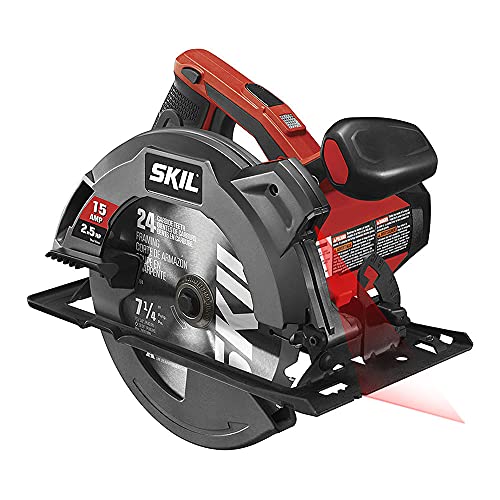
SKIL 5280-01 15-Amp 7-1/4" Circular Saw
Best for: DIYers and homeowners who want a capable circular saw without spending much
- Brand
- SKIL
- Type
- Corded circular saw
- Power
- Corded (120V)
- Voltage
- 120V, 15 Amp
- Weight
- ~8.7 lbs
$69.00Amazon price as of Oct 7, 11:32 PM EDTProduct prices and availability are accurate as of the date/time indicated and are subject to change. Any price and availability information displayed on Amazon.com at the time of purchase will apply to the purchase of this product.
What we like
- Budget price for a 15-amp circular saw with laser guide
- Laser guide helps beginners make straighter cuts
- Carrying bag and 24-tooth blade included
- Lightweight and easy to handle
Watch out for
- No electric brake (blade coasts after trigger release)
- Depth adjustment uses a wrench, not quick-release
- Plastic construction won't survive heavy professional use
What I like most about the SKIL 5280-01 is that it proves you don't need a mid-range budget for a functional circular saw. For under $100, you get a 15-amp motor, a laser guide for cut line reference, a dust blower, a 24-tooth carbide blade, and a carrying bag. That feature list at this price is exceptional.
The laser guide projects a line ahead of the blade, showing where the cut will go. It's helpful for beginners who haven't developed the muscle memory for freehand cutting. The 15-amp motor at 5,300 RPM handles hardwood and plywood without complaint. Pair it with a clamped straightedge or Kreg Rip-Cut guide and you get cuts that rival much more expensive setups.

SKIL TS6307-00 15-Amp 10" Portable Jobsite Table Saw
Best for: DIYers and hobbyists who want a rack-and-pinion fence without the premium price
- Brand
- SKIL
- Type
- Portable jobsite table saw with folding stand
- Power
- Corded
- Voltage
- 110V, 15 Amp
- Weight
- 51 lbs (saw only)
$299.00Amazon price as of Oct 7, 11:32 PM EDTProduct prices and availability are accurate as of the date/time indicated and are subject to change. Any price and availability information displayed on Amazon.com at the time of purchase will apply to the purchase of this product.
What we like
- Rack-and-pinion fence at this price point is exceptional value
- 3-1/2" depth of cut handles 4x4 lumber in one pass
- Lightest full-size option at 51 lbs for genuine portability
- 3-year warranty is the longest among popular table saws
Watch out for
- 25-1/2" rip capacity falls short for full sheet goods
- Folding stand is less robust than dedicated rolling stands
- Limited 5/8" dado capacity
I think the SKIL TS6307-00 delivers the feature you'd expect to find on pricier saws: a rack-and-pinion fence system. In the $250 to $350 range, this is the most affordable table saw with a fence that actually stays parallel to the blade without constant fiddling.
The 3-1/2 inch depth of cut at 90 degrees is the deepest among standard 10-inch jobsite saws, meaning it handles 4x4 lumber in a single pass. At 51 lbs, it's also significantly lighter than the DeWalt DWE7491RS (90 lbs), making it genuinely portable for one person. The integrated folding stand and 3-year warranty round out a compelling value package.
Common Questions
Can a circular saw replace a table saw?
For most cuts, yes. A circular saw with a guide rail can rip plywood, crosscut lumber, and bevel boards with accuracy that approaches a table saw. Where it falls short is repeated identical cuts (where a table saw fence saves time), dado joints (which require a table saw and dado blade set), and high-volume production work. Many experienced woodworkers use both tools regularly, reaching for the circular saw on jobsites and the table saw in the shop.
Is a table saw safe for beginners?
A table saw is safe for beginners who take the time to learn proper technique. Always use the blade guard and riving knife. Never stand directly behind the blade (stand to the side to avoid kickback). Use push sticks for narrow stock. Never freehand a cut without the fence. And never reach over a spinning blade. The tool itself isn't dangerous. Complacency and poor technique are.
Should I buy a cordless or corded circular saw?
For a first circular saw, corded is the better value. A corded 15-amp saw like the SKIL 5280-01 (under $100) or DeWalt DWE575SB ($100 to $200) delivers full power with no battery investment. Cordless saws from DeWalt, Milwaukee, and Makita have reached performance parity with corded models, but the battery and charger add significantly to the total cost. Go cordless if you're already invested in a battery platform or need to cut where outlets don't exist.
Final Verdict: Circular Saw vs Table Saw
In the circular saw vs table saw debate, I recommend buying a circular saw first if you're a beginner. The SKIL 5280-01 (under $100) is the budget entry point: 15 amps, a laser guide, and a carrying bag at a true budget price. If you want to step up, the mid-range DeWalt DWE575SB is the lightest 15-amp corded saw with the deepest cutting depth in its class. Add a straightedge guide or a Kreg Rip-Cut, and you have a setup that handles framing, deck building, sheet goods, and basic woodworking.
When your projects demand repeated precision cuts, dado joints, or faster production, add a table saw. I'd pick the SKIL TS6307-00 ($250 to $350) as the best value entry with its rack-and-pinion fence. The DeWalt DWE7491RS ($500 to $700) is the proven standard with 32-1/2 inches of rip capacity and a rolling stand.
The smartest path for most people: start with a budget or mid-range circular saw (under $200), build your skills, and save for a table saw when your projects outgrow what a handheld saw can do. You'll eventually own both. The circular saw just earns its spot in the toolbox first.
Affiliate Disclosure
This post contains affiliate links. As an Amazon Associate, HomeBuildLab earns from qualifying purchases at no additional cost to you. Learn more
Prices shown are from Amazon at the time indicated and may change. The price and availability on Amazon.com at the time of purchase apply.
Sam Hartwell
Sam Hartwell edits HomeBuildLab's tool reviews and home improvement guides. Every pick starts with manufacturer spec sheets, warranty terms, parts availability and owner feedback, then gets matched to a specific job and budget. Guides list the trade-offs plainly and get updated when models change or go out of stock.
Keep reading: Saws
All saws guides → Comparison
Saws
Table Saw vs Track Saw: Which is Better for Sheet Goods?
Table saw vs track saw: which one handles plywood better? I compare cut quality, safety, price, and portability so you can pick the right saw for your shop.
Updated
 Comparison
Saws
Table Saw vs Miter Saw: Which Do You Actually Need First?
Table saw vs miter saw: I compare cut types, versatility, safety, portability, and price so you can pick the right first saw for your home workshop in 2026.
Updated
 Comparison
Saws
Miter Saw vs Circular Saw: Key Differences That Actually Matter
Miter saw vs circular saw: which one should you buy first? I compare accuracy, portability, cut types, and cost so you pick the right saw for your projects.
Updated
 How-To
Saws
Table Saw Safety Tips Every Beginner Needs to Know
Learn critical table saw safety rules every beginner needs. Avoid kickback, use push sticks correctly, and protect yourself from the most common injuries.
Updated
 How-To
Saws
How to Make a Rip Cut with a Circular Saw: A Step-by-Step Guide
Learn how to make a rip cut with a circular saw using a guide, the right blade, and proper technique. Step-by-step instructions for straight, safe cuts.
Updated
 How-To
Saws
How to Change a Circular Saw Blade: Step-by-Step
Learn how to change a circular saw blade safely in minutes. Step-by-step instructions covering spindle locks, blade direction, and common mistakes to avoid.
Updated
The HomeBuildLab newsletter
New guides and tool deals worth knowing about
One short email when we publish or update a buying guide. No spam, unsubscribe anytime.