Miter Saw vs Circular Saw: Key Differences That Actually Matter
Miter saw vs circular saw: which one should you buy first? I compare accuracy, portability, cut types, and cost so you pick the right saw for your projects.
Reader-supported: we may earn a commission when you buy through links on this page, at no extra cost to you. How we research
We don't run a test lab. For each guide we compare manufacturer specs, warranty terms and owner reviews, then match models to specific jobs and budgets. We say when a pick is a trade-off, and every product has cons listed.
As an Amazon Associate, HomeBuildLab earns from qualifying purchases. Read our full affiliate disclosure.

The miter saw vs circular saw debate comes up constantly, and I think it deserves a straight answer. If you can only buy one saw, should it be a miter saw or a circular saw? Both make crosscuts. Both handle dimensional lumber. Both show up on every "essential tools" list. But they solve very different problems, and buying the wrong one first means frustrating workarounds until you get the other.
Here's the core difference: a miter saw excels at making precise angle cuts on narrow stock. Crown molding, baseboards, picture frames, deck boards. You set the angle, lock it in, and make identical cuts all day long. A circular saw is a portable generalist. It crosscuts, rip cuts, bevels, and handles sheet goods like plywood. You can take it anywhere, cut almost anything, and it doesn't need a dedicated workspace.
The miter saw vs circular saw question isn't really about which is "better." It's about which one matches the work you're doing right now and the projects you're planning next. In my opinion, too many guides overcomplicate this decision. I'll break down exactly where each saw wins, where each falls short, and when you genuinely need both.
Quick Answer
Get a miter saw if your primary work involves trim, molding, framing cuts, or any project requiring repeated precise crosscuts at consistent angles. A miter saw's detent system locks into common angles (22.5, 45, and beyond) so every cut matches the last.
Get a circular saw if you need a general-purpose cutting tool for construction, sheet goods, rip cuts, and portability. A circular saw handles more types of cuts in more locations than any other single saw.
If you're starting a workshop from scratch and can only buy one saw, I'd pick the circular saw as the more versatile first purchase. But if your project list includes trim work, molding, or deck building, a miter saw will save you hours of frustration that a circular saw simply cannot eliminate.
Compare our picks
2 picks- Best Miter Saw Value PickDeWalt DWS779 12" Double-Bevel Sliding Compound Miter Saw
DeWalt · Corded · 56 lbs
Anyone who wants pro-level miter saw performance without paying for the XPS light
$399.00Amazon price as of Oct 5, 8:01 PM EDTProduct prices and availability are accurate as of the date/time indicated and are subject to change. Any price and availability information displayed on Amazon.com at the time of purchase will apply to the purchase of this product.
View on Amazon - Best Corded Circular SawDeWalt DWE575SB 15-Amp 7-1/4" Lightweight Circular Saw
DeWalt · Corded (120V) · 8.8 lbs
Users who want the lightest, deepest-cutting corded circular saw available
$140.99Amazon price as of Oct 5, 8:01 PM EDTProduct prices and availability are accurate as of the date/time indicated and are subject to change. Any price and availability information displayed on Amazon.com at the time of purchase will apply to the purchase of this product.
View on Amazon
Key Differences at a Glance
| Feature | Miter Saw | Circular Saw |
|---|---|---|
| Primary strength | Precise angle crosscuts | General-purpose cutting |
| Crosscuts | Excellent (locked fence, repeatable) | Good (requires a guide for precision) |
| Rip cuts | Not possible | Yes, with a straightedge guide |
| Sheet goods (plywood) | No (workpiece is too wide) | Yes, the preferred tool |
| Angle cuts | Preset detents, 0-60 degrees | Manual bevel adjustment, 0-57 degrees |
| Portability | Low (25-65 lbs, needs a stand) | High (5-11 lbs, handheld) |
| Setup time | Set angle once, repeat all day | Set up a guide for each cut |
| Typical weight | 24-65 lbs | 5-11 lbs |
| Price range | Under $150 to $1,000+ | Under $100 to about $250 |
| Workspace needed | Dedicated stand or bench | None (operates freehand) |
| Cut repeatability | Excellent (fence + detents) | Poor to fair (depends on jigs) |
| Learning curve | Low for basic cuts | Moderate (freehand control required) |
When to Choose a Miter Saw
A miter saw is the right tool when accuracy at specific angles matters more than versatility. Here are the projects where a miter saw is clearly the better choice.
Trim work and baseboards. Installing baseboards means cutting dozens of pieces at 45-degree angles (or 22.5 degrees for outside corners). A miter saw locks into these angles with detent stops, producing identical cuts every time. Doing this with a circular saw requires marking each angle individually, clamping a guide, and hoping for consistency. You'll spend three times as long and get worse results.
Crown molding. Crown molding requires compound angle cuts (miter and bevel simultaneously). A dual-bevel sliding miter saw handles this in one pass. Attempting compound angles with a circular saw is technically possible but practically miserable.
Framing. Cutting studs to length is what a miter saw was born for. Set the saw to 90 degrees, mark your length, and chop. A 12-inch sliding miter saw like the DeWalt DWS779 cuts through 2x14 lumber at 90 degrees. You can process a stack of framing lumber in a fraction of the time it takes with a circular saw.
Deck building. Deck boards need clean, square crosscuts and sometimes angled cuts for borders. A miter saw on a portable stand delivers fast, consistent results.
Repeated identical cuts. Any project where you need 20, 50, or 100 pieces at the same length and angle. The fence, detent system, and stop block capability of a miter saw make repetitive cutting fast and accurate.
When to Choose a Circular Saw
A circular saw is the right tool when you need versatility, portability, or the ability to cut wide stock and sheet goods.
Rip cuts. Cutting a board along its length (with the grain) is a rip cut. Miter saws physically cannot do this. A circular saw with a straightedge guide rips plywood, dimensional lumber, and sheet goods cleanly. If you don't own a table saw, the circular saw is your rip-cutting tool.
Plywood and sheet goods. A 4x8 sheet of plywood doesn't fit on a miter saw. A circular saw with a guide rail breaks down full sheets into manageable panels. This is one of the most common cuts in home improvement, and only a circular saw (or a table saw) handles it.
Portability. A circular saw weighs 5 to 11 lbs and runs off a battery. You can carry it up a ladder, use it on a roof, or bring it to a friend's house in a backpack. A miter saw weighs 25 to 65 lbs, needs a stand, and typically needs a power outlet. The portability gap is enormous.
Tighter budgets. A capable circular saw like the SKIL 5280-01 costs under $100. A comparable miter saw like the Metabo HPT C10FCG2 costs more (under $150) and prices climb quickly from there. If you need one saw and money is tight, the circular saw stretches further.
Rough construction. Framing walls, building sheds, cutting lumber to rough length. When cuts don't need to be furniture-grade, a circular saw's speed and portability make it the faster tool for rough work.
Bevel cuts on wide stock. A circular saw bevels to 50-57 degrees on boards of any width. A miter saw can only bevel material that fits against its fence, typically maxing out at 2x14 dimensional lumber.
Miter Saw vs Circular Saw: Head-to-Head Breakdown
Crosscut Accuracy
I think the miter saw wins here, and it's not close. A miter saw clamps the workpiece against a fence, and the blade drops through the material on a fixed pivot. The geometry of the tool guarantees a straight, square cut every time. No guide needed, no clamping required, no drift.
A circular saw can produce accurate crosscuts, but it requires setup: mark the line, clamp a speed square or straightedge, and run the saw along the guide. With practice and a good guide, the results are excellent. Without a guide, freehand circular saw crosscuts will wander. For a single cut, the extra setup is minor. For 50 cuts in a row, the miter saw's zero-setup repeatability saves a tremendous amount of time.
Angle Cuts
Miter saws are purpose-built for angle cuts. The turntable rotates to preset detent positions (22.5, 31.6, 45 degrees, and more), and you lock the angle with a cam handle. Dual-bevel models tilt the blade left and right, so you can cut opposing angles without flipping the workpiece. A miter saw changes angle in seconds.
A circular saw adjusts bevel angle by tilting the base plate, which works well for single bevel cuts. But it only bevels in one direction, and there's no turntable for miter angles. To make a miter cut with a circular saw, you angle the guide, not the saw. Compound angles (miter plus bevel) are where the circular saw's limitations become painful. The miter saw handles them effortlessly.
Rip Cuts
The circular saw wins by default: miter saws cannot make rip cuts at all. The blade on a miter saw only travels across a fixed width (determined by the blade size and sliding capacity). It physically cannot cut along the length of a board.
A circular saw with a clamped straightedge produces clean, straight rip cuts through plywood, dimensional lumber, and hardwood. For long rip cuts in thick material, a table saw is the ideal tool, but a circular saw is a capable substitute.
Portability
A full-size circular saw weighs 8 to 11 lbs. Compact models like the Ryobi PSBCS01B weigh around 5 lbs. You pick it up with one hand. Cordless models run on the same batteries as your drill, and you can use them anywhere.
A miter saw weighs 24 lbs at minimum (the Metabo HPT C10FCG2) and 65 lbs at the heavy end (the Makita LS1219L). Most popular models weigh 48 to 58 lbs. You need a stand, a flat surface, and usually a power outlet (cordless miter saws exist, but they're expensive). Moving a miter saw means planning. Moving a circular saw means picking it up.
Price
Entry-level circular saws start under $100 for capable corded models. A solid cordless option like the DeWalt DCS575B runs around $200 or more (tool only). The total range spans roughly $60 to $250.
Entry-level miter saws start under $150 for basic compound models. A quality dual-bevel sliding miter saw costs about $250 to $500. Professional models with advanced features reach $700 to $1,000. You're also likely to spend $80 to $200 on a miter saw stand, which is a cost circular saws don't have.
Dollar for dollar, the circular saw delivers more cutting versatility per dollar spent.
Do You Need Both?
Many serious DIYers and most professional carpenters own both, and there's a good reason. These saws complement each other rather than compete.
The circular saw handles the work that a miter saw physically cannot: rip cuts, sheet goods, cutting in place on a roof or up a ladder. The miter saw handles the work that a circular saw does poorly: precise angled crosscuts, trim joints, and high-volume repetitive cuts.
Here's a practical scenario. You're building a deck. The circular saw rips the ledger board, cuts the rim joist to length on the ground, and trims plywood for a privacy screen. The miter saw (on a portable stand nearby) crosscuts every deck board to length, angles the border pieces, and miters the stair treads. Both saws earn their place.
If you're buying your first saw, I recommend starting with the circular saw. It covers more ground. When your projects demand precise angles, repeatable crosscuts, or trim work, add the miter saw. Most people reach that point within their first year of serious DIY work.
For starting out, a budget-friendly pair works well: the SKIL 5280-01 circular saw (under $100) paired with the Metabo HPT C10FCG2 miter saw (under $150). That's both saws for a modest budget, covering nearly every cut a homeowner needs.
My Top Picks
If you've decided which type of saw fits your needs, here are the specific models I recommend. These two picks represent the best value in each category based on the specs and user feedback I compared.

DeWalt DWS779 12" Double-Bevel Sliding Compound Miter Saw
Best for: Anyone who wants pro-level miter saw performance without paying for the XPS light
- Brand
- DeWalt
- Type
- 12" dual-bevel sliding compound miter saw
- Power
- Corded
- Voltage
- 120V, 15 Amp
- Weight
- 56 lbs
$399.00Amazon price as of Oct 5, 8:01 PM EDTProduct prices and availability are accurate as of the date/time indicated and are subject to change. Any price and availability information displayed on Amazon.com at the time of purchase will apply to the purchase of this product.
What we like
- Same motor, capacity, and build quality as the DWS780 at a lower price
- Can be upgraded with XPS LED kit later if desired
- 75%+ dust collection matches the premium model
- Widely available with excellent parts and accessories support
Watch out for
- No built-in LED cutline indicator (the main difference vs. DWS780)
- Same rear-extending rails that require wall clearance
- 56 lbs is not truly portable
- 3-year warranty is standard, not exceptional
The DeWalt DWS779 is the same saw as the flagship DWS780 with one difference: no built-in XPS LED cutline system. Same 15-amp motor, same 3,800 RPM, same crosscut capacity, same dust collection, same build quality. It typically costs noticeably less.
The 75%+ dust collection, stainless steel miter detent plate with 10 positive stops, tall sliding fences, and cam lock miter handle are all identical to the premium model. For users who prioritize performance and value over the LED feature, the DWS779 is the smarter purchase.
What I like most about the DWS779 is that it delivers professional performance at a price that doesn't require justification. This is the miter saw to buy if your projects include trim carpentry, framing, deck building, or any work requiring precise angled crosscuts on stock up to 2x14.
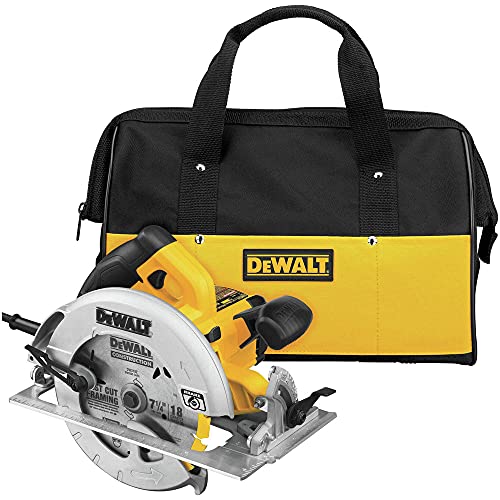
DeWalt DWE575SB 15-Amp 7-1/4" Lightweight Circular Saw
Best for: Users who want the lightest, deepest-cutting corded circular saw available
- Brand
- DeWalt
- Type
- Corded circular saw
- Power
- Corded (120V)
- Voltage
- 120V, 15 Amp
- Weight
- 8.8 lbs
$140.99Amazon price as of Oct 5, 8:01 PM EDTProduct prices and availability are accurate as of the date/time indicated and are subject to change. Any price and availability information displayed on Amazon.com at the time of purchase will apply to the purchase of this product.
What we like
- Lightest 15-amp corded saw at 8.8 lbs
- Deepest cutting depth at 2-9/16" for clean dimensional lumber cuts
- 57-degree bevel capacity is the widest for any corded saw here
- ToughCord system and 10-foot cord for durability and reach
Watch out for
- No laser guide for cut line reference
- 5,200 RPM is lower than 5,800 RPM competitors
- Aluminum shoe (less durable than magnesium over time)
- No carrying case included
The DeWalt DWE575SB holds two records among corded circular saws: lightest at 8.8 lbs and deepest cutting depth at 2-9/16 inches. That combination means less fatigue and cleaner cuts through dimensional lumber. The extra depth clears 2x material with room to spare, reducing the chance of an incomplete cut.
The 57-degree bevel capacity is the widest of any corded saw in its class, with positive stops at 22.5 and 45 degrees. The electric brake stops the blade after each cut. The ToughCord system reinforces the cord at the connection point, preventing the most common failure mode for corded tools. A 10-foot cord (longer than most competitors at 6-8 feet) gives you more working room without an extension cord.
In the $100 to $200 range, I believe this is the corded circular saw that delivers the best balance of weight, cutting depth, and bevel range. If you don't need cordless freedom, the DWE575SB is the saw to get.
Common Questions
Can a miter saw replace a circular saw?
No. A miter saw cannot make rip cuts, cannot cut sheet goods, and isn't portable enough for many jobsite tasks. It does one category of cut (angled crosscuts on narrow stock) far better than a circular saw, but it can't cover the range of work a circular saw handles.
Can a circular saw replace a miter saw?
For occasional angle cuts, yes. You can set a speed square to 45 degrees and make a serviceable miter cut with a circular saw. But if you're installing trim, cutting molding, or making dozens of identical angled cuts, the circular saw approach is slower, less accurate, and more frustrating. The miter saw's precision and repeatability are hard to replicate.
Which saw is safer for beginners?
A miter saw is generally considered safer for beginners. The workpiece stays clamped against the fence, your hands stay away from the blade, and the cutting motion is a controlled downward chop. A circular saw requires you to control the tool freehand across the workpiece, which demands more awareness of blade position and kickback risk. Both saws are safe when used properly with appropriate safety gear.
Final Verdict
The miter saw vs circular saw decision comes down to what you're building next. If you need one saw and want maximum versatility, get a circular saw. The DeWalt DWE575SB ($100 to $200) is the lightest 15-amp corded option with the deepest cutting depth. For cordless, the DeWalt DCS575B (around $200 or more, bare tool) delivers corded-equivalent power without the cord. Either one handles crosscuts, rip cuts, bevel cuts, and sheet goods.
If your projects center on trim, molding, framing cuts, or anything requiring precise repeated angles, get a miter saw. Personally, I prefer the DeWalt DWS779 ($300 to $500) as the sweet spot for performance and value with 12-inch sliding capacity. For a budget entry point, the Metabo HPT C10FCG2 (under $150) delivers a functional miter saw with a 5-year warranty.
If you can swing both, you should. The circular saw and miter saw together cover virtually every straight cut in home improvement. Start with whichever matches your next project, and add the other when the need arises. You won't regret owning both.
Affiliate Disclosure
This post contains affiliate links. As an Amazon Associate, HomeBuildLab earns from qualifying purchases at no additional cost to you. Learn more
Prices shown are from Amazon at the time indicated and may change. The price and availability on Amazon.com at the time of purchase apply.
Sam Hartwell
Sam Hartwell edits HomeBuildLab's tool reviews and home improvement guides. Every pick starts with manufacturer spec sheets, warranty terms, parts availability and owner feedback, then gets matched to a specific job and budget. Guides list the trade-offs plainly and get updated when models change or go out of stock.
Keep reading: Saws
All saws guides → Comparison
Saws
Table Saw vs Miter Saw: Which Do You Actually Need First?
Table saw vs miter saw: I compare cut types, versatility, safety, portability, and price so you can pick the right first saw for your home workshop in 2026.
Updated
 Comparison
Saws
Circular Saw vs Table Saw: The Right First Saw for Beginners
Circular saw vs table saw: which one should you buy first? I compare cost, portability, precision, and safety to help beginners pick the right first saw.
Updated
 Comparison
Saws
Table Saw vs Track Saw: Which is Better for Sheet Goods?
Table saw vs track saw: which one handles plywood better? I compare cut quality, safety, price, and portability so you can pick the right saw for your shop.
Updated
 How-To
Saws
How to Cut Crown Molding with a Miter Saw: A Step-by-Step Guide
Learn how to cut crown molding with a miter saw using the nested method. Step-by-step guide to inside corners, outside corners, coped joints, and pro tips.
Updated
 How-To
Saws
How to Square a Miter Saw for Accurate Cuts
Learn how to square a miter saw in three simple steps: adjust the fence, bevel, and miter detents for dead-accurate crosscuts and tight joints every time.
Updated
 How-To
Saws
How to Make a Rip Cut with a Circular Saw: A Step-by-Step Guide
Learn how to make a rip cut with a circular saw using a guide, the right blade, and proper technique. Step-by-step instructions for straight, safe cuts.
Updated
The HomeBuildLab newsletter
New guides and tool deals worth knowing about
One short email when we publish or update a buying guide. No spam, unsubscribe anytime.