Jigsaw vs Reciprocating Saw: Picking the Right Blade for the Job
Jigsaw vs reciprocating saw: one cuts curves with precision, the other tears through walls. Learn which saw fits your projects and when you need both.
Reader-supported: we may earn a commission when you buy through links on this page, at no extra cost to you. How we research
We don't run a test lab. For each guide we compare manufacturer specs, warranty terms and owner reviews, then match models to specific jobs and budgets. We say when a pick is a trade-off, and every product has cons listed.
As an Amazon Associate, HomeBuildLab earns from qualifying purchases. Read our full affiliate disclosure.

The jigsaw vs reciprocating saw debate comes up constantly, and I think the confusion is understandable. Both use a blade that moves back and forth to cut material. Both accept interchangeable blades for different materials. Both are handheld, relatively affordable, and found in nearly every serious tool collection. That's where the similarities end.
In practice, these two saws serve completely different purposes. A jigsaw is a precision tool. It presses a workpiece against a flat base plate and drives a short blade downward through the material, giving you control over curves, cutouts, and detail work. A reciprocating saw (often called a sawzall, after Milwaukee's trademark) is a demolition tool. It drives a long blade forward into whatever you point it at: walls, pipes, nails, tree branches, and anything else that needs to come apart.
Choosing between them isn't about which one is "better." It's about what you're actually doing. I've seen too many people grab the wrong saw for the job, fight the tool the entire time, and end up with poor results. Here's how to make the right call.
Quick Answer
I recommend a jigsaw if you need to cut curves, make interior cutouts, work with plywood or laminate, or do any kind of finish carpentry where the cut quality matters.
I'd pick a reciprocating saw if you need to demolish walls, cut through nail-embedded lumber, remove old plumbing, prune trees, or do any rough cutting where speed matters more than precision.
If you do remodeling work regularly, you'll eventually want both. I believe they complement each other perfectly because their strengths don't overlap.
Compare our picks
2 picks- Best Overall JigsawDeWalt DCS334B 20V MAX XR Cordless Jig Saw
DeWalt · Cordless (20V MAX, battery sold separately) · 5.2 lbs (tool only)
Woodworkers and DIYers who want cordless freedom without sacrificing cut quality
$138.11Amazon price as of Oct 7, 9:39 PM EDTProduct prices and availability are accurate as of the date/time indicated and are subject to change. Any price and availability information displayed on Amazon.com at the time of purchase will apply to the purchase of this product.
View on Amazon - Best Overall Reciprocating SawMilwaukee 2821-20 M18 FUEL SAWZALL
Milwaukee · Cordless (M18 18V, battery sold separately) · 6.8 lbs (bare tool)
Remodelers and contractors who want the fastest cordless cutting with all-day battery life
$183.98Amazon price as of Oct 7, 9:39 PM EDTProduct prices and availability are accurate as of the date/time indicated and are subject to change. Any price and availability information displayed on Amazon.com at the time of purchase will apply to the purchase of this product.
View on Amazon
Jigsaw vs Reciprocating Saw: Key Differences at a Glance
| Feature | Jigsaw | Reciprocating Saw |
|---|---|---|
| Primary Use | Precision cuts, curves, cutouts | Demolition, rough cuts, remodeling |
| Blade Direction | Points downward through a base plate | Points forward, exposed |
| Cut Quality | Clean, controlled | Rough, aggressive |
| Cut Types | Curves, scrollwork, bevels, plunge cuts | Straight teardown, flush cuts, overhead cuts |
| Materials | Wood, plywood, laminate, metal sheet, tile | Framing lumber, nail-embedded wood, pipe, drywall, branches |
| Stroke Length | 3/4" to 1" | 7/8" to 1-1/4" |
| Typical SPM | 500 to 3,500 | 2,300 to 3,200 |
| Weight Range | 4 to 6.5 lbs | 5 to 9 lbs |
| Price Range | Under $50 to about $250 | Under $100 to about $300 |
| Precision | High | Low |
| Aggression | Low to moderate | High |
When to Choose a Jigsaw
A jigsaw excels anywhere you need to follow a line. The base plate sits flat on your workpiece and keeps the blade perpendicular to the surface, which means your cuts stay square and predictable. Orbital action settings let you balance speed against cut quality, and variable speed control lets you slow down for tight radius curves or delicate materials.
Here's where a jigsaw is the right tool:
- Curved cuts in plywood and hardwood. No other portable saw cuts smooth curves. A jigsaw with a quality blade and low orbital action produces curves clean enough for finished furniture.
- Countertop cutouts. Cutting a sink or cooktop opening in a laminate countertop is a classic jigsaw job. Drill a starter hole, insert the blade, and follow your line.
- Scrollwork and decorative cuts. Thin blades on low speed can follow surprisingly tight radii, down to about 1/4 inch depending on the blade width.
- Bevel cuts. Most jigsaws tilt their base plate up to 45 degrees, letting you make angled cuts that a reciprocating saw simply cannot do.
- Cutting metal sheet and thin stock. With a metal-cutting blade (24+ TPI) and straight cutting mode, a jigsaw handles mild steel up to 3/8 inch and aluminum up to 3/4 inch.
- Finish carpentry. Trim work, cabinetry, shelving, and any project where the cut edge will be visible.
The key jigsaws from my roundup range from the budget-friendly BLACK+DECKER BDEJS600C (under $50) to the precision-focused Bosch JS572EBK barrel-grip at the premium end. Personally, I prefer the mid-range DeWalt DCS334B for most DIYers because it hits the sweet spot of cordless convenience and cut quality.
When to Choose a Reciprocating Saw
A reciprocating saw is built for destruction and rough work. There's no base plate guiding the cut. You push the blade into the material, the shoe rests against the surface for leverage, and the saw tears through whatever is in front of it. That lack of precision is actually the point: you need a saw that doesn't care about nail-embedded wood, copper pipe, or three layers of drywall stacked together.
Here's where a reciprocating saw earns its keep:
- Demolition. Tearing out walls, removing old framing, stripping a kitchen to the studs. This is the tool's primary purpose.
- Cutting nail-embedded lumber. A bi-metal demolition blade chews through nails, screws, and staples without flinching. No other saw handles this as well.
- Plumbing and pipe cutting. Metal-cutting blades slice through copper, PVC, cast iron, and galvanized pipe in place. Plumbers consider a reciprocating saw essential.
- Pruning and tree work. With a pruning blade, a reciprocating saw handles branches up to 8 inches in diameter. It won't replace a chainsaw, but it's far more maneuverable for limbing and cleanup.
- Flush cutting. Need to cut a pipe, nail, or piece of wood flush against a wall or floor? The flexible blade bends slightly to make cuts that other saws can't reach.
- Overhead and awkward-angle cuts. Reciprocating saws are designed to work in any orientation, which makes them ideal for cutting joists from below, pipes above a ceiling, or branches overhead.
My reciprocating saw roundup covers options from the budget BLACK+DECKER BDCR20C (a complete kit with battery) to the pro-grade Milwaukee SUPER SAWZALL. I think the DeWalt DCS382B offers the best value for most users, while the Milwaukee 2821-20 is the overall performance leader. Both sell as mid-range bare tools.
Head-to-Head Breakdown
Precision
This isn't a close contest. A jigsaw is a precision instrument. The base plate, orbital settings, variable speed dial, and short downward-pointing blade all work together to keep your cut on the line. Higher-end models like the Bosch JS572EBK use a double-roller blade guide system that virtually eliminates lateral blade deflection.
A reciprocating saw has no base plate, no blade guide, and a long blade that flexes under load. You can make a straight cut with one, but "straight" is relative. If cut quality matters, the jigsaw wins every time.
Power and Speed
Reciprocating saws are built to overpower material, not finesse it. A full-size model like the Milwaukee 2821-20 delivers a 1-1/4 inch stroke at 3,000 SPM, removing material aggressively with every cycle. The Milwaukee SUPER SAWZALL matches the output of a 15-amp corded saw.
Jigsaws top out around 3,500 SPM, but the stroke length is shorter (typically 1 inch), and the blade is thinner. The result is far less material removal per second, which is exactly what you want for controlled cuts but a limitation when you need raw speed through thick lumber.
Materials
Both saws handle wood and metal with the right blades, but they approach different ends of the spectrum.
A jigsaw works best with sheet goods, plywood, hardwood boards, laminate, thin metal, ceramic tile (with a carbide grit blade), and plastic. These are materials where you need a clean edge.
A reciprocating saw works best with framing lumber, nail-embedded wood, drywall, plaster, copper pipe, PVC, cast iron, tree branches, and composite decking. These are materials where getting through them quickly matters more than a clean edge.
Versatility
A jigsaw is the more versatile saw for project work. It handles curves, straight cuts, bevels, plunge cuts, and interior cutouts across a wider range of materials and thicknesses. If you could only own one saw for general woodworking and home projects, a jigsaw covers more ground.
A reciprocating saw is more versatile in a different way: it goes places other saws can't. Tight plumbing cavities, overhead framing, inside walls, outdoor tree work. The compact DeWalt DCS367B at just 14.5 inches long fits between wall studs. No jigsaw can do that kind of work.
Price
Both tools span a wide price range and overlap significantly. Budget options for both start under $100. Mid-range models from DeWalt and Milwaukee fall roughly in the $130 to $200 range as bare tools. Pro-grade options reach $250 and up.
If you're buying your first saw and your budget only covers one, think about your most common projects. For workshop and home improvement tasks (shelving, trim, crafts, repairs), a jigsaw delivers more utility per dollar. For property maintenance and remodeling (demo, pruning, pipe work, deck removal), a reciprocating saw is the better investment.
My Top Picks
If you're ready to buy, here are my top recommendations for each saw type. These two models stood out across my full roundup reviews for their combination of performance, build quality, and value.
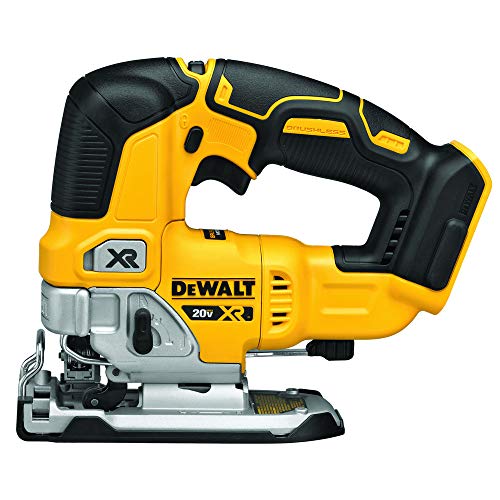
DeWalt DCS334B 20V MAX XR Cordless Jig Saw
Best for: Woodworkers and DIYers who want cordless freedom without sacrificing cut quality
- Brand
- DeWalt
- Type
- Cordless top-handle jigsaw
- Power
- Cordless (20V MAX, battery sold separately)
- Voltage
- 20V MAX
- Weight
- 5.2 lbs (tool only)
$138.11Amazon price as of Oct 7, 9:39 PM EDTProduct prices and availability are accurate as of the date/time indicated and are subject to change. Any price and availability information displayed on Amazon.com at the time of purchase will apply to the purchase of this product.
What we like
- Brushless motor delivers excellent runtime and near-zero maintenance
- All-metal keyless blade clamp with lever-action for fast changes
- LED work light and dust blower keep the cut line visible
- Keyless bevel adjustment with positive detents at 4 angles
Watch out for
- Battery and charger sold separately (a real added cost if you're new to 20V MAX)
- 3,200 SPM max is slightly slower than the Milwaukee's 3,500
- 5.2 lbs (tool only) gets heavier with a battery attached
The DeWalt DCS334B is the jigsaw I recommend to anyone who doesn't have a strong reason to choose something else. The brushless motor delivers efficient power without the maintenance concerns of a brushed motor, and the 3,200 SPM top speed handles everything from hardwood to sheet metal. The all-metal lever-action keyless blade clamp makes blade changes genuinely fast, and the keyless bevel adjustment with detents at four angles means you can switch without fumbling for tools.
If you're already in the DeWalt 20V MAX ecosystem, this is a no-brainer. If you're not, it's worth starting. For a full breakdown of seven jigsaws across every budget, see my best jigsaws roundup.

Milwaukee 2821-20 M18 FUEL SAWZALL
Best for: Remodelers and contractors who want the fastest cordless cutting with all-day battery life
- Brand
- Milwaukee
- Type
- Cordless reciprocating saw
- Power
- Cordless (M18 18V, battery sold separately)
- Voltage
- 18V
- Weight
- 6.8 lbs (bare tool)
- Size
- 17.1" x 3.6" x 6.3"
$183.98Amazon price as of Oct 7, 9:39 PM EDTProduct prices and availability are accurate as of the date/time indicated and are subject to change. Any price and availability information displayed on Amazon.com at the time of purchase will apply to the purchase of this product.
What we like
- Fastest cutting speed in the 18V cordless class
- Lighter than previous generation while maintaining full power
- QUIK-LOK anti-corrosion blade clamp stays reliable in harsh conditions
- REDLINK PLUS electronics protect against overload and over-discharge
Watch out for
- Battery and charger sold separately (M18 batteries are pricey)
- Higher vibration than the Makita XRJ05Z
- No orbital action (step up to the SUPER SAWZALL for that)
What I like most about the Milwaukee 2821-20 is that it replaced the legendary 2720 and improved on it in every way that matters. The POWERSTATE brushless motor delivers the fastest cutting speed in the 18V cordless class. REDLINK PLUS electronics monitor temperature, voltage, and current to protect the tool and batteries from damage under heavy loads. At 6.8 lbs bare, it's lighter than the previous generation, which adds up during a full day of demolition.
If you're in the M18 ecosystem, this is the obvious choice. For a full comparison of seven reciprocating saws, see my best reciprocating saws roundup.
Common Questions
Can a reciprocating saw make curved cuts?
Technically, yes. The blade is flexible enough to follow a gentle curve. But the results will be rough, imprecise, and inconsistent. If you need curved cuts that look presentable, use a jigsaw. A reciprocating saw's curved cutting ability is limited to rough-in work where the cut will be hidden.
Can a jigsaw do demolition work?
Not effectively. A jigsaw's base plate needs to sit flat on the material, which isn't possible when you're cutting into a wall cavity or removing framing. The thin blade and short stroke length also mean it can't power through nail-embedded lumber the way a reciprocating saw can. Using a jigsaw for demolition is slow, awkward, and hard on the tool.
Do I need both saws?
If you do any remodeling, the answer is probably yes. A bathroom renovation, for example, might require a reciprocating saw to tear out the old vanity, subfloor, and plumbing, and then a jigsaw to make precise cutouts in the new countertop and flooring. The two tools rarely substitute for each other because they solve different problems.
Final Thoughts
The jigsaw vs reciprocating saw question has a simple answer once you understand the distinction. These saws are not competitors. They're teammates. A jigsaw is for building and creating. A reciprocating saw is for tearing down and cutting through. In my opinion, comparing them is like comparing a scalpel to a machete: both cut, but you'd never swap one for the other.
If you're choosing one saw: I'd pick a jigsaw as the more versatile first purchase for most homeowners. It handles a wider range of everyday projects, from cutting shelving to trimming laminate to making sink cutouts. The DeWalt DCS334B or the Ryobi PBLJS01B (both mid-range bare tools) are strong starting points.
If you already own a jigsaw and want to expand: a reciprocating saw unlocks demolition, remodeling, and outdoor cutting that no other tool handles as well. I recommend the DeWalt DCS382B for the best balance of performance and value.
If you do remodeling work: get both. You'll reach for them on every project, and the combined investment (roughly $300 for two solid mid-range bare tools) pays for itself the first time you avoid calling a contractor for a simple demo job.
For detailed product recommendations, check my full roundups on the best jigsaws and best reciprocating saws.
Affiliate Disclosure
This post contains affiliate links. As an Amazon Associate, HomeBuildLab earns from qualifying purchases at no additional cost to you. Learn more
Prices shown are from Amazon at the time indicated and may change. The price and availability on Amazon.com at the time of purchase apply.
Sam Hartwell
Sam Hartwell edits HomeBuildLab's tool reviews and home improvement guides. Every pick starts with manufacturer spec sheets, warranty terms, parts availability and owner feedback, then gets matched to a specific job and budget. Guides list the trade-offs plainly and get updated when models change or go out of stock.
Keep reading: Saws
All saws guides → Comparison
Saws
Table Saw vs Track Saw: Which is Better for Sheet Goods?
Table saw vs track saw: which one handles plywood better? I compare cut quality, safety, price, and portability so you can pick the right saw for your shop.
Updated
 How-To
Saws
Jigsaw Blade Types Explained: How to Pick the Right One for Every Cut
Not sure which jigsaw blade types you need? This guide covers blade materials, TPI ratings, and tooth geometry so you pick the right blade every time.
Updated
 How-To
Saws
How to Cut a Straight Line with a Jigsaw: Tips That Actually Work
Learn how to cut straight with a jigsaw using the right blade, a guide fence, and proper technique. Practical tips to eliminate blade wander for good.
Updated
 How-To
Saws
Types of Saws: What Each One Does and Which to Buy First
Learn the different types of saws, what each one does best, and which saw to buy first. A practical guide with honest buying recommendations for beginners.
Updated
 Comparison
Saws
Table Saw vs Miter Saw: Which Do You Actually Need First?
Table saw vs miter saw: I compare cut types, versatility, safety, portability, and price so you can pick the right first saw for your home workshop in 2026.
Updated
 Comparison
Saws
Miter Saw vs Circular Saw: Key Differences That Actually Matter
Miter saw vs circular saw: which one should you buy first? I compare accuracy, portability, cut types, and cost so you pick the right saw for your projects.
Updated
The HomeBuildLab newsletter
New guides and tool deals worth knowing about
One short email when we publish or update a buying guide. No spam, unsubscribe anytime.