Table Saw Buying Guide: What to Look For Before You Buy
This table saw buying guide breaks down types, key specs, fence quality, safety features, and common mistakes so you pick the right saw for your budget.
Reader-supported: we may earn a commission when you buy through links on this page, at no extra cost to you. How we research
We don't run a test lab. For each guide we compare manufacturer specs, warranty terms and owner reviews, then match models to specific jobs and budgets. We say when a pick is a trade-off, and every product has cons listed.
As an Amazon Associate, HomeBuildLab earns from qualifying purchases. Read our full affiliate disclosure.

If you're looking for a table saw buying guide that cuts through the noise, you're in the right place. A table saw is the centerpiece of most woodworking workshops. It rips lumber, crosscuts stock, handles sheet goods, and cuts joinery like dados and rabbets. No other tool combines the same speed, accuracy, and versatility in a single package. But buying the wrong table saw wastes money, eats up floor space, and leaves you fighting the tool instead of building with it.
Here's what most table saw buying guides won't tell you: the motor matters less than the fence. I believe a 15-amp saw with a sloppy fence produces crooked cuts all day long, while a moderate saw with a rock-solid fence produces furniture-quality results. Rip capacity, fence accuracy, and dust collection are the specs that separate a productive table saw from one that frustrates you on every cut. Don't get distracted by horsepower alone.
In this guide, I break down the four main types of table saws, the specs that actually affect your work, the safety features worth paying for, and the common mistakes that cost beginners time and money. If you already know what you need and just want model-by-model reviews, jump to our best table saw roundup.
Quick Picks: The Right Table Saw for Your Situation
Each pick is covered in detail at the end of this guide.
- Best Overall (Sheet Goods on the Go): DeWalt DWE7491RS. 32-1/2" rip capacity and a rack-and-pinion fence on a rolling stand.
- Best Value: SKIL TS6307-00. A rack-and-pinion fence at a budget price. Check price|Review
- Best Benchtop/Compact: DeWalt DWE7485. The smallest footprint with a fence that still stays true. Check price|Review
- Best for a Home Workshop: Delta 36-6023. Full sheet-goods rip capacity plus dado capability for joinery. Check price|Review
- Best for Safety-First Beginners: SawStop CTS-120A60. Flesh-detection brake stops the blade in under 5 milliseconds. Check price|Review
Compare our picks
5 picks- Best OverallDeWalt DWE7491RS 10" Table Saw with Rolling Stand
DeWalt · Corded · 90 lbs (with stand ~110 lbs)
Contractors and serious DIYers who need maximum rip capacity with portability
$599.00Amazon price as of Oct 7, 3:07 AM EDTProduct prices and availability are accurate as of the date/time indicated and are subject to change. Any price and availability information displayed on Amazon.com at the time of purchase will apply to the purchase of this product.
View on Amazon - Best ValueSKIL TS6307-00 15-Amp 10" Portable Jobsite Table Saw
SKIL · Corded · 51 lbs (saw only)
DIYers and hobbyists who want a rack-and-pinion fence without the premium price
$299.00Amazon price as of Oct 7, 3:07 AM EDTProduct prices and availability are accurate as of the date/time indicated and are subject to change. Any price and availability information displayed on Amazon.com at the time of purchase will apply to the purchase of this product.
View on Amazon - Best Benchtop/CompactDeWalt DWE7485 8-1/4" Compact Jobsite Table Saw
DeWalt · Corded · 53.4 lbs
Contractors and DIYers who need the smallest possible footprint without sacrificing quality
$425.08Amazon price as of Oct 7, 3:07 AM EDTProduct prices and availability are accurate as of the date/time indicated and are subject to change. Any price and availability information displayed on Amazon.com at the time of purchase will apply to the purchase of this product.
View on Amazon - Best for a Home WorkshopDelta 36-6023 10" Table Saw with 32-1/2" Rip Capacity
Delta · Corded · 77 lbs
Home workshop woodworkers who rip sheet goods and cut dado joinery
$499.99Amazon price as of Oct 7, 3:07 AM EDTProduct prices and availability are accurate as of the date/time indicated and are subject to change. Any price and availability information displayed on Amazon.com at the time of purchase will apply to the purchase of this product.
View on Amazon - Best for Safety-First BeginnersSawStop CTS-120A60 Compact Table Saw
SawStop · Corded · 68 lbs
Beginners, schools, and anyone who values finger safety above all else
$974.00Amazon price as of Oct 7, 3:07 AM EDTProduct prices and availability are accurate as of the date/time indicated and are subject to change. Any price and availability information displayed on Amazon.com at the time of purchase will apply to the purchase of this product.
View on Amazon
Types of Table Saws
Not all table saws serve the same purpose. The type you need depends on where you'll use it, how often you'll move it, and what kind of projects you tackle.
Benchtop/Compact
Benchtop table saws are the smallest, lightest, and most portable option. They sit on a workbench or optional stand, weigh around 50 to 55 lbs, and use direct-drive universal motors. The DeWalt DWE7485 is the best example in this category: it uses an 8-1/4" blade instead of the standard 10", which shrinks the footprint dramatically while still delivering a rack-and-pinion fence.
The trade-off is cutting capacity. Benchtop saws typically offer 18 to 24 inches of rip capacity and shallower maximum depth of cut. The DWE7485, for instance, only cuts 2-9/16" deep at 90 degrees. You can handle standard dimensional lumber (2x4, 2x6), but thick stock and full sheet goods are out of reach. Blade options are also more limited since 8-1/4" blades are less common at hardware stores than the ubiquitous 10" size.
Best for: Small workshops, occasional use, portability above all else.
Jobsite/Portable
In my opinion, jobsite table saws hit the sweet spot between power and portability. They run 15-amp universal motors, use standard 10" blades, and come with folding or rolling stands. Two standouts define this category: the DeWalt DWE7491RS (32-1/2" rip capacity, rolling stand) and the SKIL TS6307-00 (rack-and-pinion fence at a budget price).
Most jobsite saws weigh between 50 and 90 lbs (saw only) and offer 25 to 32 inches of rip capacity. The better models include rack-and-pinion fence systems that stay parallel to the blade without constant fiddling. These saws handle dimensional lumber, sheet goods, and many joinery tasks. For most DIYers and contractors, a jobsite saw is all you need.
Best for: Contractors, serious DIYers, anyone who needs to move the saw regularly.
Contractor
Contractor table saws were once the standard for jobsite work, but as they evolved, they grew heavier and less portable. Today, they function mainly as stationary workshop saws. They feature belt-driven induction motors (quieter and more durable than the universal motors in jobsite saws), cast iron or cast iron extension tables, and more table surface area for supporting larger workpieces.
The motor hangs off the back of the saw on a hinge, which creates two problems. First, the open back design makes dust collection difficult. Second, the exposed motor is vulnerable to sawdust infiltration over time. Contractor saws typically deliver 1 to 2 HP and weigh 200+ lbs.
Contractor saws have largely been replaced by two categories: jobsite saws (for portability) and hybrid saws (for workshop precision). Unless you find a great deal on a used one, a hybrid saw offers better value for a permanent workshop setup.
Best for: Workshop hobbyists who want more power and table surface than a jobsite saw but don't need full cabinet saw performance.
Cabinet/Hybrid
Cabinet and hybrid saws are the heaviest, most precise, and most powerful table saws available for home workshops. Cabinet saws enclose the motor inside the base, which dramatically improves dust collection, reduces vibration, and protects the motor from sawdust. They use belt-driven induction motors (3 to 5 HP on full cabinet saws), cast iron tables, and cabinet-mounted trunnions for smooth, precise blade adjustments.
Full cabinet saws weigh 500+ lbs, require 240-volt circuits, and cost $1,500 to $5,000+. That puts them out of reach for most home workshops.
Hybrid saws bridge the gap. The Ridgid R4520 was the classic example: a cast iron table, a TEFC (Totally Enclosed Fan Cooled) induction motor, a 4" dust port, and 30" rip capacity, all on a 120-volt circuit. It has since been discontinued, but it still turns up on the used market, and it shows what to look for in a hybrid. Saws in this class weigh around 250 lbs, so they go where you put them and stay there. In exchange, you get the flat, vibration-free cutting surface that no aluminum jobsite table can match.
Best for: Dedicated home workshops where the saw won't move. Furniture builders, cabinetmakers, and anyone who prioritizes precision over portability.
Key Specs That Matter
Spec sheets are full of numbers. These are the ones that actually affect your work.
Motor Power (Amps and HP)
Most jobsite and benchtop table saws run 15-amp motors on standard 120-volt household circuits. That's the maximum a standard outlet can deliver, so nearly every portable saw maxes out at the same amperage. The difference between saws comes down to how efficiently they use those 15 amps.
Horsepower ratings can be misleading. Manufacturers often list "peak" or "max developed" HP, which is the brief surge at startup, not the sustained output during cutting. A saw rated at "4.0 HP max" might deliver 1.5 to 2 HP continuously. Focus on how the saw performs under load (does the blade slow down in hardwood?) rather than the HP number on the box.
For hybrid and cabinet saws, motor power matters more. A 3 HP cabinet saw on a 240-volt circuit delivers significantly more sustained torque than any 120-volt portable. If you regularly cut thick hardwoods or run dado stacks, that extra power prevents bogging and produces cleaner cuts.
Rip Capacity
Rip capacity is the maximum distance between the blade and the fence. It determines the widest board you can cut.
For dimensional lumber (2x4 through 2x12), 24 inches is sufficient. For full sheet goods (4x8 plywood and MDF), you need at least 30 inches to rip a sheet in half. The DeWalt DWE7491RS leads the jobsite category at 32-1/2 inches.
Here's the practical reality: if you only occasionally rip sheet goods, a circular saw with a straightedge or a track saw handles those cuts better than a table saw anyway. Don't pay $200 extra for rip capacity you'll use twice a year. But if you regularly work with plywood for cabinetry or built-ins, 30+ inches of rip capacity saves real time.
Blade Size
The standard table saw blade is 10 inches in diameter, and that's what you should buy unless portability is your top priority. A 10" blade cuts about 3-1/8" deep at 90 degrees, which handles all standard dimensional lumber. It also accepts dado blade stacks on saws with long enough arbors.
The 8-1/4" blade (found on the DeWalt DWE7485 and some cordless saws) reduces the saw's footprint and weight. But it limits your depth of cut to about 2-9/16", can't handle 4x stock, and restricts your blade selection since fewer 8-1/4" blades are available at retail. For most users, 10" is the right choice.
Fence System
I think the fence is the most important component on a table saw. Period. It determines whether your cuts are straight and repeatable or crooked and frustrating. A bad fence will waste more of your time than any other shortcoming.
Rack-and-pinion fences use a gear mechanism to slide smoothly along a rail. They lock firmly and stay parallel to the blade. The DeWalt DWE7491RS and SKIL TS6307-00 both use rack-and-pinion systems, and it's one of the main reasons they're top picks.
T-square fences (also called Biesmeyer-style) clamp at the front rail and use the rail as a reference. Higher-end T-square fences are excellent, but cheaper versions can drift out of parallel, especially after heavy use. If you buy a saw with a T-square fence, budget time for periodic alignment checks.
Friction-based fences on the cheapest saws are the worst option. They slide and lock with a simple clamp, and they drift out of alignment constantly. Expect to square the fence before every session. If a saw has a friction fence, plan on upgrading it or choosing a different saw altogether.
When comparing table saws, put the fence at the top of your checklist. Personally, I prefer a moderate saw with a great fence over a powerful saw with a mediocre fence every time.
Dust Collection
Table saw dust collection is often overlooked, but it directly affects your health and your shop's cleanliness. Fine wood dust is a serious respiratory hazard with long-term health consequences. Every table saw produces it. The question is whether your saw captures it or dumps it into the air you breathe.
2-1/2" dust ports connect to a shop vac. A shop vac moves about 80 CFM (cubic feet per minute) of air. That's enough to catch the larger chips and some of the fine dust, but a meaningful amount still escapes. Most jobsite saws use 2-1/2" ports.
4" dust ports connect to a dedicated dust collector, which moves 400 to 1,000+ CFM. The difference in dust extraction is dramatic. If you're setting up a permanent workshop, prioritize a saw with a 4" port and pair it with a proper dust collector. Expect to find 4" ports mainly on hybrid and cabinet saws. Nearly every jobsite saw sticks with 2-1/2".
Even the best dust port only captures 50 to 60% of the dust at the source. An overhead blade guard with a dust port (available on many saws) catches additional dust from above the table. Combined, these two collection points make a real difference.
Dado Capacity
A dado blade is a stacked set of blades that cuts wide, flat-bottomed grooves. You use them for dadoes (cross-grain slots for shelves), rabbets (edge channels for cabinet backs), and other joinery like half-laps and tenons. If you build furniture, cabinets, or shelving, dado capability is essential.
Not all table saws accept dado blades. The saw needs a long enough arbor (the shaft that holds the blade) and enough motor power to spin the wider stack. Most 10" jobsite saws accept dado stacks up to 13/16" wide, which covers the most common joinery widths. Some saws, like the SawStop CTS-120A60 compact model, cannot accept dado blades at all.
Check the dado capacity before you buy. A saw that can't run dados limits your joinery options to a router table, which is slower and less convenient for most dado work.
Safety Features to Look For
Table saws cause more amputations than any other woodworking tool. An estimated 30,000+ emergency room visits per year in the U.S. involve table saws. Safety features aren't optional extras. They're fundamental to the tool.
Riving knife. This is the single most important safety feature on a table saw. A riving knife is a curved piece of metal mounted directly behind the blade. It moves up and down with the blade and prevents the workpiece from pinching the back of the blade, which is the primary cause of kickback. Kickback happens when the wood closes around the blade and gets violently thrown back toward the operator. Every modern table saw should have a riving knife. If a saw doesn't have one, don't buy it.
Blade guard. The transparent plastic guard that covers the top of the blade prevents accidental hand contact from above and to the sides. Many woodworkers remove the blade guard because it can obstruct visibility or interfere with certain cuts. That's a mistake for beginners. Keep the guard on for every through-cut. Remove it only when the cut type (like dados or non-through cuts) requires it, and put it back immediately after.
Anti-kickback pawls. These are small, hinged, barbed fingers that mount behind the blade (often attached to the riving knife assembly). They allow the workpiece to pass forward but dig in and prevent backward movement if kickback occurs. They're a secondary defense that works alongside the riving knife.
SawStop flesh-detection technology. SawStop saws carry a small electrical signal in the blade. When skin contacts the spinning blade, the signal changes (because human tissue conducts electricity differently than wood). A brake fires an aluminum block into the blade teeth, stopping rotation in under 5 milliseconds, and the blade retracts below the table surface. Instead of an amputation, you get a small nick.
The brake cartridge is a single-use component that you have to buy again after each activation. The blade also typically needs replacing. Think of it as a small insurance payout to keep your fingers. SawStop saws cost more upfront (the compact CTS runs around $1,000), but for beginners, schools, and anyone who values their hands, the technology is worth serious consideration.
What to Skip
Not every feature on a table saw spec sheet is worth paying for. Here's what sounds good but doesn't matter much in practice.
Laser guides. Some table saws include a laser line that projects where the blade will cut. In theory, it helps you align your workpiece. In practice, experienced woodworkers almost universally consider them useless. A properly set up fence and blade make the laser redundant. Cheap lasers also drift out of alignment over time, which means they actually mislead you. Don't pay extra for a laser, and don't pick a saw based on having one.
Fancy stock miter gauges. The miter gauge that ships with most table saws is mediocre at best. The slots are standardized, so aftermarket miter gauges (like the Incra or Kreg options) are a significant upgrade. Don't pay a premium for a saw because it claims to have a better-than-average miter gauge. Plan on upgrading it separately if precision crosscutting matters to you, or build a crosscut sled, which is more accurate than any miter gauge.
Extended warranties on portable saws. Jobsite saws live hard lives and most failures happen within the manufacturer's warranty period anyway. The exception is the Ridgid Lifetime Service Agreement, which is genuinely excellent. Most third-party extended warranties aren't worth the cost.
Onboard storage. Some saws advertise onboard storage compartments for push sticks, wrenches, and blade guards. It's a nice convenience, not a buying factor. You can hang a push stick on a nail.
Common Mistakes When Buying a Table Saw
Buying Too Much Saw
A 250-lb hybrid table saw with a cast iron top is overkill if you're building a few shelves a year. A budget jobsite saw handles 90% of home projects perfectly well. Buy for how you actually work, not for the dream shop you might build someday. You can always upgrade later, and a used table saw in good condition holds its value well.
Ignoring the Fence Quality
This is the most common mistake. Budget saws cut costs on the fence first, and a bad fence turns every rip cut into a fight. Before buying, check user reviews specifically about the fence. Does it lock firmly? Does it stay parallel? Does it drift after heavy use? A saw with a great motor and a terrible fence is a bad saw.
Forgetting Dust Collection
Many first-time buyers don't think about dust collection until the shop is covered in sawdust and they're coughing. At minimum, connect a shop vac to the dust port. For a permanent workshop, invest in a proper dust collector with 4" hose. Your lungs and your shop floor will thank you.
Skipping the Stand
A jobsite table saw without a stand is an awkward, dangerous mess. Some saws include stands; others sell them separately. Before you compare prices, check whether the stand is included. A saw that costs $300 without a stand and another that costs $400 with a rolling stand might be the same real-world price once you buy a stand for the first one.
Not Budgeting for a Better Blade
Every table saw ships with a basic 24-tooth ripping blade. It works, but it's not great. A quality 40-tooth combination blade (like a Freud Diablo D1040X) dramatically improves cut quality in both ripping and crosscutting. The difference between a stock blade and a good aftermarket blade is more noticeable than the difference between a budget saw and one that costs twice as much. Budget a little extra for a blade upgrade on top of the saw's purchase price.
Overlooking the Power Circuit
Portable 15-amp table saws run on standard 120-volt household outlets. But they draw close to the maximum that a 15-amp circuit can handle. If you're running the saw on the same circuit as a shop vac, dust collector, or other tools, you'll trip the breaker. Ideally, your table saw gets its own dedicated circuit. Check your garage or workshop wiring before you buy, especially if you're considering a 240-volt hybrid or cabinet saw.
Table Saw Picks for Every Situation
The best table saw depends on the decisions this guide walked through: saw type, fence quality, rip capacity, dado capability, and how much safety technology you want. Here's what I'd buy for each common situation. For all eight models we compared, see the full best table saw roundup. If you're still deciding whether a table saw is even the right first saw, our table saw vs miter saw comparison helps you choose.
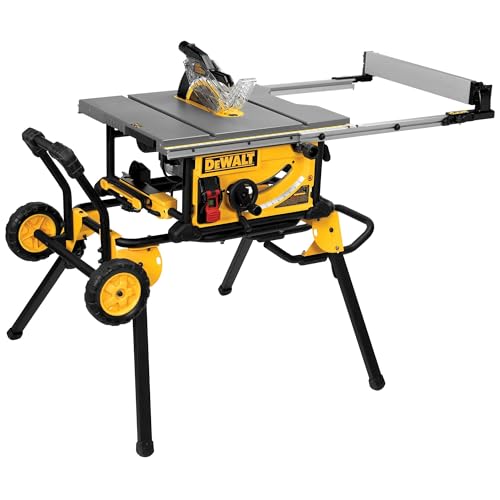
DeWalt DWE7491RS 10" Table Saw with Rolling Stand
Best for: Contractors and serious DIYers who need maximum rip capacity with portability
- Brand
- DeWalt
- Type
- Jobsite table saw with rolling stand
- Power
- Corded
- Voltage
- 120V, 15 Amp
- Weight
- 90 lbs (with stand ~110 lbs)
$599.00Amazon price as of Oct 7, 3:07 AM EDTProduct prices and availability are accurate as of the date/time indicated and are subject to change. Any price and availability information displayed on Amazon.com at the time of purchase will apply to the purchase of this product.
What we like
- Industry-leading 32-1/2" rip capacity handles full sheet goods
- Rack-and-pinion telescoping fence stays accurate cut after cut
- Rolling stand makes transport and storage practical
- Proven design with extensive accessories and parts availability
Watch out for
- Heavy at 90 lbs (saw only), 110+ lbs with stand
- 2-1/2" dust port works with a shop vac, not a full dust collector
- Premium price compared to budget jobsite saws
Remember the rip capacity rule from earlier: you need 30 inches or more to split a 4x8 sheet. The DWE7491RS gives you 32-1/2 inches, the most in the jobsite class, and pairs it with a rack-and-pinion telescoping fence that stays parallel to the blade.
The rolling stand folds for transport and locks solid for use, so you get sheet-goods capacity without giving up floor space permanently. If you work with plywood regularly and need to move the saw, this is the one to beat.

SKIL TS6307-00 15-Amp 10" Portable Jobsite Table Saw
Best for: DIYers and hobbyists who want a rack-and-pinion fence without the premium price
- Brand
- SKIL
- Type
- Portable jobsite table saw with folding stand
- Power
- Corded
- Voltage
- 110V, 15 Amp
- Weight
- 51 lbs (saw only)
- Warranty
- 3-year limited
$299.00Amazon price as of Oct 7, 3:07 AM EDTProduct prices and availability are accurate as of the date/time indicated and are subject to change. Any price and availability information displayed on Amazon.com at the time of purchase will apply to the purchase of this product.
What we like
- Rack-and-pinion fence at a budget price point
- 3-1/2" depth of cut handles 4x4 lumber in one pass
- Folding stand included, at 51 lbs for the saw
- 3-year warranty
Watch out for
- 25-1/2" rip capacity falls short for full sheet goods
- Folding stand is less robust than dedicated rolling stands
- Limited 5/8" dado capacity
This guide keeps coming back to one point: the fence matters more than the motor. The SKIL TS6307-00 is the cheapest saw I'd recommend that gets the fence right, with a rack-and-pinion system at a budget price. The folding stand is included, so there's no hidden cost there either.
It also cuts 3-1/2 inches deep at 90 degrees, enough for 4x4 lumber in one pass. The trade-off is 25-1/2 inches of rip capacity. That's plenty for dimensional lumber, but you'll break down full plywood sheets with a circular saw first.

DeWalt DWE7485 8-1/4" Compact Jobsite Table Saw
Best for: Contractors and DIYers who need the smallest possible footprint without sacrificing quality
- Brand
- DeWalt
- Type
- Compact jobsite table saw
- Power
- Corded
- Voltage
- 120V, 15 Amp
- Weight
- 53.4 lbs
$425.08Amazon price as of Oct 7, 3:07 AM EDTProduct prices and availability are accurate as of the date/time indicated and are subject to change. Any price and availability information displayed on Amazon.com at the time of purchase will apply to the purchase of this product.
What we like
- Most compact table saw footprint available
- Rack-and-pinion fence from a proven design
- Metal roll cage base protects the saw during transport
- Power-loss reset prevents accidental restarts
Watch out for
- 2-9/16" depth of cut cannot handle 4x4 lumber
- 8-1/4" blade has fewer retail options than 10"
- Stand sold separately
If your "shop" is one corner of the garage and the saw lives on a shelf between projects, the benchtop category is where you belong. The DWE7485 is the best example, as the types section above mentioned. It keeps a rack-and-pinion fence and 24-1/2 inches of rip capacity in a much smaller package.
Be honest about the blade size trade-off covered in the specs section. The 8-1/4" blade cuts 2-9/16" deep, so 2x lumber is fine but 4x4s are not. Replacement blades are also harder to find at the hardware store than standard 10" blades.
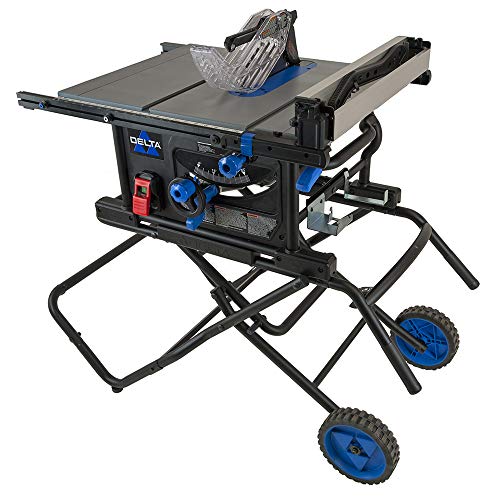
Delta 36-6023 10" Table Saw with 32-1/2" Rip Capacity
Best for: Home workshop woodworkers who rip sheet goods and cut dado joinery
- Brand
- Delta
- Type
- 10" contractor-style table saw with stand
- Power
- Corded
- Voltage
- 120V, 15 Amp
- Weight
- 77 lbs
- Warranty
- 5-year professional
$499.99Amazon price as of Oct 7, 3:07 AM EDTProduct prices and availability are accurate as of the date/time indicated and are subject to change. Any price and availability information displayed on Amazon.com at the time of purchase will apply to the purchase of this product.
What we like
- 32-1/2" rip capacity handles full sheet goods
- 8" stacked dado capacity (up to 13/16") for joinery
- Rack and pinion fence rails for fast, accurate adjustments
- 5-year professional warranty
Watch out for
- Not a cast iron hybrid, so less mass to damp vibration
- Heavy at 77 lbs to move around the shop
- Smaller pool of user reviews than more established models
If you build shelves, cabinets, or furniture, the dado capacity section above is the one to reread. The Delta 36-6023 accepts an 8" stacked dado set up to 13/16" wide and matches the DeWalt's 32-1/2" rip capacity, which covers the two jobs a home shop leans on most.
It isn't a cast iron hybrid, so it lacks the mass of a true stationary saw. But at a mid-range price with a stand and a 5-year warranty, it's the most practical way to get sheet-goods capacity and full joinery on a standard 120-volt circuit.

SawStop CTS-120A60 Compact Table Saw
Best for: Beginners, schools, and anyone who values finger safety above all else
- Brand
- SawStop
- Type
- Compact table saw with flesh-detection
- Power
- Corded
- Voltage
- 120V, 15 Amp, 1.5 HP
- Weight
- 68 lbs
$974.00Amazon price as of Oct 7, 3:07 AM EDTProduct prices and availability are accurate as of the date/time indicated and are subject to change. Any price and availability information displayed on Amazon.com at the time of purchase will apply to the purchase of this product.
What we like
- Flesh-detection technology stops the blade in under 5 milliseconds
- Full 10" blade with 3-1/8" depth of cut
- Compact and relatively portable at 68 lbs
Watch out for
- Cannot accept dado blades (major limitation for joinery)
- Premium price for the safety technology
- Brake cartridge must be replaced (and paid for) after each activation
The safety section above explains how SawStop's flesh-detection brake works: skin contact stops the blade in under 5 milliseconds and drops it below the table. If you're new to table saws, or kids and less experienced users will be in the shop, that protection is worth the premium. Pair it with the habits in our table saw safety guide.
The catch matters, though. The CTS cannot accept a dado stack, so it's a poor fit if joinery is your main goal. Each brake activation also means buying a new cartridge, plus usually a new blade.
Final Thoughts
A table saw is a long-term investment, and I recommend taking your time with this decision. The right one will serve you for a decade or more. The wrong one will frustrate you on every cut and eventually get replaced anyway.
Start with the fence. A rack-and-pinion system (like those on the DeWalt DWE7491RS and SKIL TS6307-00) saves you from constant alignment headaches. Next, consider rip capacity: 24" is fine for dimensional lumber, but 30"+ matters if you work with sheet goods regularly. Factor in dust collection, dado capacity, and safety features based on your specific needs.
For most DIYers and contractors, a quality jobsite saw in the $300 to $600 range handles everything you'll throw at it. For a permanent workshop, a hybrid saw with a cast iron table and 4" dust port is worth the upgrade. And regardless of what saw you buy, invest in a good combination blade, connect a dust collection system, and always use the riving knife.
Once your saw is home, our guide on how to use a table saw walks you through setup and your first cuts. The best table saw is the one that matches your projects, your space, and your budget. I hope this table saw buying guide helps you narrow your options, and then go build something.
Affiliate Disclosure
This post contains affiliate links. As an Amazon Associate, HomeBuildLab earns from qualifying purchases at no additional cost to you. Learn more
Prices shown are from Amazon at the time indicated and may change. The price and availability on Amazon.com at the time of purchase apply.
Sam Hartwell
Sam Hartwell edits HomeBuildLab's tool reviews and home improvement guides. Every pick starts with manufacturer spec sheets, warranty terms, parts availability and owner feedback, then gets matched to a specific job and budget. Guides list the trade-offs plainly and get updated when models change or go out of stock.
Keep reading: Saws
All saws guides → Comparison
Saws
Table Saw vs Track Saw: Which is Better for Sheet Goods?
Table saw vs track saw: which one handles plywood better? I compare cut quality, safety, price, and portability so you can pick the right saw for your shop.
Updated
 How-To
Saws
Table Saw Safety Tips Every Beginner Needs to Know
Learn critical table saw safety rules every beginner needs. Avoid kickback, use push sticks correctly, and protect yourself from the most common injuries.
Updated
 How-To
Saws
How to Use a Table Saw Safely: A Beginner's Guide
Learn how to use a table saw safely with this beginner's guide covering rip cuts, crosscuts, kickback prevention, and the safety rules that matter most.
Updated
 Comparison
Saws
Table Saw vs Miter Saw: Which Do You Actually Need First?
Table saw vs miter saw: I compare cut types, versatility, safety, portability, and price so you can pick the right first saw for your home workshop in 2026.
Updated
 Comparison
Saws
Circular Saw vs Table Saw: The Right First Saw for Beginners
Circular saw vs table saw: which one should you buy first? I compare cost, portability, precision, and safety to help beginners pick the right first saw.
Updated
 Top Picks
Saws
Best Table Saws for Every Workshop: 8 Picks from Jobsite to Cabinet
I compared 8 table saws from budget to premium to find the best table saw for every shop. Honest reviews covering safety, precision, rip capacity, and value.
Updated
The HomeBuildLab newsletter
New guides and tool deals worth knowing about
One short email when we publish or update a buying guide. No spam, unsubscribe anytime.