Table Saw vs Miter Saw: Which Do You Actually Need First?
Table saw vs miter saw: I compare cut types, versatility, safety, portability, and price so you can pick the right first saw for your home workshop in 2026.
Reader-supported: we may earn a commission when you buy through links on this page, at no extra cost to you. How we research
We don't run a test lab. For each guide we compare manufacturer specs, warranty terms and owner reviews, then match models to specific jobs and budgets. We say when a pick is a trade-off, and every product has cons listed.
As an Amazon Associate, HomeBuildLab earns from qualifying purchases. Read our full affiliate disclosure.

If you're building a workshop from scratch, the table saw vs miter saw question comes up fast: which one should be your first big saw? Both are essential. Both cost real money. And unless your budget is unlimited, you're probably buying one before the other.
Here's the honest answer that most tool guides won't give you: neither saw is universally "better." I think a table saw is the more versatile tool overall. A miter saw is faster and more precise at the specific cuts it handles. The right choice depends entirely on what you're building in the next 6 to 12 months, not on what some hypothetical workshop "should" have.
I compared both saw types across cut quality, versatility, safety, portability, and price to help you make the right call. If you want specific product recommendations, check my best table saw and best miter saw roundups. This article focuses on helping you decide which type of saw deserves your money first.
Quick Answer: Table Saw vs Miter Saw
Get a table saw first if your projects involve ripping lumber to width, cutting sheet goods (plywood, MDF), or building furniture and cabinets. I believe the table saw handles the widest range of cuts and serves as the foundation of most workshops.
Get a miter saw first if you're doing trim work, framing, deck building, or any project that requires fast, accurate crosscuts at precise angles. A miter saw does one category of cuts, but it does them faster and more accurately than any other tool.
Compare our picks
2 picks- Best Table Saw PickDeWalt DWE7491RS 10" Table Saw with Rolling Stand
DeWalt · Corded · 90 lbs (with stand ~110 lbs)
Contractors and serious DIYers who need maximum rip capacity with portability
$599.00Amazon price as of Oct 7, 7:00 PM EDTProduct prices and availability are accurate as of the date/time indicated and are subject to change. Any price and availability information displayed on Amazon.com at the time of purchase will apply to the purchase of this product.
View on Amazon - Best Miter Saw Value PickDeWalt DWS779 12" Double-Bevel Sliding Compound Miter Saw
DeWalt · Corded · 56 lbs
Anyone who wants DWS780 performance without paying for the XPS light
$399.00Amazon price as of Oct 7, 7:00 PM EDTProduct prices and availability are accurate as of the date/time indicated and are subject to change. Any price and availability information displayed on Amazon.com at the time of purchase will apply to the purchase of this product.
View on Amazon
Key Differences at a Glance
| Feature | Table Saw | Miter Saw |
|---|---|---|
| Primary Cut | Rip cuts (along the grain) | Crosscuts (across the grain) |
| Secondary Cuts | Crosscuts, dados, rabbets, bevels | Miter cuts, bevel cuts, compound angles |
| Sheet Goods | Yes, with adequate rip capacity | No |
| Portability | Heavy, needs dedicated space | Lighter, easier to move between jobs |
| Price Range | About $300 to $1,700+ | Under $150 to $1,000+ |
| Learning Curve | Steeper (kickback risk is real) | Moderate (safer by design) |
| Setup Time | Fence alignment, blade adjustment | Place material, set angle, cut |
| Dust Collection | Moderate to good | Poor to excellent (varies widely) |
| Best For | Workshop-centered builds | Jobsite work and trim carpentry |
When to Choose a Table Saw
A table saw is the only workshop tool that rips lumber to width efficiently. If you need to take a 2x8 and turn it into two narrower pieces, or rip a sheet of plywood into shelf-width strips, a table saw is the tool. A circular saw with a straightedge can approximate rip cuts, but it's slower, less accurate, and exhausting over multiple cuts.
Beyond rip cuts, a table saw handles crosscuts (with a miter gauge or crosscut sled), dado joints, rabbets, bevels, and tapers. It's the Swiss Army knife of the workshop. Furniture makers, cabinet builders, and anyone working with sheet goods will use a table saw on nearly every project. A saw like the DeWalt DWE7491RS, with 32-1/2 inches of rip capacity and a rack-and-pinion fence, handles everything from framing lumber to full plywood sheets.
The trade-off is space and portability. Even a "portable" jobsite table saw weighs 50 to 90 lbs and needs room for infeed and outfeed. You need a dedicated spot in your garage or shop. Table saws also demand more respect than miter saws. Kickback (when the blade catches the wood and throws it back at you) is a real hazard that requires proper technique, a riving knife, and attention. Beginners should take time to learn safe operation before making their first cut.
When to Choose a Miter Saw
A miter saw excels at one thing: cutting boards to length at precise angles. It does this faster and more accurately than any other method. Drop a board on the fence, line up your mark, pull the blade down, done. For trim carpentry (baseboards, crown molding, door casings), framing, and deck building, a miter saw turns a 10-minute task into a 30-second one.
Angles are where the miter saw truly separates itself. Personally, I prefer using a miter saw for angled cuts because getting a perfect 45-degree miter for a picture frame or baseboard corner is trivial. Doing the same cut on a table saw requires a miter gauge, careful setup, and practice. Dual-bevel miter saws tilt both directions, so you can cut opposing angles without flipping the workpiece. For crown molding, that capability alone saves hours per room.
Miter saws are also more portable and jobsite-friendly. A 12-inch sliding miter saw like the DeWalt DWS779 weighs 56 lbs, sets up in minutes on a folding stand, and goes where the work is. Framers and trim carpenters bring miter saws to every job. You won't see many table saws on a trim carpentry truck, but you'll always see a miter saw.
Head-to-Head Breakdown
Crosscuts
The miter saw wins this category decisively. Drop the board on the fence, align your cut mark, pull the trigger. Crosscuts on a miter saw are fast, repeatable, and accurate to within 1/64 of an inch when the saw is properly calibrated.
You can crosscut on a table saw using a miter gauge or a crosscut sled, and the results can be very accurate. But the setup takes longer, and you're feeding the board through a spinning blade rather than bringing the blade to the board. For repetitive crosscuts (cutting 20 deck boards to the same length, for example), a miter saw with a stop block is dramatically faster.
Rip Cuts
The table saw wins this category with no real competition. Ripping a board to width is the table saw's primary function. Set the fence to your desired width, push the board through, and you get a straight, parallel cut every time.
A miter saw cannot make rip cuts. The blade travels across the grain, not along it. If ripping lumber is a regular part of your projects, you need a table saw. There is no miter saw workaround for this.
Versatility
In my opinion, the table saw is the more versatile tool overall. It rips, crosscuts, cuts dados and rabbets (with a dado blade set), makes bevels, cuts tapers with a jig, and handles sheet goods. A well-equipped table saw with a few jigs can substitute for several other tools.
A miter saw does crosscuts, miter cuts, bevel cuts, and compound angles. That's a narrower range, but it covers those cuts better than a table saw does. The specialization is the point: you trade versatility for speed and precision in its core function.
Portability
The miter saw wins on portability. A 10-inch sliding miter saw weighs 25 to 50 lbs depending on the model. The budget Metabo HPT C10FCG2 weighs just 24 lbs. You can carry it with one hand, set it on a pair of sawhorses, and start cutting.
Table saws range from 50 lbs (compact jobsite models like the DeWalt DWE7485) to 250 lbs (hybrid saws like the Ridgid R4520). Even the lightest table saw needs a stable surface and room on both sides for feeding material. Portability is possible with a rolling stand, but it's never as convenient as grabbing a miter saw and going.
Safety
Neither saw is inherently safe, but table saws carry more risk. The exposed spinning blade and the potential for kickback make the table saw the leading cause of woodworking-related emergency room visits. Proper technique (using a riving knife, push sticks, and blade guards) reduces the risk significantly, but the consequences of a mistake are serious. SawStop's flesh-detection technology (premium-priced, starting with the compact CTS-120A60) is the gold standard for table saw safety.
Miter saws are safer by design. The blade is enclosed in a guard that retracts only during the cut, and the cutting action (pulling the blade down or across a stationary board) keeps your hands away from the blade path. You can still get hurt, especially if you reach under the blade guard or hold small pieces improperly. But the risk profile is lower than a table saw.
Price
Miter saws offer a lower entry point. You can buy a capable 10-inch compound miter saw (the Metabo HPT C10FCG2) for under $150. A solid 10-inch sliding dual-bevel saw (the SKIL MS6305-00) runs under $300. The popular DeWalt DWS779 sits in the $300 to $500 range.
Table saws start higher. The best budget option I've found, the SKIL TS6307-00, costs around $300. The most popular model, the DeWalt DWE7491RS, sits in the $500 to $700 range. Premium options with SawStop safety run roughly $1,000 to $1,700 and up.
If budget is tight, a miter saw gets you cutting for less money upfront. But remember that a circular saw ($50 to $150) with a straightedge guide can handle rough crosscuts, while nothing substitutes for a table saw's rip cuts. That changes the math if you already own a decent circular saw.
Can You Get By with Just One?
Yes, but the workarounds matter.
If you buy only a table saw: You can crosscut with a miter gauge or crosscut sled. For occasional crosscuts, this works fine. For angle cuts (miters and bevels), a table saw can do them, but it's slower and less intuitive than a miter saw. Cutting 45-degree miters for baseboard corners on a table saw is possible but tedious compared to a miter saw. If you pair a table saw with a decent circular saw and a speed square for rough crosscuts, you can handle most projects.
If you buy only a miter saw: You cannot rip lumber to width. Period. A circular saw with a straightedge can make rough rip cuts in a pinch, but it's not a long-term solution for accurate, repeatable rips. If your projects don't require ripping (trim work, framing, deck building), a miter saw alone works well. The moment you need to rip a sheet of plywood or size lumber to a specific width, you'll need a table saw or a trip to the lumber yard's panel saw.
The practical compromise: If you own a circular saw already (and most people do), buy the saw that covers the gap in your toolkit. A circular saw handles rough crosscuts and rough rip cuts. A miter saw adds precision crosscuts and angle work. A table saw adds accurate rip cuts, sheet goods capability, and joinery. Think about which gap costs you the most time and frustration.
My Top Picks
If you've decided which type of saw you need, here are the specific models I recommend. For full roundups with more options, see my best table saw and best miter saw guides.
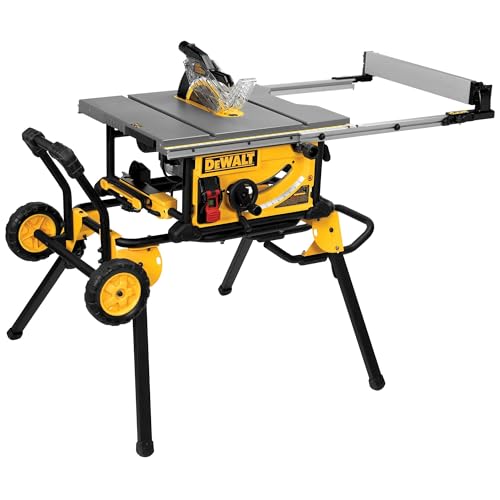
DeWalt DWE7491RS 10" Table Saw with Rolling Stand
Best for: Contractors and serious DIYers who need maximum rip capacity with portability
- Brand
- DeWalt
- Type
- Jobsite table saw with rolling stand
- Power
- Corded
- Voltage
- 120V, 15 Amp
- Weight
- 90 lbs (with stand ~110 lbs)
$599.00Amazon price as of Oct 7, 7:00 PM EDTProduct prices and availability are accurate as of the date/time indicated and are subject to change. Any price and availability information displayed on Amazon.com at the time of purchase will apply to the purchase of this product.
What we like
- Industry-leading 32-1/2" rip capacity handles full sheet goods
- Rack-and-pinion telescoping fence stays accurate cut after cut
- Rolling stand makes transport and storage practical
- Proven design with extensive accessories and parts availability
Watch out for
- Heavy at 90 lbs (saw only), 110+ lbs with stand
- 2-1/2" dust port could be more effective with a 4" option
- Premium price compared to budget jobsite saws
What I like most about the DeWalt DWE7491RS is straightforward: 32-1/2 inches of rip capacity with a rack-and-pinion telescoping fence that stays true. It's been the best-selling jobsite table saw for years, and the reason is that combination. No other saw in this price range gives you enough rip capacity to handle full sheet goods with a fence system this reliable. The rolling stand folds for transport, and the 15-amp motor at 4,800 RPM handles hardwoods and sheet goods without hesitation.

DeWalt DWS779 12" Double-Bevel Sliding Compound Miter Saw
Best for: Anyone who wants DWS780 performance without paying for the XPS light
- Brand
- DeWalt
- Type
- 12" dual-bevel sliding compound miter saw
- Power
- Corded
- Voltage
- 120V, 15 Amp
- Weight
- 56 lbs
$399.00Amazon price as of Oct 7, 7:00 PM EDTProduct prices and availability are accurate as of the date/time indicated and are subject to change. Any price and availability information displayed on Amazon.com at the time of purchase will apply to the purchase of this product.
What we like
- Same motor, capacity, and build quality as the DWS780 at a lower price
- Can be upgraded with XPS LED kit later if desired
- 75%+ dust collection matches the premium model
- Widely available with excellent parts and accessories support
Watch out for
- No built-in LED cutline indicator (the main difference vs. DWS780)
- Same rear-extending rails that require wall clearance
- 56 lbs is not truly portable
The DeWalt DWS779 is the exact same saw as the premium DWS780 with one difference: no built-in XPS LED cutline system. Same 15-amp motor, same 3,800 RPM, same crosscut capacity, same dust collection, same build quality. It typically costs noticeably less. I'd pick this miter saw for anyone building a workshop or starting in trim carpentry. It delivers professional performance at a price that doesn't require justification.
Common Questions
Can a table saw replace a miter saw?
Technically, yes. A table saw with a good miter gauge or crosscut sled can make accurate crosscuts and miter cuts. But it's slower, less convenient, and worse at compound angles. Most woodworkers who own both saws reach for the miter saw every time a crosscut or angle cut comes up, because it's simply faster. If budget forces you to choose one, a table saw is the more capable single tool. But you'll miss the miter saw's speed.
Which saw is safer for beginners?
A miter saw is easier to learn and carries less risk. The blade guard, the stationary workpiece, and the limited cutting motion make serious accidents less likely. A table saw demands more knowledge (kickback prevention, push stick use, riving knife setup) before you should start cutting. Beginners who choose a table saw first should watch instructional videos, read the manual thoroughly, and practice on scrap material before tackling a real project.
Should I buy both at the same time?
If your budget allows it, yes. The combination of a table saw and miter saw covers virtually every cut a home workshop needs. A good pairing on a moderate budget: the SKIL TS6307-00 table saw (around $300) and the DeWalt DWS779 miter saw ($300 to $500). That's a mid-range budget for a shop that handles rip cuts, crosscuts, miters, bevels, sheet goods, and basic joinery. That combination outperforms any single saw at twice the price.
Final Verdict: Table Saw vs Miter Saw
So, table saw vs miter saw: which should you buy first? For most people setting up a home workshop, I recommend buying the table saw first. It's the more versatile tool, handles the cuts no other saw can replicate (rip cuts and sheet goods), and serves as the foundation for furniture, cabinetry, and most woodworking projects. The DeWalt DWE7491RS ($500 to $700) is my top pick for its 32-1/2 inch rip capacity and rock-solid fence. On a tighter budget, the SKIL TS6307-00 (around $300) delivers a rack-and-pinion fence and serious capability for the price.
If your projects are mostly trim carpentry, framing, or deck building, buy the miter saw first. The DeWalt DWS779 ($300 to $500) gives you professional-grade 12-inch sliding performance at a fair price, and it's the saw I recommend to anyone building a workshop. For budget-conscious buyers, the SKIL MS6305-00 (under $300) packs dual-bevel sliding capability with an LED shadow line into an impressive package.
The real answer? Plan to own both eventually. I believe a table saw and a miter saw together handle 95% of the cuts you'll ever need to make. Buy the one that matches your next project, and save for the other.
Affiliate Disclosure
This post contains affiliate links. As an Amazon Associate, HomeBuildLab earns from qualifying purchases at no additional cost to you. Learn more
Prices shown are from Amazon at the time indicated and may change. The price and availability on Amazon.com at the time of purchase apply.
Sam Hartwell
Sam Hartwell edits HomeBuildLab's tool reviews and home improvement guides. Every pick starts with manufacturer spec sheets, warranty terms, parts availability and owner feedback, then gets matched to a specific job and budget. Guides list the trade-offs plainly and get updated when models change or go out of stock.
Keep reading: Saws
All saws guides → Comparison
Saws
Table Saw vs Track Saw: Which is Better for Sheet Goods?
Table saw vs track saw: which one handles plywood better? I compare cut quality, safety, price, and portability so you can pick the right saw for your shop.
Updated
 Comparison
Saws
Miter Saw vs Circular Saw: Key Differences That Actually Matter
Miter saw vs circular saw: which one should you buy first? I compare accuracy, portability, cut types, and cost so you pick the right saw for your projects.
Updated
 Comparison
Saws
Circular Saw vs Table Saw: The Right First Saw for Beginners
Circular saw vs table saw: which one should you buy first? I compare cost, portability, precision, and safety to help beginners pick the right first saw.
Updated
 How-To
Saws
How to Cut Crown Molding with a Miter Saw: A Step-by-Step Guide
Learn how to cut crown molding with a miter saw using the nested method. Step-by-step guide to inside corners, outside corners, coped joints, and pro tips.
Updated
 How-To
Saws
How to Square a Miter Saw for Accurate Cuts
Learn how to square a miter saw in three simple steps: adjust the fence, bevel, and miter detents for dead-accurate crosscuts and tight joints every time.
Updated
 How-To
Saws
Table Saw Safety Tips Every Beginner Needs to Know
Learn critical table saw safety rules every beginner needs. Avoid kickback, use push sticks correctly, and protect yourself from the most common injuries.
Updated
The HomeBuildLab newsletter
New guides and tool deals worth knowing about
One short email when we publish or update a buying guide. No spam, unsubscribe anytime.