Band Saw vs Scroll Saw: Which Curved-Cut Saw Do You Need?
Band saw vs scroll saw: I break down the key differences in cut precision, stock thickness, versatility, and price so you can pick the right curved-cut saw.
Reader-supported: we may earn a commission when you buy through links on this page, at no extra cost to you. How we research
We don't run a test lab. For each guide we compare manufacturer specs, warranty terms and owner reviews, then match models to specific jobs and budgets. We say when a pick is a trade-off, and every product has cons listed.
As an Amazon Associate, HomeBuildLab earns from qualifying purchases. Read our full affiliate disclosure.

The band saw vs scroll saw debate comes up constantly, and I think most people overcomplicate it. Both saws cut curves, and that's where the similarities end. A band saw is a workshop workhorse: it resaws thick lumber into thinner boards, rips stock, cuts gentle curves, and even slices through metal with the right blade. A scroll saw is a precision instrument built for one thing: intricate detail work in thin material.
The confusion between these two tools is understandable. They both have thin blades, they both cut curves, and they both sit on a bench or stand. But I believe they operate in fundamentally different ways, and choosing the wrong one means you'll either lack the power you need or pay for capability you'll never use.
Here's the straightforward answer: if you're not sure which one you need, I'd pick a band saw. It covers more ground. But if your projects involve fretwork, wooden puzzles, ornaments, or interior cutouts, a scroll saw does things a band saw simply cannot. Let's break it down.
Quick Answer
Get a band saw if you need general curved cuts, resawing capability, and the ability to handle thick stock. A 14-inch floor model like the Laguna 14|12 or JET JWBS-14SFX will handle nearly any woodworking task you throw at it.
Get a scroll saw if your focus is intricate fretwork, wooden puzzles, interior cutouts, or detailed patterns in thin stock. The DeWalt DW788 is the gold standard for serious scroll work, while the WEN 3921 is the best entry point at a budget price.
If you do both types of work, I recommend buying the band saw first. It's the more versatile tool. Add a scroll saw later when your projects demand that level of detail.
Compare our picks
2 picks- Best Overall Band SawJET JWBS-14SFX 14-Inch Steel Frame Bandsaw
JET · Corded · 272 lbs
Woodworkers who want a professional 14" saw that handles everything
$1,549.00Amazon price as of Oct 8, 4:13 AM EDTProduct prices and availability are accurate as of the date/time indicated and are subject to change. Any price and availability information displayed on Amazon.com at the time of purchase will apply to the purchase of this product.
View on Amazon - Best Overall Scroll SawDeWalt DW788
DeWalt · Corded · 56 lbs
Serious hobbyists and semi-pros who want low vibration, large throat capacity, and rock-solid reliability
$551.17Amazon price as of Oct 8, 4:13 AM EDTProduct prices and availability are accurate as of the date/time indicated and are subject to change. Any price and availability information displayed on Amazon.com at the time of purchase will apply to the purchase of this product.
View on Amazon
Band Saw vs Scroll Saw: Key Differences at a Glance
| Feature | Band Saw | Scroll Saw |
|---|---|---|
| Blade Type | Continuous loop (welded into a circle) | Short, straight blade clamped at both ends |
| Throat Depth | 9" to 14" (determines max workpiece width) | 16" to 21" (larger effective capacity) |
| Cut Precision | Moderate. Good for gentle curves and straight cuts | Extremely high. Designed for tight radii and intricate patterns |
| Max Stock Thickness | 3.5" to 13" depending on model | Up to 2" (practical limit for most saws) |
| Interior Cuts | Not possible without cutting from the edge | Yes. Thread the blade through a drilled hole |
| Resawing | Yes. This is a primary use case | No |
| Noise Level | Moderate to loud (especially floor models) | Very quiet |
| Typical Price Range | Under $200 for benchtop, up to $2,000+ for premium floor models | Around $100 for entry models, up to about $900 for premium 22" saws |
When to Choose a Band Saw
A band saw is the right choice if your work involves any of the following.
Resawing lumber. This is the band saw's signature move. Slicing a thick board into thinner ones saves money on lumber and lets you create bookmatched panels, custom veneers, and thin stock from expensive hardwoods. No other stationary tool does this. You need at least 6 inches of resaw capacity for practical use, and 12 to 13 inches for serious work.
Cutting thick stock. A scroll saw maxes out around 2 inches. A band saw handles 3.5 inches on a budget benchtop model and up to 13 inches on a full-size floor model like the JET JWBS-14SFX. If you work with anything thicker than dimensional lumber, the band saw is your only option.
General curved cuts. Cutting gentle curves in furniture parts, table legs, brackets, and decorative pieces is comfortable on a band saw. You won't match a scroll saw's tight turning radius, but for most woodworking curves, a 1/4-inch band saw blade handles the job.
Versatility across materials. With the right blade, a band saw cuts wood, plastic, soft metals like aluminum and brass, and even meat and bone (butcher band saws are a separate category, but the principle is the same). Two-speed models like the WEN BA1487 and RIKON 10-3062S let you optimize blade speed for different materials.
Ripping stock. A band saw can rip boards to width, functioning as a rough alternative to a table saw. The cuts aren't as clean, but for workshop stock preparation, it gets the job done.
When to Choose a Scroll Saw
A scroll saw excels in situations where precision and detail matter more than power or capacity.
Fretwork and intarsia. If you're cutting ornate patterns with tight inside corners, pierced designs, or detailed intarsia pieces, a scroll saw is the only power tool that handles this work. The thin plain-end blades can turn in radii as small as the blade width itself, which means you can follow almost any pattern line.
Interior cutouts. This is the scroll saw's unique advantage. Disconnect the blade, thread it through a drilled starter hole, reconnect it, and cut out an interior shape without ever cutting from the edge. Band saws cannot do this because their blade is a continuous loop. If your projects require interior cutouts (think decorative panels, lettering, or puzzle pieces), the scroll saw is essential.
Wooden puzzles, ornaments, and small crafts. The scroll saw community is enormous, and for good reason. The saw turns a few dollars of 1/4-inch plywood into impressive gifts, toys, and decorative pieces. The low noise level means you can run one in a basement shop or garage without disturbing the household.
Thin stock detail work. Scroll saws cut cleanly in material from 1/8 inch to about 2 inches thick. They excel at the thinner end of that range, where a band saw's blade would be too aggressive. Veneer work, marquetry patterns, and layered ornament cutting are all scroll saw territory.
Low noise requirements. A scroll saw is dramatically quieter than a band saw. If your shop shares a wall with living space, or you work during hours when noise matters, the scroll saw is the more neighbor-friendly option.
Head-to-Head Breakdown
Cut Precision
The scroll saw wins this category decisively. Its short blade, clamped at both ends, stays perfectly vertical and allows you to steer through intricate pattern lines with almost surgical control. You can cut curves with radii under 1/8 inch using a fine plain-end blade.
A band saw cuts curves, but the continuous loop blade drifts more and can't make the tight turns a scroll saw handles. A 1/8-inch band saw blade can turn reasonably well, but you're still limited to gentler curves. For straight resawing, blade drift is a constant concern that requires quality blades and proper tensioning to manage.
Stock Thickness
The band saw dominates here. Even a budget benchtop model like the WEN BA3959 cuts 3.5 inches of stock. A 14-inch floor model handles 6 to 13 inches. If you regularly work with thick hardwoods, the band saw is the only realistic option.
Scroll saws top out at about 2 inches. Pushing thicker material through a scroll saw is technically possible on some models, but the blade speed, stroke length, and motor power aren't designed for it. You'll break blades and burn wood.
Versatility
The band saw is the more versatile tool overall. It resaws, rips, crosscuts, cuts curves, and handles multiple materials. Personally, I consider it the single most important stationary tool in the shop, and many woodworkers agree.
The scroll saw does one thing brilliantly: detailed cutting in thin material. It's a specialist, not a generalist. If your projects revolve around detailed scroll work, that specialization is exactly what you want. But it won't resaw a board, rip a plank, or cut through anything over 2 inches.
Noise and Dust
Scroll saws are quiet. You can hold a conversation next to one running at full speed. They produce fine sawdust, but the volume is small and most saws include a dust blower that keeps the cut line visible.
Band saws generate more noise and significantly more dust. Floor models with proper 4-inch dust ports connect to shop vacuums or dust collectors effectively. Benchtop models with smaller ports struggle to keep up. Plan on a dust collection solution if you're running a band saw regularly.
Price
Both tools span a wide price range, but scroll saws are generally less expensive for comparable quality.
A quality scroll saw starts in the budget tier (the WEN 3921 sells for well under $200) and tops out in the premium tier, where the DeWalt DW788 and other 20-inch saws sit around $500 or more. Most hobbyists land somewhere between the two and are well served.
Band saws start under $200 (WEN BA3959 benchtop), but a capable 14-inch floor model runs from just under $1,000 to well over $1,500. Budget benchtop band saws are functional for learning but limited. To get real resawing capability, expect to spend at least mid-range money.
If budget is the primary constraint and you could use either saw, the scroll saw is the cheaper path to a quality tool.
My Top Picks

JET JWBS-14SFX 14-Inch Steel Frame Bandsaw
Best for: Woodworkers who want a professional 14" saw that handles everything
- Brand
- JET
- Type
- Floor-standing bandsaw
- Power
- Corded
- Voltage
- 115/230V, 1-3/4 HP
- Weight
- 272 lbs
- Warranty
- 2-year JET warranty
$1,549.00Amazon price as of Oct 8, 4:13 AM EDTProduct prices and availability are accurate as of the date/time indicated and are subject to change. Any price and availability information displayed on Amazon.com at the time of purchase will apply to the purchase of this product.
What we like
- Massive 360 sq. in. cast-iron table provides excellent workpiece support
- 13" resaw capacity handles the thickest stock you'll encounter
- Welded steel frame virtually eliminates vibration
- Dual 4" dust ports for effective dust collection
Watch out for
- Blade not included, so budget extra for a quality blade
- At 272 lbs, you'll need help moving it into position
- Premium price point well above the hobbyist tier
The JET JWBS-14SFX is my top pick for band saws, and it's the saw I'd recommend to anyone building a serious workshop. What I like most about this machine is the sheer mass. The tubular steel welded frame weighs 272 pounds, and that weight translates directly into stability. Vibration is practically nonexistent, which means cleaner cuts and less blade drift during resawing.
With 13 inches of resaw capacity and the ability to run blades up to 3/4" wide, this saw handles everything from delicate curved cuts to ripping 12/4 hardwood. The 360 square inches of cast-iron table surface gives you genuine workpiece support. Dual 4-inch dust ports round out a well-engineered package.
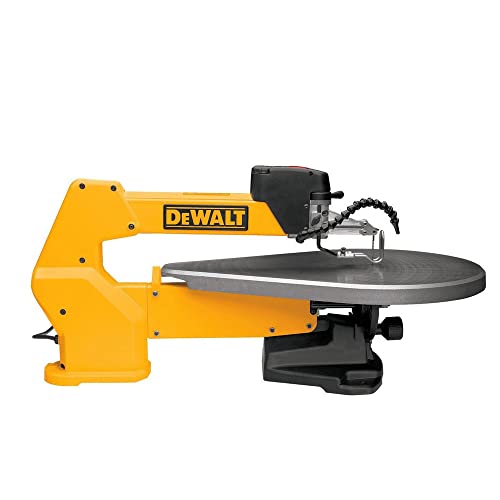
DeWalt DW788
Best for: Serious hobbyists and semi-pros who want low vibration, large throat capacity, and rock-solid reliability
- Brand
- DeWalt
- Type
- 20-inch variable-speed scroll saw
- Power
- Corded
- Voltage
- 120V
- Material
- Cast iron table, steel frame
- Weight
- 56 lbs
- Size
- 29.5" x 19.5" x 12.125"
- Warranty
- 3-year limited warranty
$551.17Amazon price as of Oct 8, 4:13 AM EDTProduct prices and availability are accurate as of the date/time indicated and are subject to change. Any price and availability information displayed on Amazon.com at the time of purchase will apply to the purchase of this product.
What we like
- Double parallel-link arm design delivers near-zero vibration for extremely clean cuts
- 20-inch throat accommodates large workpieces and patterns
- Tool-free blade clamps and front-mounted controls keep everything accessible
- Arm lifts easily for threading blades through interior cutouts
Watch out for
- Costs several times more than mid-range 16-inch alternatives
- Accepts only plain-end blades, which limits flexibility for beginners used to pin-end blades
- 56 lbs needs a dedicated spot in your shop
The DeWalt DW788 has been the scroll saw to beat for years, and nothing in its class has dethroned it. In my opinion, it's the best scroll saw you can buy at any price. The double parallel-link arm design virtually eliminates vibration, which means cleaner cuts and less fatigue during long sessions. You can set a nickel on the table while it runs and it won't fall over.
The 20-inch throat accommodates large workpieces that would overwhelm any 16-inch saw, and the 1.3-amp motor has no trouble pushing through 2-inch hardwood at lower speeds. If scroll sawing is more than a passing interest, I believe this is the saw that won't hold you back.
Common Questions
Can a scroll saw do everything a band saw does?
No. A scroll saw cannot resaw lumber, cut thick stock, or rip boards. It is specifically designed for detailed cutting in thin material (under 2 inches). If you need a general-purpose curved-cut saw, the band saw covers far more ground.
Can a band saw make the detailed cuts a scroll saw makes?
Not really. A band saw can cut curves, but it can't match the tight turning radius of a scroll saw, and it cannot make interior cutouts without cutting in from the edge. If your work involves fretwork, puzzles, or pierced designs, the band saw won't get you there.
Should I buy both?
If your budget and shop space allow it, owning both is ideal. They complement each other perfectly. The band saw handles heavy stock preparation, resawing, and general curves. The scroll saw handles detail work, interior cuts, and thin-stock precision. Many serious woodworkers own both and use them for entirely different tasks.
Final Verdict
When it comes to the band saw vs scroll saw decision, I think the answer is straightforward for most woodworkers: the band saw comes first. Its versatility makes it useful across almost every project, from furniture making to general stock preparation. I recommend the Laguna 14|12 and JET JWBS-14SFX for serious workshops, while the WEN BA1487 gets you into a full 14-inch floor model under $1,000.
If your primary interest is scroll work, fretwork, puzzles, or ornamental cutting, skip the band saw and go straight to a scroll saw. I'd pick the DeWalt DW788 as the gold standard with its 20-inch throat and near-zero vibration. On a budget, the WEN 3921 is the best value in scroll saws and a solid starting point.
The bottom line on band saw vs scroll saw: these are not competing tools. They're complementary ones. A band saw is a generalist that belongs in every serious shop. A scroll saw is a specialist that earns its place the moment your projects demand intricate detail. Know which type of cutting you do most, and start there.
Affiliate Disclosure
This post contains affiliate links. As an Amazon Associate, HomeBuildLab earns from qualifying purchases at no additional cost to you. Learn more
Prices shown are from Amazon at the time indicated and may change. The price and availability on Amazon.com at the time of purchase apply.
Sam Hartwell
Sam Hartwell edits HomeBuildLab's tool reviews and home improvement guides. Every pick starts with manufacturer spec sheets, warranty terms, parts availability and owner feedback, then gets matched to a specific job and budget. Guides list the trade-offs plainly and get updated when models change or go out of stock.
Keep reading: Saws
All saws guides → Top Picks
Saws
Best Tile Saws for Clean Cuts: 6 Picks from DIY to Pro
I compared 6 tile saws from budget tabletop to pro 10-inch models. Find the best tile saw for backsplash, floors, and large format tile in my buying guide.
Updated
 Top Picks
Saws
Best Scroll Saws for Intricate Cuts: Precision Picks for 2026
I compared the 7 best scroll saws for 2026, from budget to premium. See which ones cut cleanest, vibrate least, and deliver the best value at every price.
Updated
 Top Picks
Saws
Best Band Saws in 2026: Benchtop and Floor Models Worth Buying
I compared the best band saws from budget benchtop to pro floor models. Find the right band saw for your shop with my honest reviews and buying guide.
Updated
 Comparison
Saws
Table Saw vs Track Saw: Which is Better for Sheet Goods?
Table saw vs track saw: which one handles plywood better? I compare cut quality, safety, price, and portability so you can pick the right saw for your shop.
Updated
 How-To
Saws
Jigsaw Blade Types Explained: How to Pick the Right One for Every Cut
Not sure which jigsaw blade types you need? This guide covers blade materials, TPI ratings, and tooth geometry so you pick the right blade every time.
Updated
 How-To
Saws
How to Cut Crown Molding with a Miter Saw: A Step-by-Step Guide
Learn how to cut crown molding with a miter saw using the nested method. Step-by-step guide to inside corners, outside corners, coped joints, and pro tips.
Updated
The HomeBuildLab newsletter
New guides and tool deals worth knowing about
One short email when we publish or update a buying guide. No spam, unsubscribe anytime.