Best Tile Saws for Clean Cuts: 6 Picks from DIY to Pro
I compared 6 tile saws from budget tabletop to pro 10-inch models. Find the best tile saw for backsplash, floors, and large format tile in my buying guide.
Reader-supported: we may earn a commission when you buy through links on this page, at no extra cost to you. How we research
We don't run a test lab. For each guide we compare manufacturer specs, warranty terms and owner reviews, then match models to specific jobs and budgets. We say when a pick is a trade-off, and every product has cons listed.
As an Amazon Associate, HomeBuildLab earns from qualifying purchases. Read our full affiliate disclosure.
Our top picks
Compare all 6 ↓- Best OverallDeWalt D24000S 10" Wet Tile Saw with Stand
Tile installers and serious DIYers who need a professional-grade saw they can transport alone
$999.00Amazon price as of Nov 23, 6:54 AM ESTProduct prices and availability are accurate as of the date/time indicated and are subject to change. Any price and availability information displayed on Amazon.com at the time of purchase will apply to the purchase of this product.
View on Amazon - Best ValueQEP 22900Q 7" Power Pro Tile Wet Saw
DIYers who want more power than a budget saw and less water mess in the room where they're installing
- Best BudgetQEP 22700Q 7" 700XT Wet Tile Saw
Homeowners tackling a single backsplash or small tiling project

Finding the best tile saw comes down to one thing: making clean cuts through ceramic, porcelain, and stone without cracking the material. I think a wet tile saw is the tool that delivers this most consistently. Score-and-snap cutters work for basic ceramic tile, but the moment you hit porcelain, glass, or natural stone, you need a diamond blade and a way to control heat and dust. On most saws that's water: it cools the diamond blade, suppresses dust, and prevents the heat fractures that ruin expensive tile.
Here's what most tile saw lists overlook: in my opinion, rip capacity and cutting depth matter more than motor power for most projects. Don't overspend on saw size if your projects don't demand it.
Bottom line: A 7-inch tabletop saw handles backsplash and standard floor tile perfectly. You only need a 10-inch saw for large format tile, thick stone, or plunge cuts for outlets.
I compared six tile saws, from budget tabletop models to a handheld wet saw and professional 10-inch saws, to find the best tile saw for every project and budget.
Quick Picks: Best Tile Saws at a Glance
- Best Overall: DeWalt D24000S. I'd pick this first. Lightest 10" saw at 69 lbs with 24" rip and plunge cutting. Check price|Review
- Best Value: QEP 22900Q. A 1 HP tabletop wet saw with a water baffle and 3-year warranty at a mid-range price. Check price|Review
- Best Budget: QEP 22700Q 700XT. Under $100 with a 7" blade, 1-1/4" cut depth, and a table extension. Check price|Review
- Best for Large Tile: DeWalt D36000S. 37" rip capacity for large format tile and planks. Check price|Review
- Best Portable: DeWalt DWC860W. A 6.6-lb handheld wet/dry saw for cuts on installed tile and places a tabletop saw can't reach. Check price|Review
- Best for Pros: iQ Power Tools iQTS244. A 10" dry-cut saw with built-in vacuum that captures 99.5% of dust, so there's no water slurry at all. Check price|Review
Compare our picks
6 picks- Best OverallDeWalt D24000S 10" Wet Tile Saw with Stand
DeWalt · Corded · 69 lbs
Tile installers and serious DIYers who need a professional-grade saw they can transport alone
$999.00Amazon price as of Nov 23, 6:54 AM ESTProduct prices and availability are accurate as of the date/time indicated and are subject to change. Any price and availability information displayed on Amazon.com at the time of purchase will apply to the purchase of this product.
View on Amazon - Best ValueQEP 22900Q 7" Power Pro Tile Wet Saw
QEP · Corded · 28.25 lbs
DIYers who want more power than a budget saw and less water mess in the room where they're installing
- Best BudgetQEP 22700Q 7" 700XT Wet Tile Saw
QEP · Corded · 19 lbs
Homeowners tackling a single backsplash or small tiling project
- Best for Large TileDeWalt D36000S 10" High Capacity Wet Tile Saw with Stand
DeWalt · Corded · 91 lbs
Professional tile installers working with large format tile and thick stone
$1,379.00Amazon price as of Nov 23, 6:54 AM ESTProduct prices and availability are accurate as of the date/time indicated and are subject to change. Any price and availability information displayed on Amazon.com at the time of purchase will apply to the purchase of this product.
View on Amazon - Best PortableDeWalt DWC860W 4-3/8" Wet/Dry Masonry Saw
DeWalt · Corded · 6.6 lbs
Remodelers and installers who need to cut tile in place or carry a saw anywhere on a jobsite
$215.18Amazon price as of Nov 23, 6:54 AM ESTProduct prices and availability are accurate as of the date/time indicated and are subject to change. Any price and availability information displayed on Amazon.com at the time of purchase will apply to the purchase of this product.
View on Amazon - Best for ProsiQ Power Tools iQTS244 10" Dry Cut Tile Saw
iQ Power Tools · Corded · 93 lbs
Professional tile installers who work inside occupied homes and want clean, water-free cutting
$1,950.00Amazon price as of Nov 23, 6:54 AM ESTProduct prices and availability are accurate as of the date/time indicated and are subject to change. Any price and availability information displayed on Amazon.com at the time of purchase will apply to the purchase of this product.
View on Amazon
What Actually Matters in a Tile Saw
- Rip capacity is the maximum length of a straight cut. For standard 12x12 tile, any saw works. For 18x18 tile, you need at least 18 inches of rip capacity. For large format tile (24x48 planks), you need 30+ inches. Always match rip capacity to your largest tile size.
- Depth of cut determines the thickest material you can cut. Standard ceramic tile is 1/4 to 3/8 inch thick. Porcelain floor tile is 3/8 to 1/2 inch. Natural stone pavers can be 1-2 inches thick. A 7-inch saw with about 1 inch of depth handles standard tile. A 10-inch wet saw with 3+ inch depth handles everything.
- Water and dust management is unique to tile saws. Wet cutting creates a slurry of water and tile dust, and some saws contain this mess better than others. The QEP 22900Q's interior water baffle cuts down on spray, which matters when you're cutting in the room where you're installing. Dry-cut saws like the iQTS244 skip water entirely and use a built-in vacuum instead.
- Blade quality directly affects cut quality. The diamond blade included with most saws is adequate for ceramic but may chip porcelain or glass tile.
Pro tip: Budget a little extra for a porcelain-rated blade if you're cutting anything harder than basic ceramic.
My Top Tile Saw Picks
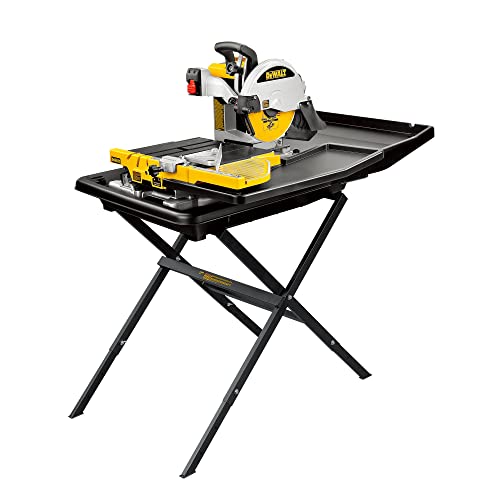
DeWalt D24000S 10" Wet Tile Saw with Stand
Best for: Tile installers and serious DIYers who need a professional-grade saw they can transport alone
- Brand
- DeWalt
- Type
- 10" wet tile saw with folding stand
- Power
- Corded
- Voltage
- 120V, 15 Amp, 1.5 HP
- Weight
- 69 lbs
- Size
- 36" x 29" x 20.4"
- Warranty
- 3-year limited
$999.00Amazon price as of Nov 23, 6:54 AM ESTProduct prices and availability are accurate as of the date/time indicated and are subject to change. Any price and availability information displayed on Amazon.com at the time of purchase will apply to the purchase of this product.
What we like
- Lightest 10" wet tile saw at 69 lbs for one-person transport
- Exceptional cutting accuracy (1/32" over 18" cuts)
- Integrated plunge cut capability for outlets and registers
- Stand and porcelain blade included
Watch out for
- Premium price
- 24" rip capacity may not handle the largest format tiles (36"+)
- Water containment requires attention during use
- Stand is functional but not the most robust
Our take: The installer's saw: lightest 10-inch here, accurate, with stand and blade included. The price is premium.
The DeWalt D24000S is the tile saw professional installers reach for when accuracy and portability both matter. I believe it's the best tile saw for anyone who needs professional-grade performance they can transport solo. At 69 lbs, it's the lightest 10-inch wet tile saw available, and every other 10-inch saw in this roundup weighs more.
The cantilevering rail and cart system with stainless steel rollers sets it apart. DeWalt claims accuracy to 1/32 inch over 18-inch cuts, and user feedback confirms it. A cut line indicator, integrated plunge feature for outlet cuts and dual adjustable water nozzles round out the package.
- Included: the folding stand (a separate stand adds real cost) and an XP4 porcelain tile blade that is a quality blade, not a throwaway.
- Capacity: the 24-inch rip handles most residential and commercial tile, and plunging extends it to 28 inches. For larger tiles, the D36000S offers a bigger platform.
QEP 22900Q 7" Power Pro Tile Wet Saw
Best for: DIYers who want more power than a budget saw and less water mess in the room where they're installing
- Brand
- QEP
- Type
- 7" tabletop wet tile saw
- Power
- Corded
- Voltage
- 120V, 6.5 Amp, 1 HP
- Weight
- 28.25 lbs
- Size
- 22.5" x 18.1" x 8"
- Warranty
- 3-year limited
What we like
- 1 HP direct-drive motor handles porcelain better than budget saws
- Interior water baffle reduces spray and recycles water
- Unlimited rip and diagonal capacity on a push-through table
- 3-year warranty
Watch out for
- 1-1/8" depth of cut limits thick stone work
- No sliding cart, so long cuts depend on your feed technique
- No plunge cutting for outlet notches
Our take: The tabletop saw I'd buy for porcelain floors and kitchen installs: real 1 HP power and a baffle that keeps the room cleaner.
What I like most about the QEP 22900Q is that it gives you a real 1 HP direct-drive motor in a tabletop saw you can carry with one hand. That extra power over budget 3/4 HP saws matters once you move from wall ceramic to porcelain floor tile, where weaker motors bog down and chip edges.
The interior water baffle keeps spray down and recycles water back into the reservoir, so you refill and mop less. That makes it practical to set up in the kitchen or bathroom where you're installing instead of hauling every cut back to the garage.
- Capacity: the blade is fixed and you push the tile across the table, so QEP rates rip and diagonal capacity as unlimited.
- Bevels: the table tilts for 15, 30, and 45 degrees, and a folding bench-stop keeps the saw from walking on a countertop.
- Blade: a 7-inch continuous rim diamond blade is included.
The limits are the ones every tabletop saw shares. The 1-1/8 inch depth of cut won't handle thick stone, and there's no sliding cart or plunge feature, so long cuts in big tile take a steady hand.
QEP 22700Q 7" 700XT Wet Tile Saw
Best for: Homeowners tackling a single backsplash or small tiling project
- Brand
- QEP
- Type
- 7" tabletop wet tile saw with table extension
- Power
- Corded
- Voltage
- 120V, 4.8 Amp, 3/4 HP
- Weight
- 19 lbs
- Size
- 21" x 16" x 6.87"
- Warranty
- 3-year limited
What we like
- Under $100 entry point for functional wet tile cutting
- 1-1/4" depth of cut handles thicker tile than the 22900Q
- Lightweight at 19 lbs and easy to store
- Table extension and 3-year warranty included
Watch out for
- 3/4 HP motor struggles with dense porcelain and stone
- Basic water tray creates more splash than baffled saws
- Not built for professional-volume work
Our take: The cheapest functional wet saw. Enough for one backsplash or a small bathroom, not for dense porcelain floors.
The QEP 700XT is the entry point for wet tile cutting, and a functional one. For under $100, you get:
- A 3/4 HP motor and a 7-inch continuous rim diamond blade
- A lock-down rip guide and an angle guide for 22.5 and 45 degree diagonal cuts
- An 8-inch table extension that mounts on either side
The 1-1/4 inch depth of cut is actually deeper than the pricier 22900Q (1-1/8 inch), so it handles thick tile just fine. At 19 lbs, it's the lightest tabletop saw in this roundup, and setup is minimal: fill the water tray, plug it in, and start cutting. The 3-year warranty is generous at this price.
The limitations are proportional to the price. The 4.8-amp motor slows down in dense porcelain and stone, and the basic water tray throws more splash than the 22900Q's baffle system. Personally, I prefer the 22900Q for floors, but for a single backsplash or small bathroom, those limitations don't matter.

DeWalt D36000S 10" High Capacity Wet Tile Saw with Stand
Best for: Professional tile installers working with large format tile and thick stone
- Brand
- DeWalt
- Type
- 10" high capacity wet tile saw with stand
- Power
- Corded
- Voltage
- 120V, 15 Amp, 1.5 HP
- Weight
- 91 lbs
$1,379.00Amazon price as of Nov 23, 6:54 AM ESTProduct prices and availability are accurate as of the date/time indicated and are subject to change. Any price and availability information displayed on Amazon.com at the time of purchase will apply to the purchase of this product.
What we like
- 37" rip capacity (41" with plunge) handles the largest format tiles
- 1/32" accuracy over 30" cuts for professional-grade precision
- 3-3/8" depth of cut handles thick stone and pavers
- Fits through standard 30" doorframes despite large capacity
Watch out for
- Expensive, well above most homeowner budgets
- Heavy at 91 lbs
- Overkill for standard residential tile projects
- Requires significant workspace
Our take: Only for pros working large format tile: 37 inches of rip and 1/32 inch accuracy. Overkill for a single room.
The DeWalt D36000S exists because tile formats keep getting bigger. Large format tiles (24x48 inch planks, 36x36 inch squares) require rip capacity that standard models can't deliver. The D36000S provides 37 inches (41 inches with plunge), handling the largest residential and commercial tiles available.
Accuracy is exceptional: 1/32 inch over 30-inch cuts. The rigid frame with stainless steel rollers gives the same smooth feed as the D24000S on a larger platform, and the water containment tray fully contains 18x36 and 24x24 tiles.
At 91 lbs it's heavier than the D24000S but still fits through standard 30-inch doorframes. The included stand and porcelain blade complete the package.
Bottom line: The price puts this firmly in professional territory. Homeowners tiling a single room will never need 37 inches of rip capacity, but for installers who regularly work large format tile, it pays for itself.

DeWalt DWC860W 4-3/8" Wet/Dry Masonry Saw
Best for: Remodelers and installers who need to cut tile in place or carry a saw anywhere on a jobsite
- Brand
- DeWalt
- Type
- Handheld wet/dry tile and masonry saw
- Power
- Corded
- Voltage
- 120V, 10.8 Amp
- Weight
- 6.6 lbs
$215.18Amazon price as of Nov 23, 6:54 AM ESTProduct prices and availability are accurate as of the date/time indicated and are subject to change. Any price and availability information displayed on Amazon.com at the time of purchase will apply to the purchase of this product.
What we like
- 6.6 lbs, easy to carry anywhere and cut tile in place
- Flow-adjustable water feed for wet cutting, or dry with a wet/dry blade
- 1-3/8" depth and 45-degree bevel handle tile, stone, and pavers
- Bundled XP4 porcelain-rated blade
Watch out for
- Freehand cuts are less precise than a tabletop saw
- Requires a water source for wet cutting
- Dry cutting creates silica dust, so use a respirator and dust control
Our take: The saw for cuts a tabletop can't make, like trimming installed tile in place. Not for long, dead-straight rips.
A tabletop saw needs a table, a water tray, and a place to bring every tile. The DeWalt DWC860W goes to the tile instead. It's a 6.6-pound handheld saw with a 4-3/8 inch diamond blade, a 10.8-amp motor spinning at 13,000 RPM, and a flow-adjustable water line for wet cutting.
That makes it the saw for cuts a tabletop saw can't make:
- Trimming installed tile around a new vanity
- Notching a tile already on the wall
- Cutting a threshold in place
- Slicing pavers and stone outside
This Amazon listing bundles DeWalt's DW4738 XP4 wet/dry blade, which is rated for porcelain and tile.
Watch out: Dry cutting creates silica dust. Use a respirator and dust control.
Depth of cut is 1-3/8 inches at 90 degrees, and the shoe bevels to 45 degrees. The trade-off is precision. A handheld cut depends on your hand and a guide, so for long, dead-straight rips in finished tile, a tabletop or sliding-cart saw is still the better tool.
iQ Power Tools iQTS244 10" Dry Cut Tile Saw
Best for: Professional tile installers who work inside occupied homes and want clean, water-free cutting
- Brand
- iQ Power Tools
- Type
- 10" dry-cut tile saw with integrated vacuum
- Power
- Corded
- Voltage
- 120V, 17 Amp total (1.5 HP saw, 0.8 HP vacuum)
- Weight
- 93 lbs
- Warranty
- 1-year limited
$1,950.00Amazon price as of Nov 23, 6:54 AM ESTProduct prices and availability are accurate as of the date/time indicated and are subject to change. Any price and availability information displayed on Amazon.com at the time of purchase will apply to the purchase of this product.
What we like
- Integrated vacuum captures 99.5% of dust, with no water or slurry
- Can be used indoors right next to the installation
- 24" rip and 18" diagonal capacity
- Dust bin handles over 500 linear feet of cutting between empties
Watch out for
- Most expensive saw in this roundup
- 1" depth of cut rules out thick stone and pavers
- Heavy at 93 lbs, and the warranty is only 1 year
Our take: The no-water saw for pros in occupied homes. Pricey, and at 1 inch deep it is no stone saw.
The iQTS244 changes the question from "where do I put the wet saw" to "why do I need water at all." It's a 10-inch tile saw with a built-in vacuum that captures 99.5% of the dust at the blade, which iQ rates as meeting OSHA's 2016 silica standard. There is no water tray, slurry or wet floor, and no hauling the saw outside.
For pros working in finished kitchens and occupied homes, that's the whole value: set up next to the install, cut, and keep going. The vacuum holds up to 11 lbs of dust, or more than 500 linear feet of cutting in 3/8-inch material, before you empty it.
Good to know: Capacity is 24 inches of rip and 18 inches on the diagonal, which covers most residential tile. Depth is 1 inch maximum, so it's a tile saw, not a paver or thick stone saw. For that, use the DeWalt wet saws.
Best Tile Saw Buying Guide: How to Choose
Match the saw to your tile
| Tile Type | Tile Size | Saw to Buy | Price Tier |
|---|---|---|---|
| Backsplash and small tile | Up to 12x12" | QEP 22700Q (handles the job affordably) | Under $100 |
| Standard floor tile | Up to 18x18" | QEP 22900Q (1 HP with water baffle) | $200 to $300 |
| Cuts on installed tile | Any | DeWalt DWC860W (handheld wet/dry) | $200 to $250 |
| Large floor tile and porcelain | Up to 24x24" | DeWalt D24000S or iQTS244 (dry cut) | $900 to $2,250 |
| Large format tile and planks | 24x48"+ | DeWalt D36000S (37" rip capacity) | $1,200 to $1,500 |
Use the right blade
The stock blade handles ceramic tile. For porcelain, glass, and natural stone, upgrade to a continuous rim porcelain-rated diamond blade. The difference in chip reduction is dramatic, and a quality blade costs far less than a few ruined tiles.
Manage the water
Wet tile cutting creates a mess.
- Set up smart: pick an area you can clean easily, or use a saw with good water containment (like the QEP 22900Q).
- Change the water: do it regularly during a session, because slurry dulls the blade faster.
- Dry the tray: empty and dry it after each use to prevent mineral buildup.
Common Questions
Do I need a wet tile saw for a backsplash?
Not for basic ceramic: a manual score-and-snap cutter handles straight cuts. For porcelain, glass, or natural stone, yes. A wet saw gives cleaner cuts with fewer broken tiles, and if your tile costs $5+ per square foot, it pays for itself in saved material.
Can I use a tile saw dry?
Not a wet tile saw. Running a wet-only diamond blade dry creates dangerous silica dust, overheats the blade, and cracks tiles. For dry cuts, use a dedicated dry-cut saw like the iQTS244, or a wet/dry saw like the DWC860W with a dry-rated blade, a respirator, and dust control.
How long does a diamond blade last?
A quality 7-inch blade lasts roughly 500 to 1,000 square feet of ceramic tile, less for porcelain and stone. Replace it when cuts slow noticeably, tile edges chip, or the diamond segment looks worn thin.
What size tile saw do I need?
For tiles up to 18x18 inches, a 7-inch tabletop saw works fine. For larger tiles, thick stone, or plunge cuts, you need a 10-inch saw. Match rip capacity to your largest tile, measured diagonally.
Final Thoughts on the Best Tile Saw
After comparing all six models, I recommend the QEP 22900Q for most homeowners tackling a bathroom or kitchen project. Its 1 HP motor handles porcelain, the water baffle keeps the mess down, and it costs a fraction of a 10-inch saw.
For professional installers, I'd pick the DeWalt D24000S. It's the industry standard for a reason: it's accurate, light enough for one person to transport, and includes a stand and quality blade.
If you work inside occupied homes and want to skip water entirely, I think the iQTS244 is the best tile saw for pros. Its built-in vacuum makes clean, dry cuts right next to the installation, and that saves real time on every job.
And for a single backsplash or small project where you just need to make some clean cuts without spending much, the QEP 22700Q gets the job done for under $100. No matter which best tile saw you choose, match rip capacity to your largest tile size and budget for a quality porcelain-rated blade.
The bottom line
DeWalt D24000S 10" Wet Tile Saw with Stand is our best overall.
Best for: Tile installers and serious DIYers who need a professional-grade saw they can transport alone
Affiliate Disclosure
This post contains affiliate links. As an Amazon Associate, HomeBuildLab earns from qualifying purchases at no additional cost to you. Learn more
Prices shown are from Amazon at the time indicated and may change. The price and availability on Amazon.com at the time of purchase apply.
Sam Hartwell edits HomeBuildLab's tool reviews and home improvement guides. Every pick starts with manufacturer spec sheets, warranty terms, parts availability and owner feedback, then gets matched to a specific job and budget. Guides list the trade-offs plainly and get updated when models change or go out of stock.
Keep reading: Saws
All saws guides → Top Picks
Saws
Best Scroll Saws for Intricate Cuts: Precision Picks for 2026
I compared the 7 best scroll saws for 2026, from budget to premium. See which ones cut cleanest, vibrate least, and deliver the best value at every price.
Updated
 Top Picks
Saws
Best Band Saws in 2026: Benchtop and Floor Models Worth Buying
I compared the best band saws from budget benchtop to pro floor models. Find the right band saw for your shop with my honest reviews and buying guide.
Updated
 Comparison
Saws
Band Saw vs Scroll Saw: Which Curved-Cut Saw Do You Need?
Band saw vs scroll saw: I break down the key differences in cut precision, stock thickness, versatility, and price so you can pick the right curved-cut saw.
Updated
 Comparison
Saws
Table Saw vs Track Saw: Which is Better for Sheet Goods?
Table saw vs track saw: which one handles plywood better? I compare cut quality, safety, price, and portability so you can pick the right saw for your shop.
Updated
 How-To
Saws
Jigsaw Blade Types Explained: How to Pick the Right One for Every Cut
Not sure which jigsaw blade types you need? This guide covers blade materials, TPI ratings, and tooth geometry so you pick the right blade every time.
Updated
 How-To
Saws
How to Cut Crown Molding with a Miter Saw: A Step-by-Step Guide
Learn how to cut crown molding with a miter saw using the nested method. Step-by-step guide to inside corners, outside corners, coped joints, and pro tips.
Updated
The HomeBuildLab newsletter
New guides and tool deals worth knowing about
One short email when we publish or update a buying guide. No spam, unsubscribe anytime.