Best Ceiling Fans with Lights: Cool Air and Bright Rooms in One Fixture
Quick Comparison
| Product | Best For | Buy |
|---|---|---|
 Hunter Crestfield 52" (Best Overall) Hunter · Corded (AC Motor) · 19 lbs | Living rooms, bedrooms, and family rooms that need reliable airflow with a classic look | |
 Hunter Dempsey 44" (Best for Low Ceilings) Hunter · Corded (AC Motor) · 18.3 lbs | Bedrooms and living rooms with ceilings under 9 feet | |
 Westinghouse Comet 52" (Best Value) Westinghouse · Corded (AC Motor) · 17.6 lbs | Anyone who wants a reliable 52" fan with LED lighting without spending over $100 | |
 Minka-Aire Light Wave 52" (Best Modern Design) Minka-Aire · Corded (AC Motor) · 14.1 lbs | Design-conscious homeowners who want a fan that looks like a lighting fixture | |
 Fanimation Kute 52" (Best for Large Rooms) Fanimation · Corded (DC Motor) · 15 lbs | Large living rooms, open-concept spaces, and covered patios | |
 Honeywell Carnegie 52" (Best Industrial Style) Honeywell · Corded (AC Motor) · 18 lbs | Rooms with industrial, farmhouse, or rustic decor | |
 Westinghouse Evan 52" (Best Budget Modern) Westinghouse · Corded (AC Motor) · 16 lbs | Modern or minimalist rooms where you want high airflow without a high price |
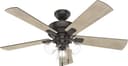
Hunter Crestfield 52" (Best Overall)
Living rooms, bedrooms, and family rooms that need reliable airflow with a classic look
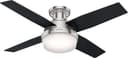
Hunter Dempsey 44" (Best for Low Ceilings)
Bedrooms and living rooms with ceilings under 9 feet
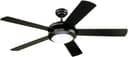
Westinghouse Comet 52" (Best Value)
Anyone who wants a reliable 52" fan with LED lighting without spending over $100
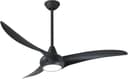
Minka-Aire Light Wave 52" (Best Modern Design)
Design-conscious homeowners who want a fan that looks like a lighting fixture

Fanimation Kute 52" (Best for Large Rooms)
Large living rooms, open-concept spaces, and covered patios
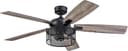
Honeywell Carnegie 52" (Best Industrial Style)
Rooms with industrial, farmhouse, or rustic decor
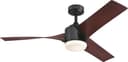
Westinghouse Evan 52" (Best Budget Modern)
Modern or minimalist rooms where you want high airflow without a high price
Choosing the best ceiling fan for your home sounds simple until you start shopping. Suddenly you're drowning in specs: CFM ratings, blade spans, AC vs. DC motors, flush mount vs. downrod, and a dozen finish options. Most "best ceiling fan" lists just rank by price or star rating without explaining why one fan actually outperforms another in your specific room.
Here's the truth: the right ceiling fan can cut your cooling costs by up to 40% because it lets you raise the thermostat 4 degrees without sacrificing comfort. But the wrong fan (too small, too weak, or poorly mounted) just pushes warm air around and collects dust. I compared motor types, airflow efficiency, noise levels, light output, and real user feedback to find the best ceiling fans across every budget and room size.
Whether you're upgrading a bedroom, living room, or covered patio, I'm confident this guide will match you with the right fan.
Quick Picks: Best Ceiling Fans at a Glance
- Best Overall: Hunter Crestfield 52". I'd pick this for most homeowners. Quiet WhisperWind motor, 5,398 CFM, and classic looks that fit any room.
- Best for Low Ceilings: Hunter Dempsey 44". My top recommendation for rooms under 9 feet, with a flush-mount design, remote, and LED light.
- Best Value: Westinghouse Comet 52". Reliable 3,589 CFM airflow with dimmable LED for under $100. Hard to beat at this price.
- Best Modern Design: Minka-Aire Light Wave 52". Sleek curved blades, integrated dimmable LED, and a premium look that I think justifies the cost.
- Best for Large Rooms: Fanimation Kute 52". DC motor delivers 6,701 CFM with whisper-quiet operation.
- Best Industrial Style: Honeywell Carnegie 52". Bold cage light, 4,229 CFM, and a farmhouse-meets-industrial aesthetic.
- Best Budget Modern: Westinghouse Evan 52". Three curved blades, 5,797 CFM, and a minimalist matte black profile.
What to Look For in a Ceiling Fan
Before diving into product reviews, understanding a few key specs will save you from buying the wrong fan.
Blade Span and Room Size
This is the single most important factor. A fan that's too small for your room won't move enough air, and an oversized fan in a small room looks awkward and creates uncomfortable wind speeds. We break down the sizing chart in detail below, but the short version: 44 inches for medium rooms, 52 inches for large rooms, and 60+ inches for great rooms and open plans.
CFM (Cubic Feet per Minute)
CFM measures how much air a fan moves. Higher is better, but efficiency matters too. Look for fans that deliver high CFM per watt. A fan with 5,000+ CFM is excellent for a living room. Bedroom fans can get away with 3,000-4,000 CFM since you're closer to the fan while sleeping.
Motor Type: AC vs. DC
AC motors are the traditional standard. They're reliable, well-proven, and cheaper. DC motors are newer, quieter, more energy-efficient (using up to 70% less power), and usually offer more speed settings. The trade-off? DC motor fans cost more upfront. For bedrooms where silence matters, a DC motor is worth the premium.
Light Kit Quality
Integrated LED lights have replaced the old socket-and-bulb kits on most quality fans. Look for at least 800 lumens for a bedroom and 1,200+ lumens for a living room or kitchen. Dimmable LEDs are non-negotiable because a fan light that's either blinding or off is useless. Some models offer tunable color temperature (warm to cool), which is a nice bonus.
Mounting Type
Flush mount (hugger) fans sit directly against the ceiling. Required for rooms with ceilings under 8 feet. They sacrifice some airflow compared to downrod mounts because the blades sit closer to the ceiling.
Downrod mount fans hang from a rod, typically placing the blades 8-9 feet above the floor. This is the most efficient configuration for air circulation. Most fans include a short (3-4 inch) downrod.
Dual mount fans work both ways, giving you flexibility. Several fans on this list offer dual mounting.
Remote Control
A remote is practically a requirement in 2026. Pulling chains is inconvenient, especially for fans mounted on high ceilings. Most quality fans now include a handheld remote that controls speed, light brightness, and direction. Smart-home integration (WiFi or Bluetooth) is available on premium models but adds cost.
Our Top Picks
Hunter Crestfield 52" (Best Overall)
Hunter Crestfield 52" (Best Overall)
Living rooms, bedrooms, and family rooms that need reliable airflow with a classic look
Pros
- 5,398 CFM airflow handles rooms up to 400 sq. ft.
- WhisperWind motor is genuinely quiet
- 1,800-lumen dimmable LED light kit serves as primary room lighting
- Available in multiple finishes (Noble Bronze, Brushed Nickel, Fresh White)
Cons
- Pull chain control only (no remote included, though a universal remote can be added)
- AC motor uses more energy than DC alternatives
- Low-profile mount option sits blades close to ceiling, reducing efficiency slightly
The Hunter Crestfield is the fan I'd recommend to most people. It does everything well without any glaring weaknesses. The WhisperWind motor pushes 5,398 CFM on high speed while remaining genuinely quiet, not just "quiet for a ceiling fan." That's enough airflow for rooms up to 400 square feet.
The three-light kit uses medium-base LED bulbs (included) that put out 1,800 lumens total, enough to serve as the primary light source in most bedrooms and a strong supplement in living rooms. The bulbs are fully dimmable, which is a feature you don't always get at this price point.
Five reversible blades with a 13-degree pitch optimize air movement in both summer (counterclockwise, downdraft) and winter (clockwise, updraft to redistribute warm air from the ceiling). Installation is straightforward, and Hunter's snap-on blades speed up the process considerably.
Hunter Dempsey 44" (Best for Low Ceilings)
Hunter Dempsey 44" (Best for Low Ceilings)
Bedrooms and living rooms with ceilings under 9 feet
Pros
- Only 11" height makes it ideal for low ceilings (8 feet or less)
- Remote control included for fan speed, light dimming, and direction
- 3,768 CFM is strong for a 44" flush-mount fan
- Reversible blade finishes for style flexibility
Cons
- 44" span limits coverage to rooms under 225 sq. ft.
- Light output is moderate, not a replacement for overhead fixtures in large rooms
- Four blades instead of five, which some buyers find less visually balanced
If your ceilings are 8 feet or lower, I think the Hunter Dempsey is your best option. At just 11 inches from ceiling to blade tip, it hugs the ceiling without sacrificing airflow. The WhisperWind motor delivers 3,768 CFM on high, which is impressive for a flush-mount 44-inch fan.
The included handheld remote controls three fan speeds, light dimming, and reverse direction. That's a major advantage over the Crestfield's pull chains, especially in bedrooms where you want to adjust the fan without getting out of bed.
Four blades with a modern, clean profile give this fan a contemporary look. The integrated LED light is dimmable and provides enough brightness for a bedroom or office. The reversible blades (black oak on one side, light-colored on the other) let you match your room's style without buying a different fan.
Westinghouse Comet 52" (Best Value)
Westinghouse Comet 52" (Best Value)
Anyone who wants a reliable 52" fan with LED lighting without spending over $100
Pros
- Under $100 makes it the best value 52" fan on this list
- Dimmable 16W LED light with frosted glass for even illumination
- Reversible blades and multiple finish options
- Lifetime motor warranty at a budget price
Cons
- Pull chain control only (remote sold separately)
- 3,589 CFM is adequate but not exceptional for 52" span
- Motor noise is noticeable on the highest speed setting
The Westinghouse Comet proves you don't need to spend $200 to get a solid ceiling fan. At around $90, it delivers 3,589 CFM of airflow, which handles rooms up to 400 square feet. That's less raw airflow than the Crestfield or Fanimation Kute, but it's more than adequate for typical bedrooms, offices, and mid-size living rooms.
The integrated 16-watt dimmable LED light kit with frosted glass provides even, glare-free illumination. Five reversible blades (matte black on one side, a lighter finish on the other) offer design flexibility.
Where the Comet shows its budget roots is in the control system: it uses pull chains for speed and light. No remote is included, though Westinghouse sells a compatible one separately. The motor is also slightly louder than Hunter's WhisperWind on high speed, but from user feedback, it's a subtle difference that most people won't notice.
Minka-Aire Light Wave 52" (Best Modern Design)
Minka-Aire Light Wave 52" (Best Modern Design)
Design-conscious homeowners who want a fan that looks like a lighting fixture
Pros
- Striking modern design that elevates any room's aesthetic
- Integrated dimmable LED with opal glass diffuser for soft, even light
- Three-speed handheld remote included
- Available in multiple premium finishes (Coal, White, Distressed Koa, Silver)
Cons
- ~$400 price tag is steep for an AC motor fan
- Three blades can wobble if installation isn't precise
- ABS blades feel less substantial than wood or metal alternatives
The Minka-Aire Light Wave doesn't look like a typical ceiling fan, and that's entirely the point. Three curved ABS blades create a sculptural silhouette that doubles as a design statement. If you've avoided ceiling fans because you think they look dated, this is the one that will change your mind.
Beyond aesthetics, the Light Wave performs well. It pushes around 4,500 CFM with its 52-inch blade span, and the integrated 17-watt dimmable LED module behind white opal glass provides warm, even light. The included three-speed handheld remote controls fan speed, light dimming, and reverse direction.
The three-blade design is intentional: fewer blades move air more efficiently at higher speeds, and the curved shape reduces turbulence. That said, three blades do produce slightly more wobble than five-blade fans if the fan isn't perfectly balanced during installation. Take your time with the mounting.
Fanimation Kute 52" (Best for Large Rooms)
Fanimation Kute 52" (Best for Large Rooms)
Large living rooms, open-concept spaces, and covered patios
Pros
- 6,701 CFM is the highest airflow on this list by a wide margin
- Efficient DC motor reduces energy costs
- Damp rated for indoor or covered outdoor use
- ENERGY STAR Most Efficient certified
Cons
- ~$360 is a premium price, though the DC motor justifies it
- Minimalist design won't appeal to traditional style preferences
- Light output is moderate compared to multi-bulb fixtures
If raw airflow is your priority, the Fanimation Kute is the clear winner on this list. In my opinion, this is the fan to get if you have a large space that needs serious air movement. Its DC motor drives 6,701 CFM on high speed, which is roughly 25% more air than any other fan here. That kind of output makes a real difference in large living rooms, open floor plans, and great rooms where lesser fans just can't keep up.
The DC motor isn't just powerful; it's efficient. It uses significantly less energy than comparable AC fans while offering more granular speed control. Most DC motor fans provide six speeds instead of the standard three, so you can fine-tune airflow precisely.
The Kute also carries an ENERGY STAR Most Efficient certification, which means lower electricity bills over time. As a damp-rated fan, it's approved for covered outdoor spaces like patios and porches, giving you more placement flexibility. The included handheld remote controls all functions.
Honeywell Carnegie 52" (Best Industrial Style)
Honeywell Carnegie 52" (Best Industrial Style)
Rooms with industrial, farmhouse, or rustic decor
Pros
- Bold industrial/farmhouse design with exposed cage light
- 4,229 CFM with reversible motor for year-round use
- Dual mounting options (flush and downrod)
- Remote control included at a mid-range price
Cons
- Cage shade limits light output compared to open or frosted glass designs
- Industrial aesthetic doesn't suit every room style
- AC motor is less efficient than DC alternatives
The Honeywell Carnegie makes a statement with its exposed drum-cage light fixture and industrial hardware. What I like most about this model is that if your home leans toward farmhouse, industrial, or rustic style, it looks intentional rather than like an afterthought stuck on the ceiling.
Performance backs up the looks. The motor pushes 4,229 CFM on high speed, covering rooms up to 400 square feet comfortably. Five dual-finish blades (gray pine on one side, brown chestnut on the other) give you styling options. Dual mounting hardware lets you flush-mount it or use a downrod for standard and vaulted ceilings.
The included remote handles fan speed, light brightness, and direction. The LED light behind the cage shade creates an ambient glow that works beautifully for mood lighting, though it's not the brightest option for task lighting. If you need strong overhead light, pair this fan with supplemental lamps.
Westinghouse Evan 52" (Best Budget Modern)
Westinghouse Evan 52" (Best Budget Modern)
Modern or minimalist rooms where you want high airflow without a high price
Pros
- 5,797 CFM delivers more airflow than many premium fans
- Sleek modern aesthetic with curved walnut blades
- Four-speed remote control included
- Lifetime motor warranty at a fair price
Cons
- Three blades can produce slight wobble at top speed
- Rated for rooms up to 225 sq. ft., smaller coverage than some 52" competitors
- Build quality feels a step below Hunter and Minka-Aire
The Westinghouse Evan proves you don't need to spend Minka-Aire money to get a modern-looking ceiling fan. Three curved walnut-finish blades give it a sleek, contemporary profile, and the matte black finish is the kind of neutral that works in almost any room.
With 5,797 CFM on high speed, the Evan actually outperforms several fans that cost twice as much. Airflow efficiency sits at 82 CFM per watt, which is excellent for an AC motor fan. The integrated 16-watt dimmable LED light with opal frosted glass puts out even, comfortable illumination.
The four-speed remote control is a welcome inclusion at this price. You get the clean design, strong airflow, and remote convenience without crossing the $200 threshold. The main trade-off is build quality: the three-blade design shows minor wobble at higher speeds if the blades aren't perfectly balanced.
Ceiling Fan Size Guide by Room
Getting the blade span right is critical. Here's a quick reference:
Room Size: Up to 75 sq. ft. | Blade Span: 29-36" | Examples: Bathrooms, walk-in closets, small offices
Room Size: 76-144 sq. ft. | Blade Span: 36-44" | Examples: Bedrooms, medium offices, kitchens
Room Size: 145-225 sq. ft. | Blade Span: 44-50" | Examples: Large bedrooms, living rooms, dining rooms
Room Size: 226-400 sq. ft. | Blade Span: 50-54" | Examples: Great rooms, master suites, open kitchens
Room Size: Over 400 sq. ft. | Blade Span: 56-72" (or two fans) | Examples: Open-concept living, vaulted great rooms
How to measure: Multiply your room's length by its width in feet. A 14x16 room is 224 square feet, which falls in the 44-50 inch range. When in doubt, go one size up. A slightly larger fan running on medium speed moves more air (and makes less noise) than a smaller fan running on high.
Ceiling height matters too. Fan blades should sit at least 7 feet above the floor and 8-10 inches below the ceiling for optimal airflow. If your ceiling is 8 feet or lower, you need a flush-mount (hugger) fan. Standard ceilings (8-9 feet) work with a short downrod. Vaulted ceilings (10+ feet) need a longer downrod to bring the fan into the airflow zone.
Common Questions About Ceiling Fans
How much does a ceiling fan save on energy costs?
The Department of Energy estimates that running a ceiling fan lets you raise your thermostat by 4 degrees without losing comfort. Since AC units use significantly more electricity than ceiling fans, the net savings are real. A typical 52" fan on high uses about 50-75 watts, while an AC unit draws 2,000-5,000 watts. The fan itself costs about $0.01 per hour to run.
Should fan blades spin clockwise or counterclockwise?
In summer, set the fan to counterclockwise (looking up at it). This creates a downdraft that makes you feel cooler. In winter, switch to clockwise at a low speed. This pulls cool air up and pushes warm air that collects near the ceiling down along the walls. Every fan on this list has a reversible motor for year-round use.
AC motor or DC motor: which is better?
DC motors are objectively better in most ways. They're quieter, more energy-efficient, and offer more speed settings. The only reason to choose an AC motor fan is budget. If you're spending under $200, you'll find much better selection with AC motors. Above $300, DC motor fans become the smarter long-term investment.
Can I install a ceiling fan where a light fixture was?
Usually, yes. But you need a fan-rated electrical box, not a standard light box. Ceiling fans are heavier and vibrate, so a regular box can pull loose over time. This is a safety issue, not just a preference. If you're unsure, have an electrician verify the box before installation.
Are smart ceiling fans worth it?
If you already use a smart home ecosystem (Alexa, Google Home, HomeKit), a WiFi-enabled fan adds genuine convenience. Voice control and scheduling through an app are features you'll actually use. But if you don't have a smart home setup, a standard remote-controlled fan works just fine.
Pairing Your Ceiling Fan with Smart Home Upgrades
A ceiling fan is just one piece of your home's climate control puzzle. If you're looking to optimize comfort and energy savings, consider pairing your new fan with a smart thermostat that can coordinate your AC and fan usage automatically. Some smart thermostats even integrate with WiFi-enabled ceiling fans for seamless temperature management.
And if you're doing a broader home upgrade, a smart lock is another improvement that adds daily convenience without major installation work.
Final Thoughts
the best ceiling fan for your home depends on three things: room size, ceiling height, and budget. For most people, I recommend the Hunter Crestfield 52" because it hits the sweet spot with strong airflow, a quiet motor, a useful light kit, and a price that won't make you wince. If low ceilings are your constraint, the Hunter Dempsey 44" is the flush-mount to beat. And if you want maximum airflow with energy efficiency, I'd point you toward the Fanimation Kute 52" and its DC motor, which are worth the investment.
Don't overthink the finish or blade count. What matters is matching the blade span to your room, getting enough CFM for the space, and choosing a ceiling fan with a decent LED light and remote control. Get those fundamentals right, and you'll wonder why you waited so long to upgrade from that wobbly, buzzing fan that's been bothering you for years.
Affiliate Disclosure
This post contains affiliate links. As an Amazon Associate, HomeBuildLab earns from qualifying purchases at no additional cost to you. Learn more
Looking for the right tools and products?
Check out our product reviews and buying guides to find the best gear for your project.
Browse Reviews