Best Surge Protectors: Real Protection (Not Just a Power Strip)
Quick Comparison
| Product | Best For | Buy |
|---|---|---|
 APC Performance SurgeArrest P12U2 (Best Overall) APC (Schneider Electric) · N/A · 2.2 lbs | Home offices and entertainment centers that need maximum outlet count and top-tier protection | |
 Amazon Basics 12-Outlet Surge Protector (Best Value) Amazon Basics · N/A · 1.8 lbs | Budget-conscious buyers who want high joule protection without overspending | |
 Tripp Lite TLP1208TELTV (Best for Home Theater) Tripp Lite (Eaton) · N/A · 2.1 lbs | Home theater setups with cable/satellite boxes, modems, and landline phones | |
 Belkin 12-Outlet Surge Protector with USB-C (Best with USB-C) Belkin · N/A · 2.0 lbs | Anyone who wants USB-C Power Delivery charging alongside comprehensive surge protection | |
 CyberPower CSP600WSURC5 (Best Wall-Mount) CyberPower · N/A · 11.5 oz | Kitchens, bathrooms, nightstands, and anywhere a long power strip is impractical | |
 CyberPower CSP1206UC (Best for Workstations) CyberPower · N/A | Desktop workstations, gaming setups, and desks crowded with bulky power adapters | |
 Anker 351 Power Strip (Best Budget Pick) Anker · N/A · 1.8 lbs | Dorm rooms, apartments, and budget setups that need USB-C and plenty of outlets |
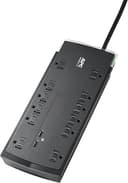
APC Performance SurgeArrest P12U2 (Best Overall)
Home offices and entertainment centers that need maximum outlet count and top-tier protection
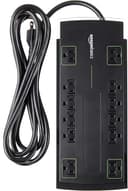
Amazon Basics 12-Outlet Surge Protector (Best Value)
Budget-conscious buyers who want high joule protection without overspending
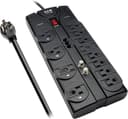
Tripp Lite TLP1208TELTV (Best for Home Theater)
Home theater setups with cable/satellite boxes, modems, and landline phones
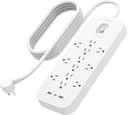
Belkin 12-Outlet Surge Protector with USB-C (Best with USB-C)
Anyone who wants USB-C Power Delivery charging alongside comprehensive surge protection
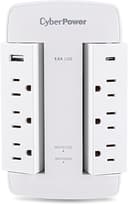
CyberPower CSP600WSURC5 (Best Wall-Mount)
Kitchens, bathrooms, nightstands, and anywhere a long power strip is impractical
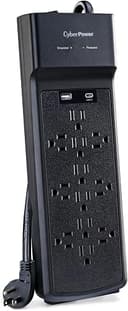
CyberPower CSP1206UC (Best for Workstations)
Desktop workstations, gaming setups, and desks crowded with bulky power adapters
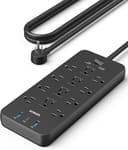
Anker 351 Power Strip (Best Budget Pick)
Dorm rooms, apartments, and budget setups that need USB-C and plenty of outlets
Most people don't think about surge protectors until something expensive stops working. A single voltage spike from a lightning strike, utility grid fluctuation, or even your HVAC cycling on can fry a TV, router, or computer in milliseconds. The best surge protector is cheap insurance for gear that costs hundreds or thousands of dollars. I think every homeowner should have at least two or three protecting their most valuable electronics.
Here's the truth: most people are plugging their electronics into basic power strips with zero surge protection and don't even realize it. And plenty of "surge protectors" on Amazon offer such low joule ratings that they're practically decorative. I compared joule ratings, clamping voltages, outlet counts, USB port options, cord lengths, and warranty coverage to find the surge protectors that actually deliver meaningful protection for your home, office, and entertainment center.
Quick Picks: Best Surge Protectors at a Glance
- Best Overall: APC P12U2. I'd pick this for most people: 4,320 joules, 12 outlets, 2 USB ports, and a $300,000 connected equipment warranty.
- Best Value: Amazon Basics 12-Outlet. 4,320 joules of protection at a fraction of the name-brand price.
- Best for Home Theater: Tripp Lite TLP1208TELTV. 2,880 joules with coax and phone line protection built in.
- Best with USB-C: Belkin SRA007. 3,480 joules, 12 outlets, USB-C PD charging, and USB-A ports.
- Best Wall-Mount: CyberPower CSP600WSURC5. Compact wall-tap design with 900 joules, six swivel outlets, and USB-C charging.
- Best for Workstations: CyberPower CSP1206UC. 3,000 joules, 12 outlets (6 widely spaced), USB-A and USB-C, and a $300,000 equipment guarantee.
- Best Budget Pick: Anker 351. My favorite budget option: 2,100 joules, 12 outlets, 3 USB ports with 20W USB-C PD.
What to Look For in a Surge Protector
Before you buy anything, you need to understand the specs that actually matter. Ignoring these is how people end up with a glorified power strip.
Joule Rating
The joule rating tells you how much energy the surge protector can absorb over its lifetime before it stops working. Think of it like a sponge: every surge it absorbs uses up some of that capacity. Once the joules are depleted, you have an unprotected power strip.
For basic electronics (lamps, phone chargers), 1,000 joules is fine. For computers, TVs, and gaming consoles, aim for 2,000 joules or higher. For home theater systems or a workstation full of expensive equipment, look for 3,000 joules or more.
Clamping Voltage
This is arguably more important than the joule rating, and most people overlook it. Clamping voltage is the maximum voltage the surge protector allows to pass through to your connected devices during a surge. Lower is better. The UL standard recognizes three tiers: 330V, 400V, and 500V. You want 400V or lower. A surge protector rated at 330V will clamp down faster and let less damaging voltage reach your gear.
Number of Outlets and USB Ports
Count your devices before you buy. Most home office setups need 8 to 12 outlets. USB ports (especially USB-C with Power Delivery) let you charge phones and tablets without extra adapters taking up outlet space.
Cord Length
Don't underestimate this. A surge protector with a 2-foot cord is useless if your outlet is behind a desk. For most setups, 6 feet is the minimum. Home theater and workshop setups benefit from 8 to 10 feet.
Warranty and Connected Equipment Coverage
Better surge protectors come with a connected equipment warranty. If a surge damages your gear while it's properly connected to the protector, the manufacturer will cover repair or replacement up to a stated dollar amount. Coverage ranges from $25,000 to $300,000 depending on the brand and model.
Indicator Lights
A good surge protector has LED indicators that tell you two things: whether the unit is grounded properly and whether the surge protection circuitry is still functional. Without these lights, you have no way of knowing when the protection has been used up.
Our Top Picks
APC Performance SurgeArrest P12U2 (Best Overall)
APC Performance SurgeArrest P12U2 (Best Overall)
Home offices and entertainment centers that need maximum outlet count and top-tier protection
Pros
- 4,320 joules is among the highest consumer ratings available
- 330V clamping voltage (tightest UL tier)
- $300,000 connected equipment warranty backs up the protection claims
- 12 outlets with 4 widely spaced for adapters
Cons
- USB ports are USB-A only (no USB-C)
- 6-foot cord is adequate but not generous
- Bulkier than some competitors
I think the APC P12U2 earns the top spot because it combines a high joule rating with a generous warranty and thoughtful design. At 4,320 joules, it has one of the highest protection ratings you'll find in a consumer-grade strip. The clamping voltage sits at 330V across the line-neutral leg, which is the tightest UL rating available.
Twelve outlets give you plenty of room, and the layout spaces four of them far enough apart to accommodate bulky wall-wart adapters without blocking neighboring plugs. The two USB-A ports deliver 2.4A of shared charging power, enough for a phone and a tablet simultaneously.
APC's $300,000 connected equipment policy isn't just marketing. APC (owned by Schneider Electric) is an enterprise power protection company. Their surge protector line benefits from the same engineering that goes into data center UPS systems. Based on user feedback, the P12U2 is consistently rated among the most reliable consumer surge protectors available.
Amazon Basics 12-Outlet Surge Protector (Best Value)
Amazon Basics 12-Outlet Surge Protector (Best Value)
Budget-conscious buyers who want high joule protection without overspending
Pros
- 4,320 joules matches premium competitors at a fraction of the price
- 8-foot cord is longer than most in this class
- Sliding outlet covers keep dust and debris out
- Fireproof MOV construction
Cons
- No USB ports
- Limited warranty compared to APC, Belkin, or Tripp Lite
- No indicator light for surge protection status on some versions
If you want maximum joule-per-dollar value, the Amazon Basics 12-outlet is hard to beat. it matches the APC P12U2 in raw protection capacity at 4,320 joules, often at less than half the price. The 8-foot cord gives you two extra feet over most competitors, which makes a real difference when your outlet is behind heavy furniture.
The design is straightforward: 12 outlets with sliding safety covers, a power on/off switch, a 15-amp resettable circuit breaker, and a keyhole slot on the back for wall mounting. The fireproof MOV (metal oxide varistor) construction adds a safety layer that cheaper strips skip.
Where does it fall short? No USB ports, and the warranty coverage is modest compared to name brands. You won't get a $300,000 connected equipment guarantee here. But for protecting a TV, a game console, and a streaming box, this strip delivers serious protection at a price that makes it easy to replace every three to five years.
Tripp Lite TLP1208TELTV (Best for Home Theater)
Tripp Lite TLP1208TELTV (Best for Home Theater)
Home theater setups with cable/satellite boxes, modems, and landline phones
Pros
- Coaxial and phone line surge protection (rare in this price range)
- Right-angle flat plug saves space behind furniture
- 8-foot cord and 12 outlets
- Lifetime warranty with $150,000 equipment insurance
Cons
- No USB charging ports
- 2,880 joules is lower than the APC or Amazon Basics picks
- Diagnostic LEDs can be hard to see when mounted behind a TV stand
What I like most about the Tripp Lite TLP1208TELTV is that it protects more than just your AC power line. Built-in RJ11 jacks guard your modem, fax, or phone line from surges. And the 2.2 GHz coaxial jacks protect cable and satellite equipment from back-door surges that travel through your coax line and damage your TV or receiver.
This matters more than most people realize. Surges don't just come through the power outlet. Lightning strikes and utility fluctuations can enter your home through any conductive path, including phone lines and coax cables. A surge protector that only guards the AC outlets leaves those entry points wide open.
The 2,880-joule rating provides solid mid-range protection. Twelve outlets (four widely spaced for adapters) and an 8-foot flat-plug cord keep things tidy behind an entertainment center. The right-angle plug sits nearly flush against the wall, so you won't push your furniture out from the wall to accommodate a bulky plug head.
Tripp Lite, now part of Eaton, has been making power protection equipment for decades. Their $150,000 equipment insurance and lifetime warranty back that reputation.
Belkin 12-Outlet Surge Protector with USB-C (Best with USB-C)
Belkin 12-Outlet Surge Protector with USB-C (Best with USB-C)
Anyone who wants USB-C Power Delivery charging alongside comprehensive surge protection
Pros
- USB-C PD port plus two USB-A ports built in
- $300,000 connected equipment warranty
- 12 outlets with clean, compact design
- On/off switch reduces standby power draw
Cons
- 6-foot cord (8 feet would be more versatile)
- USB-C port maxes out at 20W (won't fast-charge laptops)
- 3,480 joules is solid but not the highest in this roundup
If you're tired of dongles and adapters eating up your outlet space, the Belkin SRA007 is the solution. In my opinion, it's the best surge protector for modern desk setups because it's one of the few that includes a USB-C Power Delivery port alongside two USB-A ports, giving you three dedicated charging connections without sacrificing any of the 12 AC outlets.
The 3,480-joule rating lands solidly in the upper tier of consumer surge protectors. It won't match the 4,320-joule monsters, but it's more than enough for a home office with a computer, monitors, and charging devices. Belkin's build quality is consistently good, with UL certification for overload and overvoltage protection.
The $300,000 connected equipment warranty matches APC's top-tier coverage, which tells you Belkin is confident in the protection this strip delivers. The on/off switch with an indicator light lets you kill power to the whole strip when you're not using your desk setup, which also helps reduce phantom power draw.
For a smart thermostat or other sensitive electronics, this level of protection keeps your devices safe without the clutter of separate chargers.
CyberPower CSP600WSURC5 (Best Wall-Mount)
CyberPower CSP600WSURC5 (Best Wall-Mount)
Kitchens, bathrooms, nightstands, and anywhere a long power strip is impractical
Pros
- Compact wall-tap design eliminates cord clutter
- Two banks of swivel outlets make room for bulky plugs
- USB-C and USB-A charging ports (3.6A shared)
- Safe-fail design cuts power when protection is gone
Cons
- 900 joules is on the low end for surge protection
- $75,000 equipment coverage is modest
- Can block the second wall outlet depending on your plate design
Not every situation calls for a big power strip. The CyberPower CSP600WSURC5 plugs directly into a wall outlet and gives you six surge-protected outlets plus two USB charging ports: one USB-C and one USB-A, sharing 3.6 amps. It's a smart fit for spots where a cord-based strip would look messy or get in the way, like behind a nightstand, in a kitchen, or near a bathroom vanity.
The outlets sit in two banks that swivel 90 degrees left or right, so you can angle plugs to keep cords low-profile and make room for bulkier adapters. That design solves one of the biggest annoyances with wall-tap models. CyberPower also builds in safe-fail protection: if the unit can no longer protect your gear, it cuts power to connected equipment instead of quietly running unprotected.
At 900 joules, the protection level is modest compared to the full-size strips in this roundup. For the devices you'd typically plug into a wall tap (phone charger, lamp, clock, small appliance), that's adequate. You wouldn't plug a gaming PC into this, and you shouldn't. Use it for lighter-duty setups where space is the priority.
Based on user feedback, it holds a 4.6-star average, though from a fairly small pool of about 116 ratings. If you have a garage door opener or other appliance in a tight spot, a wall-tap surge protector like this keeps things clean while still offering basic spike protection.
CyberPower CSP1206UC (Best for Workstations)
CyberPower CSP1206UC (Best for Workstations)
Desktop workstations, gaming setups, and desks crowded with bulky power adapters
Pros
- 3,000 joules with $300,000 connected equipment guarantee
- 12 outlets, including 6 widely spaced for bulky adapters
- USB-C and USB-A charging ports
- Keyhole slots for wall or under-desk mounting
Cons
- 1-year base warranty is short compared to APC's lifetime coverage
- Newer model with few user reviews so far
- No clamping voltage listed, so you can't compare it directly to the APC's 330V
The CyberPower CSP1206UC is built for desks that have outgrown a small strip. Twelve surge-protected outlets and 3,000 joules of protection handle a full workstation: monitors, desktop, speakers, desk lamp, docking station, and more. One USB-A and one USB-C port let you charge a phone or tablet without giving up an outlet to a charging brick.
Six of the twelve outlets are widely spaced, and that's the feature that matters most at a real workstation. Laptop power bricks, monitor adapters, and router power supplies tend to block their neighbors on a standard strip. Here they have room.
The right-angle plug and 6-foot cord make it easy to tuck behind a desk. Keyhole slots let you mount it on a wall or under your desk, which keeps it off the floor and out of the way of your feet and chair wheels.
CyberPower backs it with a $300,000 connected equipment guarantee, the same coverage level you get from APC or Belkin, for around $40. The base warranty is only one year per the listing, though, which is shorter than APC's lifetime coverage. This is also a newer model, so user feedback is still thin: about 22 ratings averaging 4.6 stars at the time of writing.
Anker 351 Power Strip (Best Budget Pick)
Anker 351 Power Strip (Best Budget Pick)
Dorm rooms, apartments, and budget setups that need USB-C and plenty of outlets
Pros
- 12 outlets plus 3 USB ports (including USB-C PD) at a budget price
- $200,000 connected equipment warranty (generous for the price)
- 8-point safety system with fire resistance
- Compact design fits in tight spaces
Cons
- 5-foot cord is shorter than most competitors
- 2,100 joules is mid-range (not ideal for high-value equipment)
- TUV-listed but not UL-listed (some buyers prefer UL certification)
The Anker 351 packs a surprising amount of value into a budget-friendly package. Twelve AC outlets, two USB-A ports, and one USB-C port with 20W Power Delivery charging give you 15 total connection points. The 2,100-joule rating is solidly mid-range, and Anker backs it with a $200,000 connected equipment warranty, which is surprisingly generous at this price point.
Anker's 8-point safety system includes surge protection, fire resistance, overload protection, and temperature control. The wide spacing between some outlets accommodates larger adapters, though the compact form factor means not every plug will fit without some Tetris-style arrangement.
The 5-foot cord is the one compromise. It's a foot shorter than most competitors, which could be a problem if your outlet isn't conveniently located. But if cord length isn't a concern, the Anker 351 delivers more features per dollar than almost anything else in this roundup.
Surge Protector vs. Power Strip: Know the Difference
This distinction matters more than you think. A power strip is just an extension cord with multiple outlets. It gives you more places to plug things in, but it does nothing to protect your electronics from voltage spikes. Zero protection.
A surge protector looks similar but contains metal oxide varistors (MOVs) that absorb excess voltage and redirect it to the ground wire before it reaches your devices. The joule rating tells you how much total surge energy those MOVs can absorb before they burn out.
Here's the catch: once a surge protector's MOVs are depleted, it continues to function as a power strip. You still get power, but you've lost the protection. That's why indicator lights matter. Without them, you have no way to know your "surge protector" is really just a power strip at that point.
How to tell the difference when shopping:
- A surge protector will list a joule rating on the packaging. No joule rating means no surge protection.
- Look for a UL 1449 rating, which is the safety standard specifically for surge protective devices.
- If the price seems too good to be true (under $10 for a multi-outlet strip), it's probably just a power strip.
The bottom line: Never plug a computer, TV, gaming console, or any electronics you care about into a plain power strip. The cost difference between a power strip and a decent surge protector is $10 to $20. The cost of replacing a fried motherboard is $200 to $2,000.
Common Questions About Surge Protectors
How often should I replace a surge protector?
Every three to five years, or immediately after a major surge event like a lightning strike. MOVs degrade with each surge they absorb, and there's no way to know exactly how much capacity remains. If your surge protector's "protected" indicator light goes out, replace it immediately.
Do I need a surge protector if I have a whole-house surge protector?
Yes. A whole-house surge protector (installed at your electrical panel) handles large external surges from the utility grid or lightning. But smaller surges generated inside your home, like your HVAC compressor kicking on, bypass the panel-level protection. Point-of-use surge protectors at each outlet add a second layer of defense for your most valuable electronics.
Can I plug a surge protector into another surge protector?
No. Daisy-chaining surge protectors is a fire hazard and violates electrical codes. If you need more outlets, buy a single surge protector with a higher outlet count. Never stack them.
Does a higher joule rating always mean better protection?
Not necessarily. Clamping voltage matters more. A surge protector with 1,500 joules and 330V clamping provides tighter, faster protection than one with 3,000 joules and 500V clamping. The clamping voltage determines how much excess voltage reaches your devices during a spike. Lower is better. Think of joule rating as longevity and clamping voltage as quality of protection.
What's the difference between a surge protector and a UPS?
A UPS (uninterruptible power supply) includes a battery backup that keeps your devices running during a power outage, giving you time to save work and shut down safely. Most UPS units also include surge protection. A surge protector alone only handles voltage spikes. It won't keep your devices on during a blackout. If you're protecting a desktop computer with unsaved work, a UPS is the better choice.
Final Thoughts
The best surge protector depends on what you're protecting and where you're putting it. For most home offices, I recommend the APC P12U2 as the clear winner: 4,320 joules, 330V clamping, 12 outlets, and a $300,000 equipment warranty for around $40. That's exceptional value for the level of protection you get.
If budget is the priority, the Amazon Basics 12-Outlet matches the APC's joule rating at a significantly lower price. For home theater setups, the Tripp Lite TLP1208TELTV is the only pick here with coaxial and phone line protection. And if USB-C charging matters to you, the Belkin SRA007 and Anker 351 both deliver modern connectivity alongside solid surge protection.
Whatever you choose, the most important thing is that you actually use a surge protector instead of a basic power strip. The cost difference is trivial. The protection difference is everything. I'd strongly encourage you to replace your surge protectors every few years, check the indicator lights periodically, and never daisy-chain them. Your electronics will thank you.
Affiliate Disclosure
This post contains affiliate links. As an Amazon Associate, HomeBuildLab earns from qualifying purchases at no additional cost to you. Learn more
Looking for the right tools and products?
Check out our product reviews and buying guides to find the best gear for your project.
Browse Reviews