Table Saw Safety Tips Every Beginner Needs to Know
Learn critical table saw safety rules every beginner needs. Avoid kickback, use push sticks correctly, and protect yourself from the most common injuries.
Reader-supported: we may earn a commission when you buy through links on this page, at no extra cost to you. How we research
We don't run a test lab. For each guide we compare manufacturer specs, warranty terms and owner reviews, then match models to specific jobs and budgets. We say when a pick is a trade-off, and every product has cons listed.
As an Amazon Associate, HomeBuildLab earns from qualifying purchases. Read our full affiliate disclosure.

The table saw is the most versatile tool in a woodworking shop. It is also the most dangerous. According to the U.S. Consumer Product Safety Commission, roughly 30,000 table saw injuries send people to hospital emergency rooms every year. About 4,000 of those injuries are amputations. That is more than 10 amputations per day.
Those numbers are not meant to scare you away from owning a table saw. They are meant to make you take table saw safety seriously from day one. I think every woodworker should read the safety manual cover to cover before making their first cut. The vast majority of these injuries are preventable. They happen because someone skipped a safety step, got complacent, or simply did not know the risks.
This guide covers the essential table saw safety rules, equipment, and practices that will keep your fingers attached and your woodworking enjoyable. I researched dozens of accident reports and manufacturer guidelines to put this together, and I believe it is the most practical starting point for any beginner. If you are shopping for your first saw, check out my best table saws roundup and my table saw buying guide to find a model with the safety features that matter most.
The #1 Danger: Understanding Kickback
Kickback is the single most dangerous thing that can happen at a table saw. It occurs when the spinning blade catches the workpiece and hurls it back toward you at speeds that can exceed 120 miles per hour. At that velocity, a piece of wood becomes a projectile. It can break ribs, knock you unconscious, or pull your hands into the blade.
Here is what causes kickback:
The wood pinches the blade. When the cut closes behind the blade (the kerf narrows), the rising teeth at the back of the blade grab the wood and launch it. This is the most common cause of kickback, and it is exactly what a riving knife is designed to prevent.
The fence is misaligned. If your rip fence is not perfectly parallel to the blade, the wood will drift into the back of the blade as you push it through. Even a slight misalignment creates a pinch point.
Warped or twisted lumber. Boards with a bow, cup, or twist can shift during a cut. When a warped board rocks into the back of the blade, kickback is almost guaranteed.
Freehand cutting. Cutting without the fence or a miter gauge means the wood has nothing to keep it aligned with the blade. Any slight rotation of the workpiece can expose the back teeth, and kickback follows instantly.
A dull blade. Dull teeth generate more friction and heat, which increases the chance of the wood binding against the blade. Sharp blades cut cleaner and safer.
Understanding these causes is the first step. I recommend treating kickback prevention as the foundation of your entire table saw safety practice. The rest of this article covers how to prevent kickback and every other common table saw hazard.
Essential Table Saw Safety Rules
These are non-negotiable. Follow every one of them, every single time you turn on the saw.
Always use the riving knife. I believe this is the single most effective anti-kickback device on your saw. The riving knife sits directly behind the blade, rising and falling with it, and prevents the cut material from closing on the back teeth. Never remove it. If your saw did not come with one, that is a serious problem worth addressing before you make another cut.
Never stand directly behind the blade. Position yourself to the left of the blade (for right-handed operation). If kickback happens, you want to be out of the projectile's path. This simple habit could save you from a serious impact injury.
Keep the blade height correct. Set the blade so it extends about 1/4 inch above the top of the material. This minimizes the amount of exposed blade and reduces the severity of contact injuries. Some woodworkers prefer a slightly higher blade to reduce the chance of kickback. The key is to avoid setting the blade excessively high where multiple inches of teeth are exposed above the workpiece.
Unplug or disconnect the saw before changing blades or adjusting parts. The power switch alone is not enough. Accidental starts happen. Physically disconnect the saw from power before putting your hands anywhere near the blade.
Never reach over or behind a spinning blade. If an offcut is sitting near the blade after a cut, do not reach for it. Wait for the blade to stop completely, or use a push stick to move it away. Most hand injuries happen when operators reach toward a spinning blade to grab a cutoff piece.
Do not use the rip fence as a crosscut stop. When crosscutting with a miter gauge, the workpiece should not also be pressed against the rip fence. The offcut piece can get trapped between the blade and fence, and that trapped piece will kick back violently. If you need a stop for repeatable crosscuts, clamp a block to the fence ahead of the blade so the workpiece clears it before reaching the teeth.
Stay focused. Never operate a table saw when you are tired, distracted, or under the influence of anything. One moment of inattention is all it takes. If you feel your focus drifting, step away.
Safety Equipment You Need
A safe table saw setup is not just about the saw itself. You need the right accessories and protective gear.
Push Sticks and Push Blocks
Your hands should never come within 6 inches of the blade. Push sticks and push blocks are what make that possible.
Push sticks are long, narrow tools with a notch at the end that hooks the back edge of the workpiece. Use them for rip cuts where the fence-to-blade distance is less than 6 inches. Your right hand pushes the workpiece through with the push stick, while your left hand (or a featherboard) holds the stock against the fence.
Push blocks have a flat pad with a handle on top and a lip at the back. They provide both downward and forward pressure, making them ideal for ripping narrow stock where you need more control than a push stick offers.
Keep multiple push sticks within arm's reach of your saw at all times. I mount a pair on hooks right next to my saw so there is never an excuse not to use one. If you have to go looking for one, you will be tempted to skip it. That temptation is where injuries happen.
Featherboards
Featherboards clamp to the table or fence and use flexible fingers to hold the workpiece firmly against the fence (or down against the table). They provide consistent pressure that your hand cannot match, and they only allow the wood to move in one direction: forward. This dramatically reduces the risk of kickback.
Blade Guard
The blade guard is a clear plastic or polycarbonate shield that covers the top of the blade. It keeps your fingers away from the spinning teeth and helps contain sawdust. Many experienced woodworkers remove the blade guard for certain operations, but as a beginner, leave it on whenever the cut allows it. It is a simple barrier between you and the most dangerous part of the saw.
The Riving Knife (Again)
It bears repeating: the riving knife is the most important safety device on your table saw. Unlike a traditional splitter, a riving knife moves up and down with the blade, stays close to the teeth, and does not need to be removed for non-through cuts. Modern saws come with riving knives standard. If yours does not have one, I'd strongly recommend upgrading before making another cut. For recommendations on saws with excellent table saw safety features, see my best table saws guide.
Personal Protective Equipment
Safety glasses are mandatory. Every single time. Flying wood chips and sawdust are constant hazards, and a splinter in the eye can cause permanent damage.
Hearing protection matters more than most beginners realize. A table saw typically produces 95 to 105 decibels, well above the threshold for hearing damage. Earplugs or earmuffs should be part of your routine.
A dust mask or respirator protects you from fine wood dust, which is a known carcinogen with long-term exposure. This is especially important if your shop has limited dust collection.
Avoid loose clothing, jewelry, and gloves. Anything that can get caught in a spinning blade will get caught. Roll up sleeves, remove rings and bracelets, and tie back long hair. Gloves reduce your grip and can be snagged by the blade, so never wear them while operating a table saw.
Safe Cutting Practices
Knowing the rules is one thing. Applying them during actual cuts is another. Here is how to approach common table saw operations safely.
Rip Cuts
Ripping (cutting along the grain) is the table saw's primary job. Set the fence to your desired width, confirm the riving knife is in place, and position the board flat on the table with its edge firmly against the fence. Use steady, even pressure to feed the stock into the blade. Do not force it. If the saw sounds like it is struggling, you are feeding too fast.
For narrow rips (less than 6 inches between the blade and fence), always use a push stick for the last 12 inches of the cut. For very narrow rips (less than 2 inches), use a push stick in your right hand and a push block or featherboard on the fence side.
Crosscuts
Always use a miter gauge or crosscut sled for crosscuts. Never attempt to crosscut using only the rip fence, as the workpiece can rotate into the blade and kick back. Personally, I prefer using a crosscut sled for nearly all my crosscuts. It is one of the best investments you can make for both accuracy and safety. It holds the workpiece securely and keeps your hands well away from the blade.
Sheet Goods
Plywood and other large panels are awkward to handle on a table saw. The sheer size makes it difficult to maintain control. Use outfeed support (a roller stand or a helper), keep the sheet flat on the table, and guide it steadily through the blade. For your first few cuts on sheet goods, I'd recommend using a circular saw with a straightedge instead, or look into a track saw setup. Both are often safer for large panels.
Repetitive Cuts
When making the same cut multiple times, it is easy to fall into a rhythm and stop paying attention. This is exactly when accidents happen. Treat every single cut as if it is your first. Check the setup, confirm the safety equipment, and stay focused through the entire pass.
What NOT to Do: Dangerous Practices Beginners Do Not Realize Are Dangerous
Some of the most hazardous table saw habits seem harmless to beginners. Watch out for these.
Removing the riving knife "because it's in the way." This is by far the most dangerous shortcut you can take. The riving knife exists to prevent kickback. Removing it to make a particular cut easier is trading a minor inconvenience for a major safety risk. If the riving knife interferes with a specific operation (like a non-through cut on an older saw), find an alternative approach or use a different tool.
Using the fence and miter gauge at the same time. This traps the offcut between the blade and the fence, which is a textbook kickback scenario. Use one or the other, not both simultaneously (unless you are using a stop block clamped to the fence well ahead of the blade).
Cutting small pieces without a sled or jig. Freehand-cutting a small piece on a table saw is extremely dangerous. Your fingers are too close to the blade, and the small workpiece can easily be grabbed and thrown. Always use a crosscut sled, a miter gauge with a hold-down clamp, or cut the piece from a larger board.
Walking away from a spinning blade. After you finish a cut, wait for the blade to come to a complete stop before walking away. Offcuts near a spinning blade can shift, get caught, and become projectiles. Finish the operation fully before moving on.
Ignoring strange sounds. If the saw sounds different (a higher pitch, vibration, or a rhythmic clicking), stop immediately and investigate. Strange sounds often mean a loose blade, a misaligned fence, or a binding workpiece. All of these can lead to serious problems.
Clearing scraps by hand while the blade spins. This is one of the most common causes of finger injuries. Small offcuts near the blade should be left alone until the blade stops, or moved with a push stick. Never put your hand near a spinning blade for any reason.
For more guidance on proper technique, my how to use a table saw article walks through each type of cut step by step.
Should You Buy a SawStop?
SawStop is the most well-known manufacturer of table saws with flesh-detection technology. The system works by monitoring a small electrical signal in the spinning blade. Because human skin is conductive, the signal changes the instant flesh touches the blade. When contact is detected, an aluminum brake fires into the blade, stopping it within 5 milliseconds and retracting it below the table. The result is typically a small nick instead of a life-changing injury.
The technology is remarkable, and there are countless stories from woodworkers who would have lost fingers without it. But here is the honest assessment.
The case for SawStop: Medical costs for table saw injuries exceed $2 billion annually. A single emergency room visit for a serious laceration can cost tens of thousands of dollars, and an amputation can cost far more when you factor in surgery, rehabilitation, and lost income. SawStop's entry-level compact saw runs around $1,000. The math strongly favors prevention.
The trade-offs: When the brake fires, it destroys both the brake cartridge (which you have to buy again) and often the blade. SawStop saws also cost more upfront than comparable saws without the technology. And the system can produce false triggers on very wet or green wood, though this is uncommon.
The bottom line: I'd pick a SawStop over any other brand if your budget allows it. It is one of the best table saw safety investments you can make. It does not replace good safety habits (you still need to use push sticks, a riving knife, and proper technique), but it provides a critical last line of defense for the one mistake that matters most. When comparing saws, my table saw vs miter saw breakdown can help you decide which type of saw to invest in first.
Other manufacturers, including Bosch (with its REAXX system) and newer brands, are developing their own flesh-detection systems. The CPSC has also been pushing for mandatory safety standards that would require some form of blade-contact detection on all new table saws. This technology is likely to become more common and more affordable in the coming years.
Compare our picks
2 picks- Best SafetySawStop CTS-120A60 Compact Table Saw
SawStop · Corded · 68 lbs
Beginners, schools, and anyone who values finger safety above all else
$974.00Amazon price as of Oct 8, 9:10 AM EDTProduct prices and availability are accurate as of the date/time indicated and are subject to change. Any price and availability information displayed on Amazon.com at the time of purchase will apply to the purchase of this product.
View on Amazon - Best OverallDeWalt DWE7491RS 10" Table Saw with Rolling Stand
DeWalt · Corded · 90 lbs (with stand ~110 lbs)
Contractors and serious DIYers who need maximum rip capacity with portability
$599.00Amazon price as of Oct 8, 9:10 AM EDTProduct prices and availability are accurate as of the date/time indicated and are subject to change. Any price and availability information displayed on Amazon.com at the time of purchase will apply to the purchase of this product.
View on Amazon
Recommended Tools
Ready to buy? These are the top picks from our best table saw guide.

SawStop CTS-120A60 Compact Table Saw
Best for: Beginners, schools, and anyone who values finger safety above all else
- Brand
- SawStop
- Type
- Compact table saw with flesh-detection
- Power
- Corded
- Voltage
- 120V, 15 Amp, 1.5 HP
- Weight
- 68 lbs
$974.00Amazon price as of Oct 8, 9:10 AM EDTProduct prices and availability are accurate as of the date/time indicated and are subject to change. Any price and availability information displayed on Amazon.com at the time of purchase will apply to the purchase of this product.
What we like
- Flesh-detection technology stops the blade in under 5 milliseconds
- Peace of mind for beginners learning table saw safety
- Full 10" blade with 3-1/8" depth of cut
- Compact and relatively portable at 68 lbs
Watch out for
- Cannot accept dado blades (major limitation for joinery)
- Premium price for the safety technology
- Brake cartridge must be replaced (and paid for) after each activation
- 24-1/2" rip capacity is modest for the price
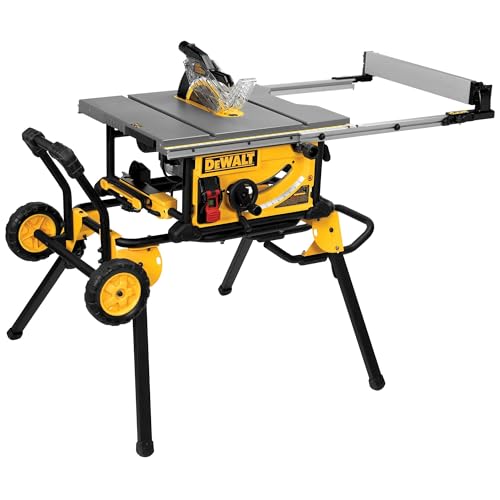
DeWalt DWE7491RS 10" Table Saw with Rolling Stand
Best for: Contractors and serious DIYers who need maximum rip capacity with portability
- Brand
- DeWalt
- Type
- Jobsite table saw with rolling stand
- Power
- Corded
- Voltage
- 120V, 15 Amp
- Weight
- 90 lbs (with stand ~110 lbs)
$599.00Amazon price as of Oct 8, 9:10 AM EDTProduct prices and availability are accurate as of the date/time indicated and are subject to change. Any price and availability information displayed on Amazon.com at the time of purchase will apply to the purchase of this product.
What we like
- Industry-leading 32-1/2" rip capacity handles full sheet goods
- Rack-and-pinion telescoping fence stays accurate cut after cut
- Rolling stand makes transport and storage practical
- Proven design with extensive accessories and parts availability
Watch out for
- Heavy at 90 lbs (saw only), 110+ lbs with stand
- 2-1/2" dust port could be more effective with a 4" option
- Premium price compared to budget jobsite saws
- Stand takes up significant floor space when deployed
Final Thoughts
Table saw safety is not a topic you learn once and forget. I think it is a discipline you practice every time you walk into your shop. The rules are straightforward: use your riving knife, keep your hands away from the blade, use push sticks, wear eye and ear protection, and never cut without proper support for the workpiece.
The 30,000 annual injuries are not happening to reckless people. They are happening to woodworkers who got comfortable, skipped one step, or did not know a particular practice was dangerous. Now you know. In my opinion, the riving knife alone prevents more accidents than any other single piece of safety equipment in your shop. Respect the tool, follow the safety rules without exception, and you will enjoy years of productive, incident-free woodworking.
If you are just getting started with table saws, I recommend pairing this table saw safety guide with my table saw buying guide to choose a saw with the right safety features, and my best table saws roundup for specific model recommendations.
Affiliate Disclosure
This post contains affiliate links. As an Amazon Associate, HomeBuildLab earns from qualifying purchases at no additional cost to you. Learn more
Prices shown are from Amazon at the time indicated and may change. The price and availability on Amazon.com at the time of purchase apply.
Sam Hartwell
Sam Hartwell edits HomeBuildLab's tool reviews and home improvement guides. Every pick starts with manufacturer spec sheets, warranty terms, parts availability and owner feedback, then gets matched to a specific job and budget. Guides list the trade-offs plainly and get updated when models change or go out of stock.
Keep reading: Saws
All saws guides → Comparison
Saws
Table Saw vs Track Saw: Which is Better for Sheet Goods?
Table saw vs track saw: which one handles plywood better? I compare cut quality, safety, price, and portability so you can pick the right saw for your shop.
Updated
 How-To
Saws
How to Use a Table Saw Safely: A Beginner's Guide
Learn how to use a table saw safely with this beginner's guide covering rip cuts, crosscuts, kickback prevention, and the safety rules that matter most.
Updated
 Comparison
Saws
Table Saw vs Miter Saw: Which Do You Actually Need First?
Table saw vs miter saw: I compare cut types, versatility, safety, portability, and price so you can pick the right first saw for your home workshop in 2026.
Updated
 Buying Guide
Saws
Table Saw Buying Guide: What to Look For Before You Buy
This table saw buying guide breaks down types, key specs, fence quality, safety features, and common mistakes so you pick the right saw for your budget.
Updated
 Comparison
Saws
Circular Saw vs Table Saw: The Right First Saw for Beginners
Circular saw vs table saw: which one should you buy first? I compare cost, portability, precision, and safety to help beginners pick the right first saw.
Updated
 Top Picks
Saws
Best Table Saws for Every Workshop: 8 Picks from Jobsite to Cabinet
I compared 8 table saws from budget to premium to find the best table saw for every shop. Honest reviews covering safety, precision, rip capacity, and value.
Updated
The HomeBuildLab newsletter
New guides and tool deals worth knowing about
One short email when we publish or update a buying guide. No spam, unsubscribe anytime.