How to Use a Table Saw Safely: A Beginner's Guide
Learn how to use a table saw safely with this beginner's guide covering rip cuts, crosscuts, kickback prevention, and the safety rules that matter most.
Reader-supported: we may earn a commission when you buy through links on this page, at no extra cost to you. How we research
We don't run a test lab. For each guide we compare manufacturer specs, warranty terms and owner reviews, then match models to specific jobs and budgets. We say when a pick is a trade-off, and every product has cons listed.
As an Amazon Associate, HomeBuildLab earns from qualifying purchases. Read our full affiliate disclosure.

A table saw is the most versatile power tool in any workshop. It rips lumber to width, crosscuts stock to length, handles sheet goods, and cuts joinery like dados and rabbets. Learning how to use a table saw properly is one of the most valuable skills you can develop as a woodworker. But it's also one of the tools that demands the most respect.
Here's the truth: a table saw is only as dangerous as the person operating it. Most accidents come from skipping safety steps, rushing cuts, or using the wrong technique for the material. I'll admit, the first time I turned on a table saw, the noise alone made me pause and rethink what I was doing. That healthy respect is a good thing. From table saw safety data, beginners who learn the fundamentals first and build good habits from day one can use a table saw safely for decades without incident. The ones who skip ahead to "just making cuts" are the ones who end up with close calls.
This guide covers the essential safety rules, the anatomy of your saw, how to make the four most common cuts, kickback prevention, and the beginner mistakes that trip people up. If you're still deciding which saw to buy, check out our table saw buying guide or our best table saws roundup first.
Essential Safety Rules (Before You Start Cutting)
These are non-negotiable. In my opinion, this section is the most important part of the entire guide. Every experienced woodworker follows these rules, and every table saw accident investigation traces back to at least one of them being broken.
Wear safety glasses and ear protection. Flying wood chips and sawdust are a constant. Table saws also produce 95 to 100+ decibels, which is loud enough to cause hearing damage with prolonged exposure. Add a dust mask or respirator if your shop doesn't have a dust collection system.
No loose clothing, jewelry, or dangling cords. Anything that can catch on a spinning blade will catch on a spinning blade. Roll up sleeves, remove rings, tuck in drawstrings, and tie back long hair. Gloves are especially dangerous near a table saw because they can grab the blade and pull your hand in. Never wear them while cutting.
Never reach over or behind the blade. The back of the blade is where kickback originates. Your hands should always be on the infeed side (the side the wood enters from). If an offcut gets stuck near the blade, turn the saw off and wait for the blade to stop completely before retrieving it.
Use the blade guard, riving knife, and anti-kickback pawls. These exist for a reason. For a deeper dive into why these matter, read our full guide to table saw safety. The blade guard keeps your fingers away from the spinning blade. The riving knife prevents the wood from pinching the blade (the number one cause of kickback). The anti-kickback pawls dig into the wood if it starts to move backward. Only remove these for specific operations that truly require it, like dado cuts.
Unplug the saw before changing blades or making adjustments. Power switches can be bumped. Plugs can be pulled. If you're reaching near the blade to swap it out or adjust the riving knife, the saw must be disconnected from power. No exceptions.
Stand to the side, not directly behind the blade. If kickback happens, the workpiece launches straight back from the blade. Your body should be offset to the left of the blade (for right-handed operators). This keeps you out of the kickback zone while still giving you full control of the workpiece.
Know Your Table Saw: Parts and What They Do
Before you make your first cut, take ten minutes to learn what every part of your saw does. Knowing your machine is the foundation of using it safely.
The Table
The flat surface where your workpiece rests. Better saws use cast iron tables, which are heavy but stay flat and absorb vibration. Jobsite saws typically use aluminum, which is lighter but can flex under heavy loads. Keep the table clean, waxed, and free of sawdust so your wood slides smoothly.
The Blade
A standard table saw uses a 10-inch circular blade. Different blades are designed for different cuts. A 24-tooth blade rips quickly along the grain. A 40-tooth combination blade handles both rip cuts and crosscuts reasonably well. A 60 to 80-tooth blade produces the cleanest crosscuts. Start with a quality 40-tooth combination blade and expand from there.
The Rip Fence
The rip fence is a straight guide that locks parallel to the blade. It determines the width of your rip cuts. A good fence stays perfectly parallel and locks firmly with one lever. A bad fence drifts, which causes binding and kickback. I think the fence is the most important part of your table saw. If yours is unreliable, I'd suggest upgrading it before doing anything else.
The Miter Gauge
A miter gauge slides in a slot (called a miter slot) on the table surface. It supports the workpiece during crosscuts and angle cuts. The gauge has a protractor head that adjusts from 0 to 45 degrees (or more) in either direction. For crosscuts, the miter gauge replaces the fence as your guide.
The Blade Guard and Riving Knife
The blade guard is a clear plastic cover that sits over the blade, preventing accidental contact. It attaches to the riving knife, a thin metal plate that sits directly behind the blade and rises and falls with it. The riving knife is your primary defense against kickback because it keeps the cut wood (the kerf) from closing back onto the blade.
Height and Bevel Adjustments
Two handwheels control the blade. One raises and lowers the blade height. The other tilts the blade for bevel cuts (typically 0 to 45 degrees). Always set blade height so the teeth extend about 1/8 to 1/4 inch above the top of your workpiece. This produces cleaner cuts and reduces the risk of kickback compared to running the blade much higher.
How to Make a Rip Cut
A rip cut runs parallel to the grain of the wood. It's the most common table saw operation and the one you'll use to reduce a board's width.
Step 1: Set the rip fence. Measure the distance from the fence to the nearest tooth on the blade that points toward the fence. Lock the fence at your desired width. Double-check the measurement at both the front and back of the blade to confirm the fence is parallel.
Step 2: Set the blade height. Raise the blade so the teeth sit about 1/8 to 1/4 inch above the top surface of your workpiece. This gives the teeth enough exposure to cut cleanly while minimizing the amount of exposed blade.
Step 3: Position yourself and the workpiece. Stand slightly to the left of the blade. Place the workpiece flat on the table with its edge firmly against the fence. The board should contact the fence before it contacts the blade.
Step 4: Turn on the saw and feed the wood. Let the blade reach full speed before you start cutting. Push the workpiece forward at a steady, controlled pace. Don't force it. Let the blade do the work. Keep firm downward and lateral pressure so the board stays flat on the table and tight against the fence throughout the entire cut.
Step 5: Use a push stick for the last 12 inches. As the workpiece approaches the back of the blade, switch to a push stick to finish the cut. What I find most important is this: your fingers should never come within 6 inches of the blade. Push the workpiece completely past the back of the blade and riving knife before reaching for the offcut.
If you're ripping narrow strips (under 3 inches), use a push stick from the very beginning. For very narrow rips (under 1.5 inches), consider a GRR-RIPPER style push block that provides downward pressure, forward pressure, and lateral pressure simultaneously.
How to Make a Crosscut
A crosscut goes across the grain to reduce a board's length. This is where the miter gauge (or a crosscut sled) comes in.
Important rule: never use the rip fence as a guide for crosscuts on short to medium boards. The workpiece can pivot between the fence and the blade, binding against both and causing violent kickback. I can't stress this enough: use the miter gauge or a crosscut sled instead.
Step 1: Set the miter gauge to 90 degrees. Verify the angle with a square if your gauge's markings are hard to read. Slide the miter gauge into the miter slot and ensure it moves smoothly.
Step 2: Mark your cut line. Use a pencil and a square to mark the cut line on your workpiece. Align the mark with the blade, accounting for the blade's kerf (the width of material the blade removes, typically about 1/8 inch).
Step 3: Hold the workpiece firmly against the miter gauge. Press the board tight against the miter gauge face and flat on the table. Your grip should be firm but not white-knuckled. Keep your hands well away from the blade path.
Step 4: Push the miter gauge and workpiece together through the blade. Use a smooth, steady motion. The miter gauge controls the direction. You control the speed. After the cut is complete, pull the miter gauge back and turn off the saw before retrieving the pieces.
For crosscuts on wider panels or for maximum accuracy, a crosscut sled is a major upgrade over a miter gauge. The sled supports the workpiece on both sides of the blade and provides a large, stable reference surface. I'd go as far as saying a crosscut sled should be one of the first jigs you build. Many woodworkers consider it the single most valuable table saw accessory.
How to Cut Bevels and Miters
Bevels and miters add angles to your cuts for joinery, molding, and decorative work. Both use the same saw but in different ways.
Bevel Cuts
A bevel tilts the blade so the cut is angled through the thickness of the board. Most table saws tilt from 0 to 45 degrees.
Turn off the saw and unplug it before adjusting the bevel angle. Use the bevel handwheel to tilt the blade to your desired angle. Verify the angle with a protractor or a digital angle gauge. Reconnect power, then make your cut using the same rip fence or miter gauge technique you'd use for a standard cut.
When bevel ripping (tilting the blade while using the fence), always tilt the blade away from the fence if your saw allows it. This prevents the workpiece from riding up the angled blade and getting trapped between the blade and the fence. On a left-tilt saw, keep the fence on the right side of the blade. On a right-tilt saw, keep the fence on the left.
Miter Cuts
A miter cut angles the workpiece across its face (like cutting the end of a picture frame piece). Set your miter gauge to the desired angle, hold the workpiece firmly against the gauge face, and push through the blade as you would for a standard crosscut.
For compound miters (combining a bevel and a miter at the same time), set both the miter gauge angle and the blade tilt. These cuts are trickier, so practice on scrap wood first. Crown molding and some box joints require compound miters.
Understanding and Preventing Kickback
Kickback is the most dangerous thing that can happen at a table saw. It occurs when the workpiece is caught by the back teeth of the blade and thrown violently toward the operator at speeds that can exceed 100 mph. Kickback injuries range from bruises to broken ribs to severe lacerations.
What causes kickback:
- The kerf closes on the blade. As wood is cut, internal stresses can cause the kerf (the cut gap) to close, pinching the back of the blade. The back teeth then lift and launch the workpiece.
- The workpiece twists away from the fence. If the board pivots during a rip cut, its edge can contact the back teeth at an angle, catching and throwing the piece.
- Using the fence for crosscuts. The offcut can get trapped between the blade and the fence with nowhere to go, causing it to bind and kick.
- Warped or twisted wood. Boards that don't sit flat on the table can rock during a cut, contacting the back teeth unpredictably.
- A misaligned fence. If the back end of the fence angles slightly toward the blade, it pinches the workpiece into the blade as you push it through.
How to prevent kickback:
- Always use the riving knife. this is your single most effective defense against kickback. The riving knife keeps the kerf from closing on the blade. Never remove it unless a specific operation (like a non-through cut with a dado stack) absolutely requires it.
- Keep the blade sharp. Dull blades require more force and are more likely to bind.
- Inspect your wood. Check for warping, twisting, large knots, and embedded nails before cutting. Flatten any bowed boards before ripping them.
- Use featherboards. A featherboard clamped to the table or fence provides constant pressure that keeps the workpiece against the fence and flat on the table, reducing the chance of the board twisting mid-cut.
- Don't force the cut. If the motor bogs down or the wood resists, stop. Check your blade, your fence alignment, and your material before continuing.
- Finish every rip cut. Never stop feeding a board partway through a rip cut and pull it backward. That exposes the back teeth to the workpiece with nothing to prevent a catch.
Common Beginner Mistakes to Avoid
Using the fence and miter gauge together. This traps the offcut between the blade and the fence, which is a recipe for kickback. Use the fence for rip cuts. Use the miter gauge for crosscuts. Not both at the same time.
Removing the blade guard and riving knife. Beginners sometimes remove these because they "get in the way." They get in the way of your fingers reaching the blade. Leave them on. The small inconvenience is worth the protection.
Setting the blade too high. More exposed blade means more potential for contact and more aggressive kickback. Set the teeth 1/8 to 1/4 inch above the workpiece. That's all you need.
Freehand cutting. Never feed a board into the blade without using the fence, miter gauge, or crosscut sled as a guide. Freehand cuts produce crooked results and create unpredictable contact angles that cause kickback.
Reaching across the blade for the offcut. After a rip cut, the offcut sits on the far side of the blade. Turn the saw off, wait for the blade to stop, and then retrieve it. Reaching across a spinning blade is one of the leading causes of table saw injuries.
Ignoring dust collection. Sawdust buildup on the table surface makes boards slide unpredictably. It also reduces visibility of your cut line. Connect a shop vac or dust collector to your saw's dust port, and clean the table surface regularly.
Cutting warped wood without preparation. If a board rocks when you place it on the table, it's not ready for the table saw. Joint one face and one edge first (or use shims on a jointing sled) so the board sits flat and stable during the cut. A circular saw with a straightedge is often a safer choice for initial rough cuts on severely warped boards.
Recommended Accessories
You don't need to spend a fortune to make your table saw safer and more accurate. These accessories provide the biggest improvement for the money.
Push sticks and push blocks. Every table saw comes with at least one basic push stick. Upgrade to a set of purpose-built push sticks and consider a GRR-RIPPER style push block for narrow rip cuts. These provide downward, forward, and lateral pressure simultaneously, giving you far more control than a basic stick.
Featherboards. Magnetic featherboards attach to the table surface instantly and keep the workpiece tight against the fence. They're inexpensive and make a noticeable difference in cut consistency and safety. Place one before the blade (never alongside or after it) to maintain pressure without interfering with the cut.
A crosscut sled. A good crosscut sled replaces the miter gauge for most crosscuts and delivers repeatable, dead-square results. You can buy one or build one from plywood and hardwood runners. Many woodworkers call it the most important jig in the shop. For table saw vs miter saw debates, a crosscut sled closes much of the accuracy gap for crosscuts.
A quality combination blade. The stock blade that ships with most table saws is adequate but not great. I'd suggest swapping it for a 40-tooth thin-kerf combination blade (like a Diablo or Freud), which cuts cleaner, requires less motor effort, and produces less waste. It's a modest expense for a significant upgrade.
An outfeed table or roller stand. Long boards and sheet goods need support behind the saw. Without it, the weight of the overhanging material pulls the workpiece down as it exits, which can cause binding or lift the front of the board off the table. A simple roller stand is inexpensive and prevents this problem entirely.
Compare our picks
2 picks- Best OverallDeWalt DWE7491RS 10" Table Saw with Rolling Stand
DeWalt · Corded · 90 lbs (with stand ~110 lbs)
Contractors and serious DIYers who need maximum rip capacity with portability
$599.00Amazon price as of Oct 7, 11:20 PM EDTProduct prices and availability are accurate as of the date/time indicated and are subject to change. Any price and availability information displayed on Amazon.com at the time of purchase will apply to the purchase of this product.
View on Amazon - Best SafetySawStop CTS-120A60 Compact Table Saw
SawStop · Corded · 68 lbs
Beginners, schools, and anyone who values finger safety above all else
$974.00Amazon price as of Oct 7, 11:20 PM EDTProduct prices and availability are accurate as of the date/time indicated and are subject to change. Any price and availability information displayed on Amazon.com at the time of purchase will apply to the purchase of this product.
View on Amazon
Recommended Tools
Ready to buy? These are the top picks from our best table saw guide.
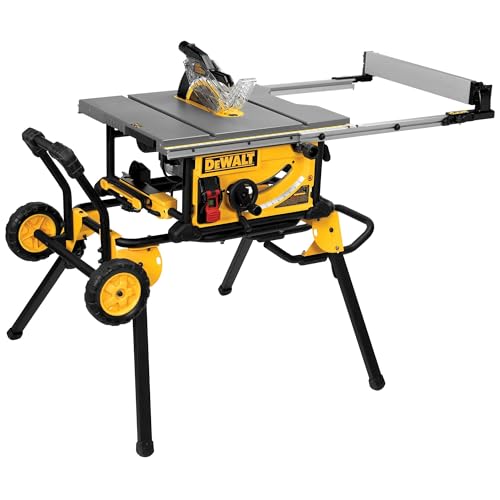
DeWalt DWE7491RS 10" Table Saw with Rolling Stand
Best for: Contractors and serious DIYers who need maximum rip capacity with portability
- Brand
- DeWalt
- Type
- Jobsite table saw with rolling stand
- Power
- Corded
- Voltage
- 120V, 15 Amp
- Weight
- 90 lbs (with stand ~110 lbs)
$599.00Amazon price as of Oct 7, 11:20 PM EDTProduct prices and availability are accurate as of the date/time indicated and are subject to change. Any price and availability information displayed on Amazon.com at the time of purchase will apply to the purchase of this product.
What we like
- Industry-leading 32-1/2" rip capacity handles full sheet goods
- Rack-and-pinion telescoping fence stays accurate cut after cut
- Rolling stand makes transport and storage practical
- Proven design with extensive accessories and parts availability
Watch out for
- Heavy at 90 lbs (saw only), 110+ lbs with stand
- 2-1/2" dust port could be more effective with a 4" option
- Premium price compared to budget jobsite saws
- Stand takes up significant floor space when deployed

SawStop CTS-120A60 Compact Table Saw
Best for: Beginners, schools, and anyone who values finger safety above all else
- Brand
- SawStop
- Type
- Compact table saw with flesh-detection
- Power
- Corded
- Voltage
- 120V, 15 Amp, 1.5 HP
- Weight
- 68 lbs
$974.00Amazon price as of Oct 7, 11:20 PM EDTProduct prices and availability are accurate as of the date/time indicated and are subject to change. Any price and availability information displayed on Amazon.com at the time of purchase will apply to the purchase of this product.
What we like
- Flesh-detection technology stops the blade in under 5 milliseconds
- Peace of mind for beginners learning table saw safety
- Full 10" blade with 3-1/8" depth of cut
- Compact and relatively portable at 68 lbs
Watch out for
- Cannot accept dado blades (major limitation for joinery)
- Premium price for the safety technology
- Brake cartridge must be replaced (and paid for) after each activation
- 24-1/2" rip capacity is modest for the price
Final Thoughts
Learning how to use a table saw is a process, not a single lesson. Start with simple rip cuts in softwood. Build your confidence with the push stick in your hand and the blade guard in place. Graduate to crosscuts, then bevels, then joinery. Every cut teaches you something about how wood behaves and how the saw responds.
The safety rules in this guide aren't suggestions. I believe they're the habits that separate woodworkers who enjoy decades of building from those who end up with a story they'd rather not tell. Use the riving knife. Use push sticks. Stand to the side. Inspect your wood. Never rush.
If you're still shopping for your first saw, our best table saws roundup covers the top picks for every budget, and our table saw buying guide breaks down the specs that actually matter. Already own a table saw and wondering whether you also need a miter saw? Our table saw vs miter saw comparison covers exactly when each tool earns its place in the shop.
Personally, I think the table saw is the tool that turns a casual DIYer into a real woodworker. Take your time, respect the machine, and build something great.
Affiliate Disclosure
This post contains affiliate links. As an Amazon Associate, HomeBuildLab earns from qualifying purchases at no additional cost to you. Learn more
Prices shown are from Amazon at the time indicated and may change. The price and availability on Amazon.com at the time of purchase apply.
Sam Hartwell
Sam Hartwell edits HomeBuildLab's tool reviews and home improvement guides. Every pick starts with manufacturer spec sheets, warranty terms, parts availability and owner feedback, then gets matched to a specific job and budget. Guides list the trade-offs plainly and get updated when models change or go out of stock.
Keep reading: Saws
All saws guides → Comparison
Saws
Table Saw vs Track Saw: Which is Better for Sheet Goods?
Table saw vs track saw: which one handles plywood better? I compare cut quality, safety, price, and portability so you can pick the right saw for your shop.
Updated
 How-To
Saws
Table Saw Safety Tips Every Beginner Needs to Know
Learn critical table saw safety rules every beginner needs. Avoid kickback, use push sticks correctly, and protect yourself from the most common injuries.
Updated
 Comparison
Saws
Table Saw vs Miter Saw: Which Do You Actually Need First?
Table saw vs miter saw: I compare cut types, versatility, safety, portability, and price so you can pick the right first saw for your home workshop in 2026.
Updated
 Buying Guide
Saws
Table Saw Buying Guide: What to Look For Before You Buy
This table saw buying guide breaks down types, key specs, fence quality, safety features, and common mistakes so you pick the right saw for your budget.
Updated
 Comparison
Saws
Circular Saw vs Table Saw: The Right First Saw for Beginners
Circular saw vs table saw: which one should you buy first? I compare cost, portability, precision, and safety to help beginners pick the right first saw.
Updated
 Top Picks
Saws
Best Table Saws for Every Workshop: 8 Picks from Jobsite to Cabinet
I compared 8 table saws from budget to premium to find the best table saw for every shop. Honest reviews covering safety, precision, rip capacity, and value.
Updated
The HomeBuildLab newsletter
New guides and tool deals worth knowing about
One short email when we publish or update a buying guide. No spam, unsubscribe anytime.