Table Saw vs Track Saw: Which is Better for Sheet Goods?
Table saw vs track saw: which one handles plywood better? I compare cut quality, safety, price, and portability so you can pick the right saw for your shop.
Reader-supported: we may earn a commission when you buy through links on this page, at no extra cost to you. How we research
We don't run a test lab. For each guide we compare manufacturer specs, warranty terms and owner reviews, then match models to specific jobs and budgets. We say when a pick is a trade-off, and every product has cons listed.
As an Amazon Associate, HomeBuildLab earns from qualifying purchases. Read our full affiliate disclosure.

If you've ever wrestled a full sheet of 3/4-inch plywood across a table saw, you already know why the table saw vs track saw debate exists. Both tools make straight cuts. Both can rip plywood. But they approach the job in fundamentally different ways, and choosing the wrong one can cost you money, shop space, or (worse) a ruined piece of expensive hardwood plywood.
Here's the short answer: if you need one saw that does everything, get a table saw. If your primary job is breaking down sheet goods and you value portability, a track saw (sometimes called a plunge saw) is the better tool. But there's a lot more nuance worth digging into before you spend $400 to $700.
I spent years doing everything on a table saw before I finally picked up a track saw, and honestly, I wish I'd understood these tradeoffs sooner. This comparison will walk you through the real differences in cut quality, safety, accuracy, price, and space requirements so you can make the right call for your shop.
Key Differences at a Glance
Before we go deep on each category, here's a quick comparison of how these two saws stack up.
| Feature | Table Saw | Track Saw |
|---|---|---|
| Best For | Rip cuts, joinery, repeat cuts | Sheet goods, long straight cuts |
| Cut Depth | Up to 3.5 inches | Up to 2.1 inches |
| Portability | Low (heavy, needs dedicated space) | High (breaks down into saw + rail) |
| Repeatability | Excellent (fence locks in place) | Moderate (requires resetting for each cut) |
| Joinery | Dados, rabbets, grooves, tenons | Limited to through-cuts |
| Safety | Moderate (kickback risk) | High (enclosed blade, no kickback) |
| Price Range | $300 to $3,000+ | $350 to $700 (with track) |
| Sheet Goods | Workable but awkward solo | Purpose-built for this job |
If you want a deeper dive into table saw options, check out our best table saws roundup and our table saw buying guide for help narrowing down models.
Table Saw vs Track Saw for Cutting Sheet Goods
This is where track saws earn their reputation. Cutting a 4x8 sheet of plywood on a table saw is doable, but it requires outfeed support, a helper, or both. You're lifting a heavy, floppy sheet onto the table surface and guiding it through a spinning blade. It works, but it's neither fun nor particularly safe when you're working alone.
A track saw flips the equation. The plywood stays flat on sawhorses or foam insulation boards, and the saw glides across the material on its aluminum guide rail system. You're moving a 10-pound saw instead of an 80-pound sheet. In my opinion, this is the single biggest practical advantage of the track saw: better control, less fatigue, and cleaner cuts.
Track saws also feature splinter guards built into the rail's edge. These rubber strips press down on the wood fibers right at the cut line, virtually eliminating tearout on the top face. For cabinet-grade plywood and melamine, this matters more than you'd think.
Winner for sheet goods: Track saw, and it's not close. I'd pick the track saw for sheet goods every single time.
Rip Cuts and Crosscuts
For ripping boards to width (say, trimming 3/4-inch oak to 3.5 inches for a face frame), the table saw is king. Set the rip fence once, and you can feed board after board through at the exact same width. No measuring, no resetting. From what I have seen about how woodworkers actually use these tools, that repeatability is the table saw's greatest strength.
A track saw can make rip cuts, but each one requires clamping the rail, verifying the measurement, and making the pass. For one or two cuts, that's fine. For 20 identical cuts, it gets tedious quickly.
Crosscuts are a similar story. A table saw with a good crosscut sled handles short crosscuts with precision. A track saw can crosscut boards too, but it really shines on longer cuts across wide panels rather than short, repetitive chops.
For a broader comparison of how the table saw stacks up against other saws for common cuts, see our circular saw vs table saw breakdown.
Cut Quality and Accuracy
Both tools can produce excellent cuts, but the quality depends on different factors for each.
Track saw cut quality is largely determined by the rail. Once the rail is positioned accurately, the cut will be straight and clean every time. The splinter guard on the rail edge prevents tearout, and the plunge mechanism lets you start a cut in the middle of a panel (something a table saw simply cannot do). A good track saw with a quality 48-tooth blade will leave edges clean enough to glue directly.
Table saw cut quality depends on the fence alignment, blade quality, and how you feed the material. A well-tuned cabinet saw with a quality blade produces flawless rip cuts. But cheaper contractor saws with stamped-steel fences can drift, producing cuts that aren't perfectly parallel.
For raw accuracy on a single long cut, I think the track saw has a slight edge because the rail eliminates human error from the equation. For repeatable accuracy across dozens of identical cuts, the table saw wins because the fence doesn't move between cuts.
Safety Comparison
This one isn't even debatable. Track saws are significantly safer.
Table saws account for more workshop injuries than any other power tool. Kickback, where the blade catches the workpiece and throws it back at you, is the primary danger. Even experienced woodworkers respect the table saw's potential to cause serious harm. Technologies like SawStop's flesh-detection system have improved things, but those systems add a significant premium to the price.
Track saws eliminate kickback entirely. The blade is fully enclosed within the housing, the saw plunges down into the material, and the rail prevents the saw from wandering. You can't accidentally touch the blade during operation. And because the workpiece stays stationary, there's no chance of it being thrown back at you.
If you have kids in your shop, share space with beginners, or simply value your fingers, the track saw's safety advantage is worth serious consideration. What I like most about the track saw's design is that safety isn't an add-on feature; it's baked into how the tool works. For more on table saw safety, I have a dedicated guide.
Price and Value
Here's how the most popular track saw models compare to common table saw categories.
| Saw | Type | Price |
|---|---|---|
| Kreg Adaptive Cutting System | Track saw (saw plus guide rail) | Budget ($300 to $400) |
| DeWalt DWS520K | Track saw (saw plus guide rail) | Mid-range ($400 to $600) |
| Makita SP6000J | Track saw (saw plus guide rail) | Mid-range ($400 to $600) |
| Festool TS 55 | Track saw (saw plus guide rail) | Premium ($600 and up) |
| Portable jobsite saws | Table saw | $300 to $600 |
| Contractor saws | Table saw | $600 to $1,200 |
| Hybrid and cabinet saws | Table saw | $1,200 to $3,000+ |
A quality track saw and a decent jobsite table saw land in roughly the same price range ($400 to $600). But the table saw gives you more versatility for that money, while the track saw gives you better portability and sheet good performance.
If your budget only allows one, think about what you cut most often. for general woodworking and home improvement projects, the table saw delivers more bang for the buck. For cabinet work, built-ins, and projects heavy on plywood, the track saw may be the smarter first purchase.
Space and Portability
This is the track saw's other major advantage. A table saw, even a portable jobsite model, takes up a permanent footprint in your shop. A full-size cabinet saw with an outfeed table can eat up a 6x10-foot area. If you're working out of a one-car garage, that's a significant chunk of your space.
A track saw breaks down to a circular saw and an aluminum rail. The rail often splits into two pieces for transport. The entire system fits in a closet, slides under a workbench, or rides in the back seat of your car to a job site. When you're done cutting, your shop floor is completely clear.
For contractors and anyone who moves between locations, a track saw paired with some rigid foam insulation (as a cutting surface) is a complete sheet-cutting station that sets up in minutes and packs away in seconds.
If you're comparing portability across different saw types, our table saw vs miter saw comparison covers similar tradeoffs.
Can a Track Saw Replace a Table Saw?
For some woodworkers, yes. If your projects primarily involve cabinetry, built-in shelving, or furniture built from sheet goods, a track saw handles 80% of what you need. Pair it with a miter saw for crosscuts on dimensional lumber, and you've covered most common cuts without ever needing a table saw.
But here's what a track saw cannot do.
Joinery. Dados, grooves, rabbets, box joints, and tenons all require the table saw (or a router). You can't put a dado stack on a track saw. If you build furniture with traditional joinery, the table saw remains essential.
Repeat rip cuts. Ripping 30 pieces of oak to the same width is a five-minute job on a table saw. On a track saw, it's a 30-minute job with more room for error.
Thick stock. Most track saws max out around 2.1 inches of cut depth. Table saws handle 3 inches or more. If you work with thick hardwoods, the table saw is the only option.
Narrow rip cuts. Ripping strips narrower than about 2 inches is awkward on a track saw because the rail needs enough material on both sides to sit flat. A table saw handles thin rips easily with a push stick.
The honest answer: a track saw can replace a table saw for some people, but it can't match a table saw's versatility. I'd tell most woodworkers to start with a table saw and add a track saw later once you get tired of wrestling sheet goods. I think most serious woodworkers end up owning both, and based on user feedback, that combination is hard to beat.
Our Recommendation
Get a table saw first if: you're building a general-purpose workshop, you do joinery, you rip lumber regularly, or you need one saw that handles the widest range of tasks. The table saw is the workhorse of any woodshop for good reason. Check our table saw buying guide for help choosing the right type and size.
Get a track saw first if: you primarily work with plywood and sheet goods, you have a small shop, you need job-site portability, or your projects are mostly cabinets and built-ins. A track saw paired with a miter saw covers a surprising amount of ground.
Get both if: you can afford it and have the space. The combination of a table saw for ripping, joinery, and repeat cuts, plus a track saw for sheet goods and long precision cuts, is the ideal setup. Many woodworkers buy the table saw first and add the track saw later when they get tired of fighting plywood sheets.
For those still building out their workshop, our circular saw vs table saw comparison can help you decide which cutting tool to prioritize first.
Compare our picks
2 picks- Best OverallDeWalt DWE7491RS 10" Table Saw with Rolling Stand
DeWalt · Corded · 90 lbs (with stand ~110 lbs)
Contractors and serious DIYers who need maximum rip capacity with portability
$599.00Amazon price as of Oct 8, 6:01 AM EDTProduct prices and availability are accurate as of the date/time indicated and are subject to change. Any price and availability information displayed on Amazon.com at the time of purchase will apply to the purchase of this product.
View on Amazon - Best ValueSKIL TS6307-00 15-Amp 10" Portable Jobsite Table Saw
SKIL · Corded · 51 lbs (saw only)
DIYers and hobbyists who want a rack-and-pinion fence without the premium price
$299.00Amazon price as of Oct 8, 6:01 AM EDTProduct prices and availability are accurate as of the date/time indicated and are subject to change. Any price and availability information displayed on Amazon.com at the time of purchase will apply to the purchase of this product.
View on Amazon
Recommended Tools
Ready to buy? These are the top picks from our best table saw guide.
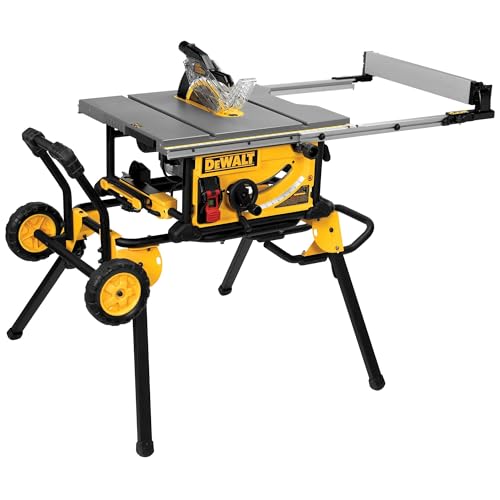
DeWalt DWE7491RS 10" Table Saw with Rolling Stand
Best for: Contractors and serious DIYers who need maximum rip capacity with portability
- Brand
- DeWalt
- Type
- Jobsite table saw with rolling stand
- Power
- Corded
- Voltage
- 120V, 15 Amp
- Weight
- 90 lbs (with stand ~110 lbs)
$599.00Amazon price as of Oct 8, 6:01 AM EDTProduct prices and availability are accurate as of the date/time indicated and are subject to change. Any price and availability information displayed on Amazon.com at the time of purchase will apply to the purchase of this product.
What we like
- Industry-leading 32-1/2" rip capacity handles full sheet goods
- Rack-and-pinion telescoping fence stays accurate cut after cut
- Rolling stand makes transport and storage practical
- Proven design with extensive accessories and parts availability
Watch out for
- Heavy at 90 lbs (saw only), 110+ lbs with stand
- 2-1/2" dust port could be more effective with a 4" option
- Premium price compared to budget jobsite saws
- Stand takes up significant floor space when deployed
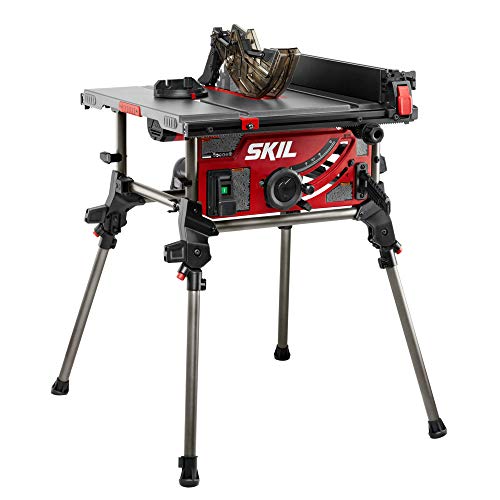
SKIL TS6307-00 15-Amp 10" Portable Jobsite Table Saw
Best for: DIYers and hobbyists who want a rack-and-pinion fence without the premium price
- Brand
- SKIL
- Type
- Portable jobsite table saw with folding stand
- Power
- Corded
- Voltage
- 110V, 15 Amp
- Weight
- 51 lbs (saw only)
- Warranty
- 3-year limited
$299.00Amazon price as of Oct 8, 6:01 AM EDTProduct prices and availability are accurate as of the date/time indicated and are subject to change. Any price and availability information displayed on Amazon.com at the time of purchase will apply to the purchase of this product.
What we like
- Rack-and-pinion fence at this price point is exceptional value
- 3-1/2" depth of cut handles 4x4 lumber in one pass
- Lightest full-size option at 51 lbs for genuine portability
- 3-year warranty is the longest in this roundup
Watch out for
- 25-1/2" rip capacity falls short for full sheet goods
- Folding stand is less robust than dedicated rolling stands
- Limited 5/8" dado capacity
- 4,600 RPM is lower than some competitors
Final Thoughts
If I were setting up a new shop from scratch, I'd buy the table saw first and budget for a track saw six months later. The table saw vs track saw decision ultimately comes down to what you build and where you build it. Neither tool is objectively better. They're designed for different strengths, and understanding those strengths is the key to spending your money wisely.
If I had to pick just one for a homeowner tackling a mix of projects, I'd lean toward the table saw for its versatility. But if someone told me they were building a set of kitchen cabinets in a two-car garage, I'd point them toward a track saw without hesitation.
The good news is that both tools have come down in price over the past few years. A quality track saw from Makita or DeWalt no longer costs Festool money, and a solid jobsite table saw can be had for under $500. Whichever direction you go, you're getting a tool that will pay for itself within a few projects.
Need help choosing a specific model? Browse our best table saws roundup for side-by-side comparisons, specs, and honest pros and cons.
Affiliate Disclosure
This post contains affiliate links. As an Amazon Associate, HomeBuildLab earns from qualifying purchases at no additional cost to you. Learn more
Prices shown are from Amazon at the time indicated and may change. The price and availability on Amazon.com at the time of purchase apply.
Sam Hartwell
Sam Hartwell edits HomeBuildLab's tool reviews and home improvement guides. Every pick starts with manufacturer spec sheets, warranty terms, parts availability and owner feedback, then gets matched to a specific job and budget. Guides list the trade-offs plainly and get updated when models change or go out of stock.
Keep reading: Saws
All saws guides → Comparison
Saws
Table Saw vs Miter Saw: Which Do You Actually Need First?
Table saw vs miter saw: I compare cut types, versatility, safety, portability, and price so you can pick the right first saw for your home workshop in 2026.
Updated
 Comparison
Saws
Circular Saw vs Table Saw: The Right First Saw for Beginners
Circular saw vs table saw: which one should you buy first? I compare cost, portability, precision, and safety to help beginners pick the right first saw.
Updated
 How-To
Saws
Table Saw Safety Tips Every Beginner Needs to Know
Learn critical table saw safety rules every beginner needs. Avoid kickback, use push sticks correctly, and protect yourself from the most common injuries.
Updated
 How-To
Saws
How to Use a Table Saw Safely: A Beginner's Guide
Learn how to use a table saw safely with this beginner's guide covering rip cuts, crosscuts, kickback prevention, and the safety rules that matter most.
Updated
 How-To
Saws
Types of Saws: What Each One Does and Which to Buy First
Learn the different types of saws, what each one does best, and which saw to buy first. A practical guide with honest buying recommendations for beginners.
Updated
 Buying Guide
Saws
Table Saw Buying Guide: What to Look For Before You Buy
This table saw buying guide breaks down types, key specs, fence quality, safety features, and common mistakes so you pick the right saw for your budget.
Updated
The HomeBuildLab newsletter
New guides and tool deals worth knowing about
One short email when we publish or update a buying guide. No spam, unsubscribe anytime.