Jigsaw Blade Types Explained: How to Pick the Right One for Every Cut
Not sure which jigsaw blade types you need? This guide covers blade materials, TPI ratings, and tooth geometry so you pick the right blade every time.
Reader-supported: we may earn a commission when you buy through links on this page, at no extra cost to you. How we research
We don't run a test lab. For each guide we compare manufacturer specs, warranty terms and owner reviews, then match models to specific jobs and budgets. We say when a pick is a trade-off, and every product has cons listed.
As an Amazon Associate, HomeBuildLab earns from qualifying purchases. Read our full affiliate disclosure.

Most people spend weeks choosing a jigsaw and about five seconds choosing the blade. That's backwards. In my opinion, understanding the different jigsaw blade types is the most overlooked skill in any workshop. The blade determines the quality of every cut you make. A mid-range jigsaw with the wrong blade will splinter, wander, and overheat, while even a budget saw with the right blade produces clean, controlled results.
Honestly, I wish someone had explained this to me before I burned through a dozen blades on my first plywood project. Understanding jigsaw blade types is the single fastest way to improve your cuts. The differences come down to four things: shank style, blade material, teeth per inch (TPI), and tooth geometry. Get those right and your jigsaw handles wood, metal, tile, laminate, and plastic with precision. Get them wrong and you burn through blades, ruin workpieces, and blame the saw for problems the blade caused.
This guide breaks down every variable so you can pick the right blade for any material. If you're still shopping for the saw itself, check out our best jigsaws roundup first.
Quick Picks: Jigsaw Blades Worth Buying
Each pick is covered in detail at the end of this guide.
- Best Starter Set: Bosch T5002. Ten blades covering clean wood, fast wood, scrolling, and metal. Check price|Review
- Best Big Assortment: Diablo DJT20S. Twenty blades in HCS, HSS, and bi-metal for wood, metal, and plastic. Check price|Review
- Best Value Set: DeWalt DW3742C. Fourteen T-shank blades with a storage case at a low price. Check price|Review
- Best for Laminate: Diablo DJT505. Fine-tooth bi-metal blades built for abrasive laminate. Check price|Review
- Best for Tile: Bosch T130RF1. Carbide grit for ceramic tile and notches around outlets. Check price|Review
Compare our picks
6 picks- Best Starter SetBosch T5002 10-Piece T-Shank Jig Saw Blade Set
Bosch
New jigsaw owners who want one of each common blade type
$15.98Amazon price as of Oct 7, 10:23 PM EDTProduct prices and availability are accurate as of the date/time indicated and are subject to change. Any price and availability information displayed on Amazon.com at the time of purchase will apply to the purchase of this product.
View on Amazon - Best Big AssortmentDiablo DJT20S 20-Piece T-Shank Jig Saw Blade Set
Diablo
Regular jigsaw users who want spares of every type, including bi-metal
$25.97Amazon price as of Oct 7, 10:23 PM EDTProduct prices and availability are accurate as of the date/time indicated and are subject to change. Any price and availability information displayed on Amazon.com at the time of purchase will apply to the purchase of this product.
View on Amazon - Best Value SetDeWalt DW3742C 14-Piece T-Shank Jig Saw Blade Set
DeWalt
DIYers who want a solid wood-and-metal assortment with a case at a low price
$19.98Amazon price as of Oct 7, 10:23 PM EDTProduct prices and availability are accurate as of the date/time indicated and are subject to change. Any price and availability information displayed on Amazon.com at the time of purchase will apply to the purchase of this product.
View on Amazon - Best for LaminateDiablo DJT505 Bi-Metal Jig Saw Blade Set for Laminate
Diablo
Cutting laminate countertops, laminate flooring, and melamine
$11.86Amazon price as of Oct 7, 10:23 PM EDTProduct prices and availability are accurate as of the date/time indicated and are subject to change. Any price and availability information displayed on Amazon.com at the time of purchase will apply to the purchase of this product.
View on Amazon - Best for TileBosch T130RF1 Carbide Grit Jig Saw Blade
Bosch
Curved cuts and notches in ceramic tile and other abrasive materials
$9.15Amazon price as of Oct 7, 10:23 PM EDTProduct prices and availability are accurate as of the date/time indicated and are subject to change. Any price and availability information displayed on Amazon.com at the time of purchase will apply to the purchase of this product.
View on Amazon - DeWalt DCS334B 20V MAX XR Cordless Jig Saw (If You Still Need the Saw)
DeWalt · Cordless (20V MAX, battery sold separately) · 5.2 lbs (tool only)
Woodworkers and DIYers who want cordless freedom without sacrificing cut quality
$138.11Amazon price as of Oct 7, 10:23 PM EDTProduct prices and availability are accurate as of the date/time indicated and are subject to change. Any price and availability information displayed on Amazon.com at the time of purchase will apply to the purchase of this product.
View on Amazon
T-Shank vs U-Shank: Why T-Shank Won
The shank is the top of the blade that locks into your jigsaw. Two styles exist: T-shank and U-shank.
T-shank blades have a flat tang shaped like the letter "T." They lock into a spring-loaded clamp on the saw, which means tool-free blade changes. You press a lever, pop the blade out, slide a new one in, and you're cutting again in seconds. Every major manufacturer (Bosch, DeWalt, Makita, Milwaukee) builds their current jigsaws around the T-shank system.
U-shank blades have a rounded notch shaped like the letter "U." They require a setscrew and often an Allen key to install. Changing blades takes longer and involves small hardware that's easy to lose on a jobsite.
Here's the bottom line: if your jigsaw was made in the last 15 years, it almost certainly uses T-shank blades. U-shank is an older standard found on vintage and budget models. Many jigsaws that accept U-shank blades also accept T-shank, but the reverse is not true. I'd suggest buying T-shank every time unless you know your saw specifically requires U-shank.
The T-shank design also provides a more secure grip. The blade seats deeper into the clamp, which reduces vibration and lateral blade wander during cuts. That translates to straighter lines and less fatigue over a long day of cutting.
Jigsaw Blade Materials
The material a blade is made from determines what it can cut, how long it lasts, and how much it costs. Four materials cover virtually every application.
HCS (High Carbon Steel)
HCS blades are the most affordable and most common option for wood cutting. The carbon steel is relatively soft and flexible, which means the blade can handle curves without snapping. That flexibility also makes HCS blades forgiving for beginners who haven't developed steady feed pressure yet.
The downside is durability. HCS teeth dull faster than other blade materials, especially in hardwoods, plywood, and any material with adhesive (like particleboard or OSB). For softwood framing, trim work, and general-purpose wood cutting, HCS blades are a great value. Just expect to swap them out more often.
HSS (High Speed Steel)
HSS blades use a harder, more heat-resistant alloy than HCS. The teeth hold an edge longer, especially in tougher materials. HSS is the traditional choice for cutting non-ferrous metals (aluminum, copper, brass) and thin sheet metal.
The trade-off is flexibility. HSS is stiffer and more brittle than HCS. Aggressive curves can snap the blade, and the stiffer body transmits more vibration to the saw. For straight cuts and gentle curves in metal and hard materials, HSS performs well. For tight-radius work, look elsewhere.
BIM (Bi-Metal)
Bi-metal blades combine the best properties of both HCS and HSS. The blade body is made from flexible high carbon steel, while the cutting teeth are welded from high speed steel. You get a blade that flexes without breaking and cuts hard materials without dulling quickly.
BIM blades last roughly twice as long as HSS and up to ten times longer than HCS in demanding applications. They handle wood, metal, plastic, and nail-embedded lumber. If I could only buy one type of jigsaw blade, it would be bi-metal every time. For most users who want one blade material to cover multiple tasks, bi-metal is the smart default. Bosch, DeWalt, and Diablo all offer excellent bi-metal jigsaw blade sets. The slightly higher price per blade pays for itself in longevity.
Carbide Grit and Carbide Tipped
Carbide blades come in two forms. Carbide-tipped blades have individual tungsten carbide teeth brazed onto a steel body. They're designed for dense materials like stainless steel, fiber cement board, and hardwood flooring. Carbide-grit blades replace traditional teeth entirely with a coating of tungsten carbide particles along the cutting edge. These handle ceramics, tile, fiberglass, and glass.
Carbide blades cost significantly more than other types, but their edge life is exceptional. A carbide-tipped blade can outlast a bi-metal blade by 50x in abrasive materials. If you're cutting tile, cement board, or stainless steel, carbide is the only practical option.
Understanding TPI (Teeth Per Inch)
TPI, or teeth per inch, is the single most important number on a jigsaw blade label. What I find most important is understanding how TPI controls the balance between cutting speed and cut quality.
| TPI Range | Cut Character | Best For |
|---|---|---|
| Low (6 to 10) | Fewer, larger teeth remove material quickly but leave a rougher edge | Fast cuts in wood, where speed matters more than finish quality |
| Medium (10 to 18) | A balance of speed and smoothness | Plywood, hardwood, and general woodworking (most wood-cutting blades fall in the 10 to 12 TPI range) |
| High (18 to 36) | More teeth produce smoother, slower cuts | Metal cutting: 24 to 36 TPI for thin sheet metal (under 1/8"), 14 to 18 TPI for thicker metal (1/8" to 1/4") |
A 6 TPI blade rips through 2x lumber fast, but the edge will need sanding. For metal, at least three teeth must be in contact with the material at all times to prevent blade stripping, which is why metal blades sit at the high end of the range.
Here's the practical rule: match the TPI to the material thickness. Thick, soft materials need low TPI for chip clearance. Thin, hard materials need high TPI for smooth, controlled cuts. If only three or fewer teeth are touching the material, the blade catches and jerks, creating a dangerous cut and a ragged edge.
Jigsaw Blade Types by Material
Knowing the blade material and TPI narrows your choices. Here's what to use for the most common cutting tasks.
Wood
Wood is the most common jigsaw material, and blade selection varies by task. I think this is where most beginners go wrong: they grab one blade and use it for everything. For rough cuts in framing lumber and softwoods, use an HCS or BIM blade with 6 to 8 TPI. For clean cuts in hardwood and plywood, step up to 10 to 12 TPI. For extra-smooth cuts in finish work, use a fine-tooth blade at 12 to 15 TPI.
Tooth geometry matters here too. Standard upward-cutting teeth (the most common design) cut on the upstroke, which means splintering happens on the top face of the workpiece. If the visible face will be on top, use a reverse-tooth or down-cut blade instead (more on that in the specialty blades section below).
For curved cuts, choose a narrower blade. Standard-width blades (around 3/8") handle gentle curves. For tight radius work, use a scrolling blade (1/4" wide or narrower). If straight cuts are giving you trouble, our guide on how to cut straight with a jigsaw covers the technique in detail.
Metal
For metal cutting, use an HSS or bi-metal jigsaw blade with 18 to 36 TPI depending on the metal thickness. Bi-metal is the better choice for most users because the flexible body handles the vibration of metal cutting without snapping.
Aluminum requires a different approach. A coarser blade (8 to 12 TPI) works better for aluminum because the soft metal clogs fine teeth. Bosch makes a dedicated aluminum-cutting blade (T127DF) with 8 TPI geometry optimized for chip clearance.
For sheet metal under 18 gauge, use 24 to 36 TPI. For steel and stainless steel up to 1/4" thick, 14 to 21 TPI works best. From user feedback, always use cutting oil or lubricant to extend blade life and reduce heat buildup. It makes a noticeable difference in blade longevity.
Tile and Ceramic
Tile, ceramic, and stone require carbide-grit blades. These blades have no traditional teeth. Instead, they use a rough coating of tungsten carbide particles that grinds through hard, brittle materials without cracking them.
A jigsaw is not the primary tool for tile work (a wet tile saw handles most jobs better), but it's invaluable for curved cuts, notches around outlets, and irregular shapes that a tile saw can't manage. Go slow, use light pressure, and keep the blade wet if possible to reduce dust and extend blade life.
Laminate and Plastic
Laminate countertops, melamine, and plastic panels all share the same problem: they chip and splinter easily on the surface closest to the blade's upstroke. The solution is a reverse-tooth blade (also called a down-cut blade) with fine teeth (10 to 14 TPI). The downward-pointing teeth cut into the top surface instead of pulling away from it, producing a chip-free edge.
For plexiglass, acrylic, and PVC pipe, use a fine-tooth blade (12 to 20 TPI) with a slow feed rate. Excessive speed generates heat, which melts plastic and welds the cut shut behind the blade.
Specialty Blades
Beyond the standard jigsaw blade types above, a few specialty options solve specific problems.
Scroll Blades
Scroll blades are narrower than standard jigsaw blades, typically 1/4" wide or less. The narrow body allows tight-radius curves, intricate shapes, and detailed cutouts. They're essential for decorative work, sink cutouts, and any pattern that requires turning corners. If you enjoy the kind of intricate work a scroll saw handles, scroll jigsaw blades let you tackle similar curves on larger workpieces.
The trade-off is straight-line accuracy. Narrow blades wander more easily, so they're not ideal for long rip cuts or straight edges. For straight cuts in general, a wider blade (or a circular saw for long cuts) is the better choice.
Reverse-Tooth Blades
Reverse-tooth blades (or down-cut blades) have teeth that point downward instead of upward on the lower portion of the blade. Standard jigsaw blades cut on the upstroke, which splinters the top surface of the workpiece. Reverse-tooth blades push the material downward as they cut, producing a clean, chip-free edge on the visible face.
Use reverse-tooth blades whenever the top surface is the "show side," especially for laminate countertops, veneered plywood, and melamine. The cut will be slightly slower than a standard blade, but the finish is dramatically cleaner.
Flush-Cut Blades
Flush-cut blades extend past the front of the jigsaw's shoe, allowing you to cut right up against a perpendicular surface. They're handy for trimming dowels, removing flooring against a wall, and any task where the saw body would otherwise prevent the blade from reaching the cut line.
How to Choose the Right Jigsaw Blade Type: Quick Reference
With so many jigsaw blade types available, standing in the blade aisle (or scrolling through Amazon) can feel overwhelming. Use this framework:
- Identify the material. Wood, metal, tile, or plastic?
- Choose the blade material. HCS for wood, HSS for metal, BIM for multi-material, carbide for tile and abrasive materials.
- Match the TPI. Low (6 to 10) for fast, rough wood cuts. Medium (10 to 18) for clean wood and plastic. High (18 to 36) for metal.
- Consider tooth direction. Standard (upcut) for most work. Reverse-tooth for laminate and show surfaces.
- Check the width. Standard width for straight cuts. Narrow/scroll width for tight curves.
If you're just getting started, I'd suggest picking up a multi-pack from Bosch (T5002), DeWalt (DW3742C), or Diablo (DJT20S). These sets include wood, metal, and multi-purpose blades in the most common TPI ranges, all in T-shank format. A good set costs $15 to $30 and handles 90% of what you'll throw at a jigsaw. All three are compared in the picks section below.
For more on choosing between a jigsaw and other cutting tools, see our comparison of jigsaws vs reciprocating saws and our overview of different types of saws.
Jigsaw Blade Picks for Every Situation
Blades are cheap, so the smart move is one good assortment plus a specialty pack for whatever material your next project involves. Here's what I'd buy based on the materials, TPI ranges, and tooth styles covered above.

Bosch T5002 10-Piece T-Shank Jig Saw Blade Set
Best for: New jigsaw owners who want one of each common blade type
- Brand
- Bosch
- Type
- T-shank jigsaw blade assortment (10 pieces)
- Material
- High carbon steel (wood) and high speed steel (metal)
$15.98Amazon price as of Oct 7, 10:23 PM EDTProduct prices and availability are accurate as of the date/time indicated and are subject to change. Any price and availability information displayed on Amazon.com at the time of purchase will apply to the purchase of this product.
What we like
- Covers clean wood, fast wood, scroll, and two metal thicknesses
- Bosch T-shank fits nearly every current jigsaw
- Storage case keeps blades organized by type
Watch out for
- Only two of each blade, so wood blades run out first
- No bi-metal or reverse-tooth blades
This set maps almost perfectly to the "by material" section of this guide. You get two each of the T101B (clean cuts in wood), T144D (fast cuts in wood), T119BO (scrolling curves), T118A (thin metal), and T118B (thicker metal). That's every common job covered in a case that keeps them sorted.
Bosch invented the T-shank, and its blade numbering is the one other brands copy. Once you learn which number you like, reordering is easy. The only thing missing is a bi-metal option, which is why I'd pair it with a bi-metal pack later.

Diablo DJT20S 20-Piece T-Shank Jig Saw Blade Set
Best for: Regular jigsaw users who want spares of every type, including bi-metal
- Brand
- Diablo
- Type
- T-shank jigsaw blade assortment (20 pieces)
- Material
- High carbon steel, high speed steel, and bi-metal
$25.97Amazon price as of Oct 7, 10:23 PM EDTProduct prices and availability are accurate as of the date/time indicated and are subject to change. Any price and availability information displayed on Amazon.com at the time of purchase will apply to the purchase of this product.
What we like
- Includes bi-metal blades, the best all-around material
- Twenty blades means spares of the types you use most
- Covers wood, nail-embedded wood, metal, and plastic
Watch out for
- Priciest assortment here
- No carbide-grit blade for tile
Earlier I said that if I could only buy one blade material, it would be bi-metal. This set gives you bi-metal blades for clean wood, nail-embedded wood, metal, and plastic, plus HCS blades for softwood and HSS blades for metal. Twenty pieces means you're not stuck when one dulls mid-project.
It costs a few dollars more than the Bosch or DeWalt sets but roughly doubles the blade count. If you use your jigsaw more than a few times a year, it's the better buy.

DeWalt DW3742C 14-Piece T-Shank Jig Saw Blade Set
Best for: DIYers who want a solid wood-and-metal assortment with a case at a low price
- Brand
- DeWalt
- Type
- T-shank jigsaw blade assortment (14 pieces)
- Material
- High carbon steel and bi-metal
$19.98Amazon price as of Oct 7, 10:23 PM EDTProduct prices and availability are accurate as of the date/time indicated and are subject to change. Any price and availability information displayed on Amazon.com at the time of purchase will apply to the purchase of this product.
What we like
- Fourteen blades for about the same price as the Bosch ten-pack
- Strong coverage of 6 and 10 TPI wood blades
- Clear storage case
Watch out for
- Fewer fine-tooth options for finish work
- No scroll or reverse-tooth blades
This set leans toward wood, with 6 and 10 TPI blades for the fast and medium cuts covered in the TPI section, plus metal-cutting blades for sheet metal and pipe. Fourteen blades in a clear case is a lot of cutting for the money.
It's a good match for a DeWalt jigsaw, but the T-shank fits Bosch, Makita, Milwaukee, and most other current saws too. If most of your cuts are in plywood and dimensional lumber, this is the set to start with.

Diablo DJT505 Bi-Metal Jig Saw Blade Set for Laminate
Best for: Cutting laminate countertops, laminate flooring, and melamine
- Brand
- Diablo
- Type
- T-shank bi-metal laminate blades (5 pieces)
- Material
- Bi-metal
$11.86Amazon price as of Oct 7, 10:23 PM EDTProduct prices and availability are accurate as of the date/time indicated and are subject to change. Any price and availability information displayed on Amazon.com at the time of purchase will apply to the purchase of this product.
What we like
- Bi-metal holds up to abrasive laminate
- Two tooth counts (14 and 20 TPI) for general and fine cuts
- Inexpensive way to protect an expensive countertop
Watch out for
- Only five blades
- Specialty pack, not useful for general wood cutting
As the laminate section explained, laminate is abrasive and chips easily, which dulls cheap blades fast. This pack gives you three 14 TPI blades for general laminate cuts and two 20 TPI blades for finer, tighter work, all in bi-metal that Diablo rates for much longer life in laminate than standard blades.
For a sink cutout or a countertop that has to look perfect, tape the cut line and cut from the back side when you can. If you need true reverse-tooth blades for veneered plywood, look for the Bosch T101BR or Diablo DJT101BR5.

Bosch T130RF1 Carbide Grit Jig Saw Blade
Best for: Curved cuts and notches in ceramic tile and other abrasive materials
- Brand
- Bosch
- Type
- T-shank carbide grit blade
- Material
- 30-grit carbide edge
- Size
- 3-1/4" length
$9.15Amazon price as of Oct 7, 10:23 PM EDTProduct prices and availability are accurate as of the date/time indicated and are subject to change. Any price and availability information displayed on Amazon.com at the time of purchase will apply to the purchase of this product.
What we like
- Cuts curves and notches a tile saw can't
- Carbide grit lasts far longer than toothed blades in tile
- T-shank fits every current jigsaw in our roundup
- Low cost for a specialty blade
Watch out for
- Slow cutting, even with good technique
- Specialty blade, so keep a spare for bigger jobs
This is the carbide-grit blade described in the tile section: no teeth, just a coarse 30-grit edge of carbide particles that grinds through ceramic instead of cracking it. Bosch designed it specifically for ceramics, and it's the blade for notching tile around outlets, pipes, and toilet flanges where a tile saw can't reach.
Go slow and turn off orbital action. Pushing hard or running at full orbit is the fastest way to crack a tile or overheat the grit edge.
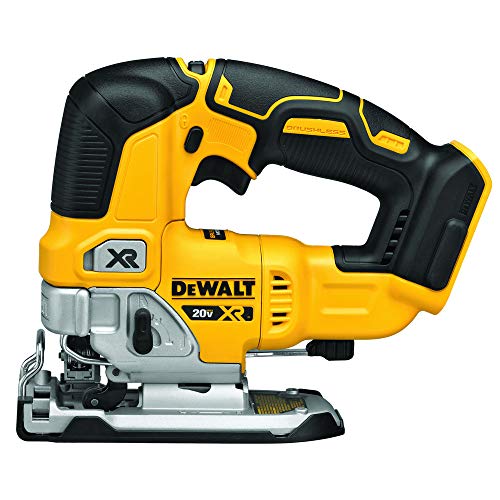
DeWalt DCS334B 20V MAX XR Cordless Jig Saw (If You Still Need the Saw)
Best for: Woodworkers and DIYers who want cordless freedom without sacrificing cut quality
- Brand
- DeWalt
- Type
- Cordless top-handle jigsaw
- Power
- Cordless (20V MAX, battery sold separately)
- Voltage
- 20V MAX
- Weight
- 5.2 lbs (tool only)
$138.11Amazon price as of Oct 7, 10:23 PM EDTProduct prices and availability are accurate as of the date/time indicated and are subject to change. Any price and availability information displayed on Amazon.com at the time of purchase will apply to the purchase of this product.
What we like
- Brushless motor delivers excellent runtime
- All-metal keyless blade clamp with lever-action for fast changes
- LED work light and dust blower keep the cut line visible
Watch out for
- Battery and charger sold separately (a real added cost if you're new to 20V MAX)
- 5.2 lbs (tool only) gets heavier with a battery attached
If you're buying blades for a saw you don't own yet, this is the jigsaw I'd pair them with. It's our top pick in the best jigsaw roundup, with a brushless motor, tool-free T-shank blade clamp, and an LED plus dust blower that keep the cut line visible.
The lever-action blade clamp makes swapping between the specialty blades above take seconds, which is exactly how this guide suggests you work.
Final Thoughts
I believe understanding jigsaw blade types turns a frustrating tool into a versatile one. The jigsaw itself provides the power and orbital action, but the blade does the actual cutting. Matching the right blade material, TPI, and tooth geometry to your workpiece is the difference between clean results and splintered, burned edges.
Start with a quality bi-metal assortment pack and add specialty blades as your projects demand them. Pick up a set of carbide-grit blades if you work with tile. Keep a few reverse-tooth blades in the drawer for laminate and veneer. And always have extra wood-cutting blades on hand, because they're the ones you'll use (and wear out) most often.
The blade is a consumable. I keep a bin of fresh blades next to my jigsaw so there's never a reason to push a dull one. Don't try to stretch a dull blade for "just one more cut." Swap it. A fresh blade is safer, faster, and produces a better result every time.
Affiliate Disclosure
This post contains affiliate links. As an Amazon Associate, HomeBuildLab earns from qualifying purchases at no additional cost to you. Learn more
Prices shown are from Amazon at the time indicated and may change. The price and availability on Amazon.com at the time of purchase apply.
Sam Hartwell
Sam Hartwell edits HomeBuildLab's tool reviews and home improvement guides. Every pick starts with manufacturer spec sheets, warranty terms, parts availability and owner feedback, then gets matched to a specific job and budget. Guides list the trade-offs plainly and get updated when models change or go out of stock.
Keep reading: Saws
All saws guides → How-To
Saws
How to Cut a Straight Line with a Jigsaw: Tips That Actually Work
Learn how to cut straight with a jigsaw using the right blade, a guide fence, and proper technique. Practical tips to eliminate blade wander for good.
Updated
 Comparison
Saws
Jigsaw vs Reciprocating Saw: Picking the Right Blade for the Job
Jigsaw vs reciprocating saw: one cuts curves with precision, the other tears through walls. Learn which saw fits your projects and when you need both.
Updated
 Top Picks
Saws
Best Reciprocating Saws: The Must-Have Demolition Tool for 2026
I compared 7 of the best reciprocating saws from budget kits to pro models. Find the right sawzall for demolition, remodeling, and pruning in my buying guide.
Updated
 Top Picks
Saws
Best Jigsaws in 2026: Corded and Cordless Picks for Curves and Cutouts
I compared the 7 best jigsaw models from budget to pro-grade. See which ones cut smoothest, handle curves best, and deliver real value for DIYers and pros.
Updated
 Comparison
Saws
Table Saw vs Track Saw: Which is Better for Sheet Goods?
Table saw vs track saw: which one handles plywood better? I compare cut quality, safety, price, and portability so you can pick the right saw for your shop.
Updated
 How-To
Saws
How to Cut Crown Molding with a Miter Saw: A Step-by-Step Guide
Learn how to cut crown molding with a miter saw using the nested method. Step-by-step guide to inside corners, outside corners, coped joints, and pro tips.
Updated
The HomeBuildLab newsletter
New guides and tool deals worth knowing about
One short email when we publish or update a buying guide. No spam, unsubscribe anytime.