How to Cut a Straight Line with a Jigsaw: Tips That Actually Work
Learn how to cut straight with a jigsaw using the right blade, a guide fence, and proper technique. Practical tips to eliminate blade wander for good.
Reader-supported: we may earn a commission when you buy through links on this page, at no extra cost to you. How we research
We don't run a test lab. For each guide we compare manufacturer specs, warranty terms and owner reviews, then match models to specific jobs and budgets. We say when a pick is a trade-off, and every product has cons listed.
As an Amazon Associate, HomeBuildLab earns from qualifying purchases. Read our full affiliate disclosure.

Jigsaws are built for curves. That flexible, thin blade is what makes them so versatile, but it is also why cutting a straight line feels like wrestling a shopping cart with a bad wheel. If you have ever wondered how to cut straight with a jigsaw, you are not alone. I spent years blaming my jigsaw before realizing the problem was my technique and blade choice, not the tool. It is one of the most common frustrations for DIYers and even some experienced woodworkers.
Here is the good news: a jigsaw can absolutely make clean, straight cuts. You just need to understand why the blade wanders in the first place, then stack a few simple techniques in your favor. From what I have seen about what actually separates clean cuts from wavy ones, I think it comes down to four things. In this guide, we will walk through the root causes of crooked cuts, the right blade choices, how to set up a guide, and the technique adjustments that make the biggest difference.
Why Jigsaw Cuts Wander
Before you can fix the problem, you need to understand it. Jigsaw blade wander comes down to three main culprits.
The blade is thin and flexible. Unlike a circular saw blade or a table saw blade, a jigsaw blade is narrow and unsupported along most of its length. Any lateral force, even slight hand pressure to one side, causes the blade to deflect. This is especially pronounced in thicker materials where the blade has more room to flex.
You are pushing too hard. This is the single most common cause. When you force the saw forward faster than the blade can cut, the blade bends backward in the kerf. The top of the cut may look fine, but the bottom angles away from your line. The result is a beveled edge that looks straight from above but is angled underneath.
Orbital action is too aggressive. Most modern jigsaws have an orbital action setting that moves the blade in an elliptical pattern for faster cuts. While useful for rough work, this setting increases vibration and encourages the blade to drift. For straight, precise cuts, it works against you.
Other factors include a dull blade, a loose or misaligned base plate, and worn blade guides inside the saw. If your jigsaw is older, check these components before blaming your technique.
Choose the Right Blade
Blade selection is half the battle when learning how to cut straight with a jigsaw. Not all blades are created equal, and using the wrong one is a guaranteed path to frustration.
Go with a thicker blade. In my opinion, this is the single most overlooked fix. Thicker blades resist lateral deflection far better than thin scroll-cutting blades. For straight cuts in wood, look for blades with a wider body profile. The Bosch T101B (10 TPI) is a popular choice for clean, straight cuts in wood and plywood.
Match the TPI to your material. For general wood cutting, 8 to 12 teeth per inch (TPI) offers a good balance of speed and cut quality. Higher TPI blades (12 or more) give you cleaner edges but cut slower. Lower TPI blades (6 to 8) cut faster but leave a rougher edge. For plywood and laminate, lean toward higher TPI to minimize tear-out. Our jigsaw blade types guide covers the full range of options.
Use T-shank blades. If your jigsaw accepts T-shank blades (most modern jigsaws do), always use them. T-shank blades lock in more securely than U-shank blades, reducing play and vibration at the connection point.
Replace dull blades immediately. A dull blade requires more forward pressure, which causes more deflection. Jigsaw blades are inexpensive. Swap them out at the first sign of resistance or burning. If you are shopping for a new jigsaw that handles blade changes well, check out our best jigsaws roundup.
Use a Straight Edge Guide
Here is the truth: freehand straight cuts with a jigsaw are unreliable, even for experienced users. The most effective way to get a consistently straight jigsaw cut is to use an external guide. This removes the variable of human steering almost entirely.
Clamp a straight board to your workpiece. This is the simplest and cheapest jigsaw guide method. Take a piece of straight lumber, a metal straightedge, or even a factory edge from a sheet of plywood, and clamp it parallel to your cut line. Run the flat edge of the jigsaw's base plate against the guide as you cut.
Measure the offset. The blade does not sit at the edge of the base plate. Measure the distance from the blade to the edge of the base plate that will ride against the guide. Add this offset to your measurement when positioning the guide. For example, if your cut line is 12 inches from the edge and your base plate offset is 1.5 inches, clamp the guide at 13.5 inches.
Use two clamps minimum. One clamp at each end of the guide prevents it from shifting during the cut. For longer cuts, add a clamp in the middle. If the guide moves even slightly, your cut will show it.
Apply pressure toward the guide, not forward. While cutting, use your off-hand to gently press the saw's base plate against the straight edge fence. This keeps the saw tracking along the guide. Avoid pressing too hard laterally, as that can cause the blade to bind. The goal is light, consistent contact.
You can also buy dedicated jigsaw guide rails from brands like Kreg and Milescraft. These work well, but I'd suggest starting with a clamped straight board before spending money on accessories. It does the same job for free, and you will learn proper technique faster without relying on specialty gear.
Speed and Orbital Settings for Straight Cuts
Your jigsaw's settings matter more than most people realize. Getting them right is a simple adjustment that pays off immediately.
Set orbital action to zero (or low). For precise straight cuts, turn the orbital action dial to 0. This was the single biggest improvement I made to my jigsaw results. It gives you a pure up-and-down stroke with minimal lateral blade movement. You will cut slower, but the blade tracks much more predictably. If you are cutting softwood and need a bit more speed, setting 1 is a reasonable compromise.
Use medium speed, not full throttle. Cranking the speed dial to maximum feels productive, but it increases vibration and makes the blade harder to control. A medium speed setting (around 60 to 75 percent of maximum) gives the teeth enough time to clear waste while keeping things manageable. For hardwoods and metals, go even slower.
Let the material dictate your pace. Softwoods like pine can tolerate faster feed rates. Hardwoods, plywood, and sheet goods need a slower, steadier approach. Laminate and melamine are especially unforgiving, so slow down and use a fine-tooth blade for these materials.
The general rule: if you hear the motor bogging down or see burn marks on the cut edge, you are pushing too fast. Back off and let the blade work at its own speed. I think patience here is what separates good jigsaw results from mediocre ones.
Technique to Cut Straight with a Jigsaw: Let the Blade Work
Even with the right blade and a guide in place, poor technique can still ruin a straight cut. Here are the habits that separate clean results from wavy edges.
Keep the base plate flat. The base plate (also called the shoe) must sit flush against the workpiece surface at all times. Any tilt introduces a bevel to your cut. Press down firmly with steady, even pressure. If you notice the saw rocking, slow down and check that nothing is obstructing the base plate.
Guide with your body, not your wrist. What I find most important is body positioning. Stand so your forearm is aligned with the cut direction. Push from your shoulder, not your wrist. Wrist steering invites small corrections that translate directly into wavy cuts. Smooth, whole-arm movement keeps you on track.
Start the cut before contacting the material. Bring the saw up to speed before the blade touches the workpiece. Plunging a stationary blade into the material causes it to grab and jump, pulling the cut off-line from the very start.
Support the workpiece properly. Clamp your material to a stable work surface with the cut line extending just past the edge. This prevents the offcut from sagging and pinching the blade, which causes deflection. Make sure the material does not vibrate excessively. Thin sheet goods may need support on both sides of the cut line.
Watch the line ahead of the blade. Focus your eyes a couple of inches ahead of where the blade meets the wood, not directly at the cut point. This gives you time to make minor corrections before they compound into visible errors.
If you want to learn more about what makes jigsaws different from other reciprocating-style tools, see our jigsaw vs reciprocating saw comparison.
When a Jigsaw Is Not the Right Tool for Straight Cuts
A jigsaw can make straight cuts. But let's be honest: it is not the best tool for every straight-cutting situation. After comparing saws across dozens of use cases, knowing when to reach for something else saves time and frustration.
Long rip cuts in plywood. If you are breaking down full sheets of plywood into strips, a circular saw with a straight edge guide will do this faster, more accurately, and with less effort. The circular saw's wider, rigid blade simply does not flex the way a jigsaw blade does. For help choosing between these tools, read our circular saw vs table saw breakdown.
Thick hardwoods. Cutting through 2-inch oak or maple with a jigsaw is technically possible, but the blade flex in dense material makes straight cuts very difficult. A table saw or circular saw handles thick stock with far less effort.
Repeated identical cuts. If you need to make the same straight cut 20 times (like cutting shelf pieces), set up a table saw with a fence or a circular saw with a guide. The consistency and speed will be dramatically better.
Where the jigsaw shines. Jigsaws are the right choice for straight cuts in thinner materials (3/4 inch or less), cuts in tight spaces where a circular saw will not fit, plunge cuts in the middle of a panel, and any situation where you also need to transition into a curve. The key is recognizing which straight cuts play to the jigsaw's strengths and which ones do not.
Compare our picks
2 picks- Best OverallDeWalt DCS334B 20V MAX XR Cordless Jig Saw
DeWalt · Cordless (20V MAX, battery sold separately) · 5.2 lbs (tool only)
Woodworkers and DIYers who want cordless freedom without sacrificing cut quality
$141.00Amazon price as of Oct 7, 3:22 AM EDTProduct prices and availability are accurate as of the date/time indicated and are subject to change. Any price and availability information displayed on Amazon.com at the time of purchase will apply to the purchase of this product.
View on Amazon - Best for PrecisionBosch JS572EBK 7.2-Amp Barrel-Grip Jig Saw Kit
Bosch · Corded (120V) · 4.9 lbs
Woodworkers and finish carpenters who need the most accurate cuts possible
$335.00Amazon price as of Oct 7, 3:22 AM EDTProduct prices and availability are accurate as of the date/time indicated and are subject to change. Any price and availability information displayed on Amazon.com at the time of purchase will apply to the purchase of this product.
View on Amazon
Recommended Tools
Ready to buy? These are the top picks from our best jigsaw guide.
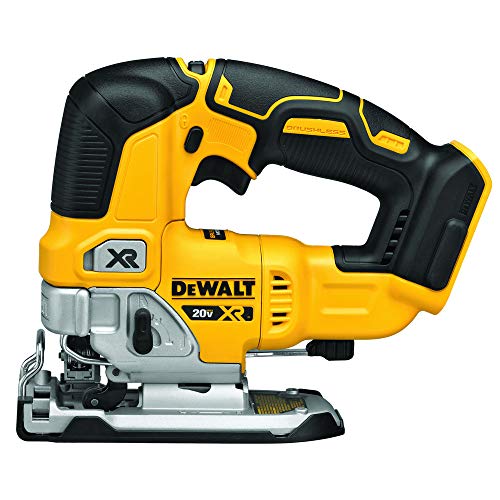
DeWalt DCS334B 20V MAX XR Cordless Jig Saw
Best for: Woodworkers and DIYers who want cordless freedom without sacrificing cut quality
- Brand
- DeWalt
- Type
- Cordless top-handle jigsaw
- Power
- Cordless (20V MAX, battery sold separately)
- Voltage
- 20V MAX
- Weight
- 5.2 lbs (tool only)
$141.00Amazon price as of Oct 7, 3:22 AM EDTProduct prices and availability are accurate as of the date/time indicated and are subject to change. Any price and availability information displayed on Amazon.com at the time of purchase will apply to the purchase of this product.
What we like
- Brushless motor delivers excellent runtime and near-zero maintenance
- All-metal keyless blade clamp with lever-action for fast changes
- LED work light and dust blower keep the cut line visible
- Keyless bevel adjustment with positive detents at 4 angles
Watch out for
- Battery and charger sold separately (a real added cost if you're new to 20V MAX)
- 3,200 SPM max is slightly slower than the Milwaukee's 3,500
- 5.2 lbs (tool only) gets heavier with a battery attached

Bosch JS572EBK 7.2-Amp Barrel-Grip Jig Saw Kit
Best for: Woodworkers and finish carpenters who need the most accurate cuts possible
- Brand
- Bosch
- Type
- Corded barrel-grip jigsaw
- Power
- Corded (120V)
- Voltage
- 120V, 7.2 Amps
- Weight
- 4.9 lbs
$335.00Amazon price as of Oct 7, 3:22 AM EDTProduct prices and availability are accurate as of the date/time indicated and are subject to change. Any price and availability information displayed on Amazon.com at the time of purchase will apply to the purchase of this product.
What we like
- Precision Control II double-roller system delivers the most accurate cuts in the roundup
- Barrel-grip design gives superior cut control for detail work
- 7.2 amps and 5-1/2" softwood cutting capacity are both class-leading
- LED and dust blower have independent on/off switches
Watch out for
- Premium price is a significant investment for a corded jigsaw
- 3,000 SPM maximum is the lowest top speed in this roundup
- Barrel grip takes adjustment if you're used to a top-handle design
- Corded, so you're tethered to an outlet
Final Thoughts
Learning how to cut straight with a jigsaw comes down to stacking a few fundamentals: choose a thick, sharp blade with the right TPI, use a clamped straight edge guide whenever possible, set the orbital action to zero, and let the blade cut at its own pace. None of these steps are complicated on their own. Together, they transform a frustrating experience into a reliable one.
The biggest mistake most people make is trying to muscle through the cut. I've seen this pattern over and over in user feedback and forum threads. A jigsaw rewards patience and finesse, not force. Press the base plate flat, keep steady contact with your guide, and resist the urge to push faster than the blade wants to go.
If you are still shopping for the right jigsaw, our best jigsaws for every project guide covers top picks across every budget. And for a deeper look at how jigsaws compare to other saws in your shop, check out our jigsaw vs reciprocating saw comparison and our guide to choosing between a miter saw and a circular saw.
If I could go back and give myself one piece of advice, it would be this: stop fighting the jigsaw and start setting it up properly. With the right setup and a little practice, you will wonder why straight cuts ever gave you trouble in the first place.
Affiliate Disclosure
This post contains affiliate links. As an Amazon Associate, HomeBuildLab earns from qualifying purchases at no additional cost to you. Learn more
Prices shown are from Amazon at the time indicated and may change. The price and availability on Amazon.com at the time of purchase apply.
Sam Hartwell
Sam Hartwell edits HomeBuildLab's tool reviews and home improvement guides. Every pick starts with manufacturer spec sheets, warranty terms, parts availability and owner feedback, then gets matched to a specific job and budget. Guides list the trade-offs plainly and get updated when models change or go out of stock.
Keep reading: Saws
All saws guides → How-To
Saws
Jigsaw Blade Types Explained: How to Pick the Right One for Every Cut
Not sure which jigsaw blade types you need? This guide covers blade materials, TPI ratings, and tooth geometry so you pick the right blade every time.
Updated
 Comparison
Saws
Jigsaw vs Reciprocating Saw: Picking the Right Blade for the Job
Jigsaw vs reciprocating saw: one cuts curves with precision, the other tears through walls. Learn which saw fits your projects and when you need both.
Updated
 Top Picks
Saws
Best Reciprocating Saws: The Must-Have Demolition Tool for 2026
I compared 7 of the best reciprocating saws from budget kits to pro models. Find the right sawzall for demolition, remodeling, and pruning in my buying guide.
Updated
 Top Picks
Saws
Best Jigsaws in 2026: Corded and Cordless Picks for Curves and Cutouts
I compared the 7 best jigsaw models from budget to pro-grade. See which ones cut smoothest, handle curves best, and deliver real value for DIYers and pros.
Updated
 Comparison
Saws
Table Saw vs Track Saw: Which is Better for Sheet Goods?
Table saw vs track saw: which one handles plywood better? I compare cut quality, safety, price, and portability so you can pick the right saw for your shop.
Updated
 How-To
Saws
How to Cut Crown Molding with a Miter Saw: A Step-by-Step Guide
Learn how to cut crown molding with a miter saw using the nested method. Step-by-step guide to inside corners, outside corners, coped joints, and pro tips.
Updated
The HomeBuildLab newsletter
New guides and tool deals worth knowing about
One short email when we publish or update a buying guide. No spam, unsubscribe anytime.