Pancake vs Hot Dog Air Compressor: Which Tank Shape Actually Matters?
Pancake vs hot dog air compressor: I compare tank shape, portability, CFM, noise, and capacity so you can pick the right compressor for your projects.
Reader-supported: we may earn a commission when you buy through links on this page, at no extra cost to you. How we research
We don't run a test lab. For each guide we compare manufacturer specs, warranty terms and owner reviews, then match models to specific jobs and budgets. We say when a pick is a trade-off, and every product has cons listed.
As an Amazon Associate, HomeBuildLab earns from qualifying purchases. Read our full affiliate disclosure.

If you're shopping for a portable air compressor, you've probably noticed two distinct tank shapes: pancake and hot dog. The pancake vs hot dog air compressor debate comes down to more than looks. Tank shape affects stability, portability, capacity, and how well the compressor fits your workspace.
Here's the short answer. Pancake compressors are more compact, more stable, and usually cheaper. Hot dog compressors can hold more air, deliver higher CFM in many cases, and tend to run quieter. In my opinion, neither design is objectively better. The right choice depends on what you're powering and where you're working.
I've owned both styles, and honestly, the decision is simpler than most people make it. Let's break down the real differences so you can stop guessing and start buying with confidence.
Key Differences at a Glance
| Feature | Pancake Compressor | Hot Dog Compressor |
|---|---|---|
| Tank Shape | Flat, round disc (two dished ends welded together) | Elongated cylinder (dished ends with a cylindrical shell) |
| Typical Capacity | 1 to 6 gallons | 2 to 8 gallons |
| Weight Range | 20 to 35 lbs | 30 to 52 lbs |
| CFM at 90 PSI | 2.0 to 2.8 (typical 6-gal models) | 2.5 to 3.8 (varies widely by model) |
| Max PSI | 150 to 165 | 130 to 150 |
| Noise Level | 70 to 80 dB | 65 to 80 dB |
| Stability | Excellent (wide, flat base) | Moderate (narrow footprint, prone to tipping) |
| Price Range | $80 to $200 | $120 to $350 |
| Best For | Light-duty nailing, inflating, home use | Extended nailing runs, woodworking, higher-demand tools |
What Is a Pancake Compressor?
A pancake compressor gets its name from the flat, round tank that sits directly on the ground. The tank is made from two dished (concave) metal ends welded together with no cylindrical shell in between. Think of it as a thick metal frisbee with a motor on top.
This design creates a wide, low center of gravity. That means the compressor doesn't tip over easily, even on uneven surfaces or when you bump it with a hose. For garage floors, decks, and jobsites, that stability matters more than you'd think.
Most pancake compressors hold between 1 and 6 gallons of air, with the 6-gallon size being the most popular. The Porter-Cable C2002 is the classic example: 6 gallons, 150 max PSI, 2.6 SCFM at 90 PSI, and 82 dB. It weighs just 30 pounds and sits in the budget-to-mid price range. I recommend the Metabo HPT EC710S as another strong contender, delivering 2.8 CFM at 90 PSI with a quieter 73 dB operating noise.
Pancake compressors almost always use oil-free pumps. That's a real advantage for casual users because it means zero maintenance on the pump itself. No oil checks, no oil changes, no worrying about storing it at an angle.
One limitation: the flat tank shape caps out at about 6 gallons in a portable package. If you need more air volume, you'll hit the ceiling of what the pancake form factor can offer.
Common pancake compressor models: Porter-Cable C2002, Metabo HPT EC710S, Craftsman CMXECXA02106410, Husky 6-Gallon 150 PSI, Bostitch BTFP02012.
What Is a Hot Dog Compressor?
A hot dog compressor uses an elongated cylindrical tank, similar in shape to (you guessed it) a hot dog. The tank is made from two dished ends welded to a cylindrical shell, giving it a longer, narrower profile than a pancake.
The biggest advantage of this shape is volume. Because the tank is tubular, manufacturers can stretch it longer to increase capacity without making the compressor dramatically wider. Hot dog compressors commonly range from 2 to 8 gallons, and some models push even higher.
The Makita MAC700 is the most popular hot dog compressor on the market. It's a 2.6-gallon, 2.0 HP model with "Big Bore" pump technology that delivers an impressive 3.3 CFM at 90 PSI. What I like most about this compressor is that it delivers more airflow than most 6-gallon pancake compressors, from a significantly smaller tank. The tradeoff? It weighs 52 pounds and uses an oil-lubricated pump that requires periodic maintenance.
Many hot dog compressors come with handles and sometimes wheels, making them easier to roll between work areas. The elongated shape also tucks against walls and under workbenches more naturally than a wide pancake.
The downside is stability. A hot dog compressor has a narrow footprint and a higher center of gravity. It can tip over if you're working on a slope or if you snag the hose. Some models include rubber feet or stabilizing legs to help, but a pancake compressor will always sit flatter.
Common hot dog compressor models: Makita MAC700, California Air Tools 8010A, Porter-Cable CMB15, Senco PC1010.
Pancake vs Hot Dog Air Compressor: Head-to-Head Comparison
Tank Capacity and Runtime
Hot dog compressors generally offer more air storage. While the most popular pancake size tops out at 6 gallons, hot dog models routinely come in 4, 6, and 8-gallon configurations. More air in the tank means longer run times between refill cycles, which matters for tasks like continuous nailing or running a paint sprayer.
That said, I think tank size alone doesn't tell the whole story. A high-CFM compressor with a smaller tank can outperform a low-CFM compressor with a larger tank, because it recovers pressure faster. The Makita MAC700 proves this point: its 2.6-gallon tank paired with a 3.3 CFM pump keeps up with many 6-gallon pancake models.
Portability
Pancake compressors win on raw portability. A typical 6-gallon pancake weighs 25 to 35 pounds, and the flat shape is easy to grab with one hand and carry to the next room or up a ladder. The Porter-Cable C2002, for example, weighs 30 pounds and has a convenient carrying handle.
Hot dog compressors are heavier, often 35 to 52 pounds, but many include integrated handles and wheels. If you're rolling the compressor across a flat shop floor, the hot dog can actually be easier to move. Carrying one up stairs or lifting it into a truck bed is another story.
For roofing work, attic projects, or any situation where you're carrying the compressor to an elevated workspace, the lighter pancake design has a clear advantage.
Stability
This one isn't close, and in my experience it matters more than you'd think. Pancake compressors sit on a wide, flat base that keeps them planted. You can work around them with hoses, bump into them, and set them on slightly uneven surfaces without worrying about a tip-over.
Hot dog compressors are prone to tipping, especially with a hose attached. Some manufacturers add stabilizing feet or rubber pads, but the elongated, narrow profile means they're inherently less stable. If you're working in tight spaces or on sloped surfaces, this is a real consideration.
CFM Output
This is where generalizations get tricky. CFM depends far more on the pump and motor than on tank shape. However, hot dog compressors tend to use more powerful motors because their target users often need higher air delivery.
The Makita MAC700 delivers 3.3 CFM at 90 PSI from its 2 HP motor. Most 6-gallon pancake compressors land between 2.0 and 2.8 CFM at 90 PSI. For light-duty tasks like running a brad nailer or inflating tires, any of these numbers work fine. For heavier tools like framing nail guns, you'll want the higher CFM that many hot dog models provide.
Noise Level
Both designs span a wide range of noise levels, but hot dog compressors have a slight edge on average. Oil-lubricated hot dog compressors (like the Makita MAC700 at 80 dB) run the pump at lower RPMs, which produces a deeper, less grating sound. Some newer pancake models have closed in the gap significantly. The Metabo HPT EC710S runs at just 73 dB, and the Husky 6-Gallon model claims 65 dB.
Oil-free pancake compressors, especially older or budget models, tend to produce a high-pitched whine that's more annoying than their decibel rating suggests. If noise matters to you, check the specific model's dB rating rather than assuming one shape is quieter than the other.
Price
Pancake compressors are generally more affordable. You can get a solid 6-gallon pancake from Craftsman, Metabo HPT, or Porter-Cable for under $250, and basic models often sell for under $200. The most popular hot dog compressors, like the Makita MAC700, usually run $250 or more.
That price difference partly reflects the oil-lubricated vs. oil-free pump distinction. Oil-lubricated hot dog compressors (Makita's lineup in particular) are built for longevity and deliver more CFM, so the premium is justified if you need the extra capability. Personally, I prefer the pancake for most homeowners: if you're just running a finish nailer on weekend trim projects, a budget pancake compressor handles the job.
Maintenance
Oil-free pancake compressors require almost zero maintenance. Check the air filter occasionally, drain the tank after use, and that's about it. I believe this is the single biggest advantage for casual users who don't want another machine to maintain.
Oil-lubricated hot dog compressors need periodic oil changes (typically every 200 to 500 hours of use) and oil level checks. It's not difficult work, but it's one more thing to remember. The upside is that oil-lubricated pumps generally last longer and run cooler.
Which Shape Is Right for You?
Choose a pancake compressor if:
- You need a light, portable compressor for around the house
- Your tasks include inflating tires, running a brad nailer, or small finishing work
- Stability on jobsites matters (roofing, decking, uneven ground)
- You want minimal maintenance with an oil-free pump
- Budget is a primary concern (under $150)
Choose a hot dog compressor if:
- You need higher CFM for extended nailing or multiple air tools
- Your workspace is a shop where the compressor stays in one spot
- You value quieter operation and longer pump life (oil-lubricated models)
- You don't mind occasional oil changes for better durability
- You need more than 6 gallons of tank capacity
Not sure yet? I'd pick a 6-gallon pancake compressor for most homeowners tackling trim, baseboards, and occasional inflation. It's cheaper, lighter, more stable, and maintenance-free. Upgrade to a hot dog model when your projects start demanding more CFM or longer runtime. And if you're still building out your pneumatic tool setup, check out my guides to the best air compressors and best nail guns for specific product recommendations.
Compare our picks
2 picks- Best Pancake CompressorPorter-Cable C2002-WK
Porter-Cable · Corded (120V) · 30 lbs
All-around garage compressor for nailing, inflating, and light air tool use
$242.79Amazon price as of Oct 7, 5:40 PM EDTProduct prices and availability are accurate as of the date/time indicated and are subject to change. Any price and availability information displayed on Amazon.com at the time of purchase will apply to the purchase of this product.
View on Amazon - Best Ultra-PortableCalifornia Air Tools 8010A
California Air Tools · Corded (120V) · 37.25 lbs
Indoor projects, apartments, or any space where noise and weight matter most
Out of stock on Amazon right now
Recommended Tools
Ready to buy? Here's one strong pick for each design. For more options, see our best air compressor guide.
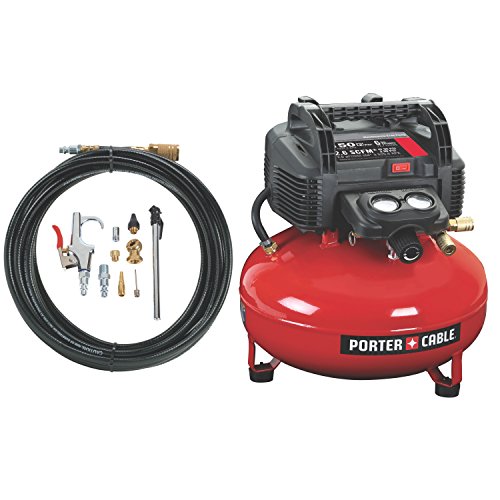
Porter-Cable C2002-WK
Best for: All-around garage compressor for nailing, inflating, and light air tool use
- Brand
- Porter-Cable
- Type
- Pancake
- Power
- Corded (120V)
- Weight
- 30 lbs
- Warranty
- 1-year limited
$242.79Amazon price as of Oct 7, 5:40 PM EDTProduct prices and availability are accurate as of the date/time indicated and are subject to change. Any price and availability information displayed on Amazon.com at the time of purchase will apply to the purchase of this product.
What we like
- Classic 6-gallon pancake design with a stable, flat base
- Two couplers support two users at once
- Maintenance-free oil-free pump
- 13-piece kit adds a 25-foot hose, blow gun, and tire gauge
Watch out for
- 2.6 CFM at 90 PSI isn't enough for continuous-use tools like sanders
- 82 dB is loud compared with quiet-series compressors
- 150 max PSI stores less air than 165 to 200 PSI models

California Air Tools 8010A
Best for: Indoor projects, apartments, or any space where noise and weight matter most
- Brand
- California Air Tools
- Type
- Hot Dog (wheeled)
- Power
- Corded (120V)
- Weight
- 37.25 lbs
Currently out of stock on Amazon. Other sellers or a restock may be listed there.
What we like
- 60 dB is the quietest compressor on this list
- 37.25 lbs with an 8-gallon tank is an exceptional weight-to-capacity ratio
- Aluminum tank is rust-free and lightweight
- Oil-free pump rated for 3,000+ hours
Watch out for
- 2.2 CFM at 90 PSI limits use to light-duty tools
- 120 max PSI is the lowest on this list
- Not suited for continuous-use tools like sanders or spray guns
Final Thoughts
The pancake vs hot dog air compressor choice ultimately comes down to how you work. Pancake compressors are the lighter, more affordable, more stable option for casual and light-duty use. Hot dog compressors deliver more air, often run quieter, and last longer thanks to oil-lubricated pumps, making them the better pick for serious woodworkers and contractors.
Don't overthink the tank shape. If I were buying my first compressor today, I'd grab a 6-gallon pancake and call it done. Focus on CFM at 90 PSI (match it to your most demanding tool), tank capacity (bigger means fewer refill pauses), and noise level (especially if you're working indoors). Get those three numbers right, and you'll be happy with either design.
If you need help figuring out the right CFM and tank size for your tools, my what size air compressor guide walks you through the math. And if you're pairing a compressor with pneumatic tools, my roundups of the best brad nailers and best paint sprayers can help you build the right setup from the start.
Affiliate Disclosure
This post contains affiliate links. As an Amazon Associate, HomeBuildLab earns from qualifying purchases at no additional cost to you. Learn more
Prices shown are from Amazon at the time indicated and may change. The price and availability on Amazon.com at the time of purchase apply.
Sam Hartwell
Sam Hartwell edits HomeBuildLab's tool reviews and home improvement guides. Every pick starts with manufacturer spec sheets, warranty terms, parts availability and owner feedback, then gets matched to a specific job and budget. Guides list the trade-offs plainly and get updated when models change or go out of stock.
Keep reading: Nailers & Compressors
All nailers & compressors guides → Buying Guide
Nailers & Compressors
What Size Air Compressor Do I Need? A Practical Sizing Guide
Find out what size air compressor you need based on CFM, PSI, and tank size. Includes a tool-by-tool chart and real sizing scenarios for home and garage.
Updated
 Top Picks
Nailers & Compressors
Best Air Compressors for Home Garage: Portable and Stationary Picks
I compared the best air compressors for home garages and workshops. From quiet trim models to 27-gallon tanks, find the right compressor for your needs.
Updated
 Comparison
Nailers & Compressors
Brad Nailer vs Finish Nailer: The Right Nailer for Your Trim Job
Brad nailer vs finish nailer: learn the key differences in gauge, holding power, and nail visibility so you pick the right tool for trim, molding, and cabinets.
Updated
 Top Picks
Nailers & Compressors
Best Brad Nailers for Trim and Finish Work: 7 Picks That Won't Split Your Wood
I compared the best brad nailers for trim, molding, and finish work. Find the right 18-gauge brad nailer for your project with honest reviews and buying advice.
Updated
 Top Picks
Nailers & Compressors
Best Nail Guns in 2026: Framing, Finish, and Roofing Picks
I compared the best nail guns for framing, finish, and brad nailing. Find the right nailer for your project with honest picks and a complete buyer's guide.
Updated
The HomeBuildLab newsletter
New guides and tool deals worth knowing about
One short email when we publish or update a buying guide. No spam, unsubscribe anytime.