Best Brad Nailers for Trim and Finish Work: 7 Picks That Won't Split Your Wood
I compared the best brad nailers for trim, molding, and finish work. Find the right 18-gauge brad nailer for your project with honest reviews and buying advice.
Reader-supported: we may earn a commission when you buy through links on this page, at no extra cost to you. How we research
We don't run a test lab. For each guide we compare manufacturer specs, warranty terms and owner reviews, then match models to specific jobs and budgets. We say when a pick is a trade-off, and every product has cons listed.
As an Amazon Associate, HomeBuildLab earns from qualifying purchases. Read our full affiliate disclosure.
Our top picks
Compare all 7 ↓- Best OverallDeWalt DCN680B 20V MAX XR Brad Nailer
Anyone who wants a do-everything cordless brad nailer with proven reliability
$301.99Amazon price as of Oct 8, 10:25 AM EDTProduct prices and availability are accurate as of the date/time indicated and are subject to change. Any price and availability information displayed on Amazon.com at the time of purchase will apply to the purchase of this product.
View on Amazon - Best ValueMetabo HPT NT50AE2 Pneumatic Brad Nailer
Anyone with a compressor who wants professional features at a fair price
$67.36Amazon price as of Oct 8, 10:25 AM EDTProduct prices and availability are accurate as of the date/time indicated and are subject to change. Any price and availability information displayed on Amazon.com at the time of purchase will apply to the purchase of this product.
View on Amazon - Best BudgetWEN 61722K 2-in-1 Pneumatic Brad Nailer and Stapler
Budget-conscious buyers who want a dependable pneumatic nailer without overspending
$41.79Amazon price as of Oct 8, 10:25 AM EDTProduct prices and availability are accurate as of the date/time indicated and are subject to change. Any price and availability information displayed on Amazon.com at the time of purchase will apply to the purchase of this product.
View on Amazon

A brad nailer is the tool that makes trim work feel effortless instead of tedious. I use mine constantly, and it is probably the tool that made the biggest difference in the quality of my finish carpentry. Whether you're installing baseboards, attaching thin molding, or assembling a bookcase, the best brad nailer sinks 18-gauge nails cleanly without splitting delicate wood. But here's the truth: not every brad nailer is worth your money, and the wrong choice can leave you with jammed magazines, inconsistent depth, and dented workpieces.
I compared pneumatic and cordless models across price, reliability, and real-world user feedback to find the best brad nailers for every budget. If you already own an air compressor, a pneumatic model saves you serious cash. If you want maximum portability, cordless options from DeWalt, Milwaukee, and Ryobi have gotten genuinely good.
The bottom line: the right brad nailer depends on how you'll use it. A weekend trim job doesn't demand a premium cordless flagship. And a busy finish carpenter shouldn't rely on a bargain-bin pneumatic. I'll help you match the tool to the task.
Quick Picks: Best Brad Nailers at a Glance
- Best Overall: DeWalt DCN680B. I'd pick this for most people. Cordless, brushless, drives up to 1,200 nails per charge with consistent depth control. Check price|Review
- Best Value (Pneumatic): Metabo HPT NT50AE2. Personally, I prefer this over any other pneumatic at this price. Just 2.2 lbs with a 5-year warranty and professional-grade features.
- Best Budget: WEN 61722K. A 2-in-1 pneumatic brad nailer and stapler for under $50. Check price|Review
- Best for Tight Spaces: Metabo HPT NT1850DFT. A compact brushless kit just 10.5 inches long that still drives 2" brads. Check price|Review
- Best Cordless Value: Ryobi P321 AirStrike. 1,900 nails per charge on the affordable ONE+ platform. Check price|Review
- Best Pneumatic for Pros: Bostitch BTFP12233 Smart Point. Oil-free with pinpoint accuracy from the Smart Point nose. Check price|Review
- Best Full-Size Cordless: Milwaukee M18 FUEL 2746-20. Nitrogen-powered with pneumatic-level driving force. Check price|Review
Compare our picks
7 picks- Best OverallDeWalt DCN680B 20V MAX XR Brad Nailer
DeWalt · Cordless (20V MAX battery) · 5.3 lbs (tool only)
Anyone who wants a do-everything cordless brad nailer with proven reliability
$301.99Amazon price as of Oct 8, 10:25 AM EDTProduct prices and availability are accurate as of the date/time indicated and are subject to change. Any price and availability information displayed on Amazon.com at the time of purchase will apply to the purchase of this product.
View on Amazon - Best ValueMetabo HPT NT50AE2 Pneumatic Brad Nailer
Metabo HPT · Pneumatic (air compressor) · 2.2 lbs
Anyone with a compressor who wants professional features at a fair price
$67.36Amazon price as of Oct 8, 10:25 AM EDTProduct prices and availability are accurate as of the date/time indicated and are subject to change. Any price and availability information displayed on Amazon.com at the time of purchase will apply to the purchase of this product.
View on Amazon - Best BudgetWEN 61722K 2-in-1 Pneumatic Brad Nailer and Stapler
WEN · Pneumatic (air compressor) · 3.2 lbs
Budget-conscious buyers who want a dependable pneumatic nailer without overspending
$41.79Amazon price as of Oct 8, 10:25 AM EDTProduct prices and availability are accurate as of the date/time indicated and are subject to change. Any price and availability information displayed on Amazon.com at the time of purchase will apply to the purchase of this product.
View on Amazon - Best for Tight SpacesMetabo HPT NT1850DFT Compact Brushless Brad Nailer
Metabo HPT · Cordless (18V MultiVolt battery, 2.0Ah battery included) · 4.4 lbs (without battery)
Finish carpenters working in cabinets, closets, and other tight spaces
$239.80Amazon price as of Oct 8, 10:25 AM EDTProduct prices and availability are accurate as of the date/time indicated and are subject to change. Any price and availability information displayed on Amazon.com at the time of purchase will apply to the purchase of this product.
View on Amazon - Best Cordless ValueRyobi P321 ONE+ AirStrike Brad Nailer
Ryobi · Cordless (18V ONE+ battery) · 5.5 lbs (tool only)
Homeowners on the Ryobi ONE+ platform who want cordless convenience at a fair price
$133.99Amazon price as of Oct 8, 10:25 AM EDTProduct prices and availability are accurate as of the date/time indicated and are subject to change. Any price and availability information displayed on Amazon.com at the time of purchase will apply to the purchase of this product.
View on Amazon - Best Pneumatic for ProsBostitch BTFP12233 Smart Point Brad Nailer
Bostitch · Pneumatic (air compressor) · 3.1 lbs
Professionals and serious hobbyists who want a premium pneumatic brad nailer
$122.39Amazon price as of Oct 8, 10:25 AM EDTProduct prices and availability are accurate as of the date/time indicated and are subject to change. Any price and availability information displayed on Amazon.com at the time of purchase will apply to the purchase of this product.
View on Amazon - Best Full-Size CordlessMilwaukee M18 FUEL 2746-20 Brad Nailer
Milwaukee · Cordless (M18 battery) · 5.3 lbs (tool only)
Professional finish carpenters who demand pneumatic-level performance from a cordless tool
$327.02Amazon price as of Oct 8, 10:25 AM EDTProduct prices and availability are accurate as of the date/time indicated and are subject to change. Any price and availability information displayed on Amazon.com at the time of purchase will apply to the purchase of this product.
View on Amazon
What Is a Brad Nailer and When Do You Need One?
A brad nailer fires 18-gauge brad nails, which are thinner than the 15 or 16-gauge nails used by finish nailers. That smaller diameter is the entire point. Brads are thin enough to fasten delicate trim, thin stock, and decorative molding without splitting the wood or leaving large holes.
Brad nailer vs. finish nailer: this is the most common point of confusion. (I cover this in detail in my brad nailer vs finish nailer comparison.) A 16-gauge finish nailer drives thicker nails with more holding power, making it the better choice for baseboards, door casings, and crown molding on hardwood. A brad nailer uses thinner 18-gauge nails that leave nearly invisible holes, making it ideal for attaching shoe molding, quarter round, thin plywood backer, picture frames, and lightweight trim. If you're working on crown molding with a miter saw, a finish nailer handles the structural attachment while a brad nailer handles the delicate detail work.
Common uses for a brad nailer:
- Shoe molding and quarter round
- Thin decorative trim and panel molding
- Cabinet face frames and back panels
- Picture frames and small woodworking projects
- Attaching thin plywood or MDF panels
- Tacking pieces in place before glue dries
The key rule: if the piece is thin enough that a 16-gauge nail might split it, reach for the brad nailer.
My Top Picks

DeWalt DCN680B 20V MAX XR Brad Nailer
Best for: Anyone who wants a do-everything cordless brad nailer with proven reliability
- Brand
- DeWalt
- Type
- Cordless brad nailer
- Power
- Cordless (20V MAX battery)
- Voltage
- 20V
- Weight
- 5.3 lbs (tool only)
- Size
- 11.8" x 10.3" x 3.7"
- Warranty
- 3-year limited
$301.99Amazon price as of Oct 8, 10:25 AM EDTProduct prices and availability are accurate as of the date/time indicated and are subject to change. Any price and availability information displayed on Amazon.com at the time of purchase will apply to the purchase of this product.
What we like
- Brushless motor delivers 800-1,200 nails per charge
- Micro nose for precise nail placement with clear sightlines
- Tool-free jam release and depth adjustment
- Compatible with the entire DeWalt 20V MAX battery ecosystem
Watch out for
- Tool-only price is steep (battery and charger sold separately)
- At 5.3 lbs, heavier than pneumatic alternatives
- Occasional misfires reported on very short 5/8" brads
I recommend the DeWalt DCN680B as the top pick because it does everything well and nothing poorly. The brushless motor drives 18-gauge brads from 5/8" to 2-1/8" with consistent countersink depth, and you can expect between 800 and 1,200 nails per charge depending on which 20V MAX battery you use. That's enough for a full day of trim work without swapping batteries.
The micro nose design gives you excellent sightline placement, which matters more than most people realize. When you're nailing quarter round into a corner, being able to see exactly where the brad will land prevents costly misses. The tool-free depth adjustment and jam release keep downtime to a minimum.
If you're already invested in DeWalt's 20V MAX platform, this is a no-brainer. It shares batteries with drills, saws, and every other tool in the lineup. The selectable trigger lets you switch between sequential firing for precision work and contact (bump) firing when speed matters.

Metabo HPT NT50AE2 Pneumatic Brad Nailer
Best for: Anyone with a compressor who wants professional features at a fair price
- Brand
- Metabo HPT
- Type
- Pneumatic brad nailer
- Power
- Pneumatic (air compressor)
- Voltage
- N/A
- Weight
- 2.2 lbs
- Size
- 12.2" x 2.4" x 10"
- Warranty
- 5-year professional warranty
$67.36Amazon price as of Oct 8, 10:25 AM EDTProduct prices and availability are accurate as of the date/time indicated and are subject to change. Any price and availability information displayed on Amazon.com at the time of purchase will apply to the purchase of this product.
What we like
- Incredibly light at 2.2 lbs for fatigue-free overhead work
- 5-year professional warranty, best in class at this price
- Depth-of-drive dial and 360-degree adjustable exhaust
- Slim profile fits into corners and tight spaces easily
Watch out for
- Requires an air compressor and hose (not standalone)
- Magazine holds 100 nails vs. 110 on some competitors
- No-mar tip can slip off on some units (keep a spare)
At 2.2 pounds, the Metabo HPT NT50AE2 is the lightest brad nailer on this list, and I think that weight difference is something you really feel after an hour of overhead nailing. The slim, elongated profile helps you reach into tight corners where bulkier nailers can't fit. For trim carpenters who already own an air compressor, this is one of the best values in the entire nailer market.
The depth-of-drive dial provides precise countersink adjustment without fumbling with allen wrenches or guess-and-check methods. The selective actuation switch toggles between sequential and bump fire modes. The 360-degree adjustable exhaust port keeps debris and oil mist off your workpiece, which is a feature that budget nailers skip entirely.
Metabo HPT backs this with a 5-year professional warranty, which is the longest in this price class. The reload indicator on the magazine is a small but genuinely useful touch: you'll always know when you're running low instead of dry-firing into your trim.
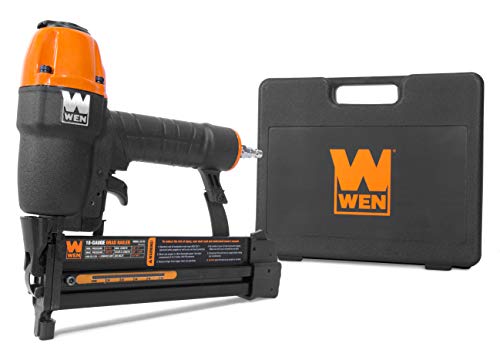
WEN 61722K 2-in-1 Pneumatic Brad Nailer and Stapler
Best for: Budget-conscious buyers who want a dependable pneumatic nailer without overspending
- Brand
- WEN
- Type
- Pneumatic brad nailer and crown stapler
- Power
- Pneumatic (air compressor)
- Voltage
- N/A
- Weight
- 3.2 lbs
- Warranty
- 2-year WEN warranty
$41.79Amazon price as of Oct 8, 10:25 AM EDTProduct prices and availability are accurate as of the date/time indicated and are subject to change. Any price and availability information displayed on Amazon.com at the time of purchase will apply to the purchase of this product.
What we like
- The cheapest nailer on this list by a wide margin
- Shoots both 18-gauge brads and 1/4" crown staples
- Tool-free depth adjustment and an included hard case
- Low air demand works with any pancake compressor
Watch out for
- 3.2 lbs is heavier than the Metabo HPT NT50AE2
- Jam clearing and depth consistency are less refined than premium models
- Shorter 2-year warranty than Metabo HPT or Bostitch
The WEN 61722K is proof that a cheap brad nailer doesn't have to feel cheap. It's the most affordable nailer on this list, and it does double duty: the same magazine takes 18-gauge brads from 5/8" to 2" or 18-gauge 1/4" crown staples. That means one tool covers trim, cabinet backs, and upholstery or screen jobs.
At 3.2 pounds with a rubber-lined grip, it's comfortable for a long afternoon of baseboard work. Depth adjustment is tool-free, and it runs at 60 to 100 PSI, so even a small pancake compressor keeps up without effort. WEN also includes a hard-shell carrying case and backs it with a two-year warranty.
This is the brad nailer I would recommend if you have one trim project and don't want to spend cordless money on a tool you'll use twice a year. It does the job, the nails go where you point them, and the price leaves room in your budget for good brads.

Metabo HPT NT1850DFT Compact Brushless Brad Nailer
Best for: Finish carpenters working in cabinets, closets, and other tight spaces
- Brand
- Metabo HPT
- Type
- Cordless compact brad nailer (kit)
- Power
- Cordless (18V MultiVolt battery, 2.0Ah battery included)
- Voltage
- 18V
- Weight
- 4.4 lbs (without battery)
- Size
- 10.5" L x 3.63" W x 11.3" H
- Warranty
- Lifetime tool warranty (Metabo HPT Lifetime Lithium-Ion warranty)
$239.80Amazon price as of Oct 8, 10:25 AM EDTProduct prices and availability are accurate as of the date/time indicated and are subject to change. Any price and availability information displayed on Amazon.com at the time of purchase will apply to the purchase of this product.
What we like
- Compact 10.5" body at 4.4 lbs fits cabinet interiors and closets
- Full 5/8" to 2" brad range despite the small size
- Kit includes battery and charger (about 1,300 nails per charge)
- Lifetime tool warranty
Watch out for
- 100-nail magazine is slightly smaller than DeWalt's or Milwaukee's
- MultiVolt platform is less common than DeWalt 20V or Milwaukee M18
- Tops out at 2" brads (no 2-1/8")
What I like most about the Metabo HPT NT1850DFT is how small it is for a full-range brad nailer. Metabo HPT redesigned it to be 30% more compact and 31% lighter than its previous cordless model, and at 10.5 inches long and 4.4 pounds (without battery), it fits inside cabinets, behind shelves, and into corners that bulkier nailers can't reach. If you do a lot of built-ins, closet shelving, or cabinet installation, that matters more than any spec on the box.
Unlike most compact tools, it doesn't give up nail length. It still drives 18-gauge brads from 5/8" to 2", so it handles shoe molding, panel trim, and standard baseboard. The brushless motor powers an air spring drive system that feels close to a pneumatic, with no ramp-up delay and up to two nails per second.
It's also sold as a kit with a 2.0Ah battery and charger, and Metabo HPT rates that battery for about 1,300 nails per charge. For anyone not already locked into DeWalt, Milwaukee, or Ryobi, that makes it one of the most cost-effective ways into a quality cordless brad nailer.

Ryobi P321 ONE+ AirStrike Brad Nailer
Best for: Homeowners on the Ryobi ONE+ platform who want cordless convenience at a fair price
- Brand
- Ryobi
- Type
- Cordless brad nailer
- Power
- Cordless (18V ONE+ battery)
- Voltage
- 18V
- Weight
- 5.5 lbs (tool only)
- Size
- 12.1" x 3.5" x 10.2"
- Warranty
- 3-year limited
$133.99Amazon price as of Oct 8, 10:25 AM EDTProduct prices and availability are accurate as of the date/time indicated and are subject to change. Any price and availability information displayed on Amazon.com at the time of purchase will apply to the purchase of this product.
What we like
- Impressive 1,900 nails per charge for all-day runtime
- Most affordable cordless brad nailer from a major brand
- Compatible with the massive Ryobi ONE+ 18V battery platform
- Redesigned smaller nose improves access and precision
Watch out for
- Heavier than pneumatic models at 5.5 lbs
- Drive power can be inconsistent in dense hardwoods
- Build quality feels less refined than DeWalt or Milwaukee
In my opinion, the Ryobi P321 AirStrike is the best cordless brad nailer for people who don't want to spend DeWalt or Milwaukee money. For roughly half the price of the DeWalt or Milwaukee (tool only), it delivers 1,900 nails per charge and drives 18-gauge brads from 5/8" to 2" with consistent results. The 45% smaller nose compared to the older P320 model means better access to tight spots and improved sightlines.
This is a compression-drive nailer, so there's no fuel cell or gas cartridge to replace. Just charge the ONE+ battery, load 18-gauge brads, and go. The tool-free depth-of-drive adjustment dials in countersinking quickly, and the dry-fire lockout prevents blank shots when the magazine is empty.
If you're already in the Ryobi ONE+ ecosystem (and millions of people are), this brad nailer shares batteries with over 300 other tools. For trim projects, cabinet work, and general fastening around the house, it performs well above its price point. Professional finish carpenters will want more power and refinement, but for the homeowner tackling a weekend project, it's hard to beat.

Bostitch BTFP12233 Smart Point Brad Nailer
Best for: Professionals and serious hobbyists who want a premium pneumatic brad nailer
- Brand
- Bostitch
- Type
- Pneumatic brad nailer
- Power
- Pneumatic (air compressor)
- Voltage
- N/A
- Weight
- 3.1 lbs
- Size
- 11.3" x 9.5" x 3.2"
- Warranty
- 7-year limited
$122.39Amazon price as of Oct 8, 10:25 AM EDTProduct prices and availability are accurate as of the date/time indicated and are subject to change. Any price and availability information displayed on Amazon.com at the time of purchase will apply to the purchase of this product.
What we like
- Smart Point nose provides pinpoint accuracy for precise placement
- Oil-free operation eliminates staining on finished surfaces
- 7-year limited warranty, among the best in pneumatic nailers
- Drives brads up to 2-1/8" for slightly more range than most
Watch out for
- Requires an air compressor and hose setup
- Costs more than double what budget pneumatics like the WEN cost
- Some users report the no-mar tip wears out and needs replacing
The Bostitch BTFP12233 has been a favorite among finish carpenters for years, and for good reason. The Smart Point technology uses a smaller, more precise nose that lets you see exactly where the nail will go before you pull the trigger. That sounds like marketing fluff until you've tried lining up a brad in a tight corner with a bulky standard nose. The difference is real.
This is an oil-free nailer, which means zero risk of oil spots on your finished trim. If you've ever had to sand out an oil stain from a pneumatic nailer on white-painted molding, you'll appreciate that feature. The Dial-A-Depth control adjusts countersinking with a simple twist, and the tool-free jam release gets you back to work quickly when a brad misfires.
Operating pressure runs from 70 to 120 PSI, and the selectable trigger switches between sequential and contact firing. At 3.1 pounds, it's light enough for extended overhead work. Bostitch backs it with a 7-year limited warranty, which is one of the longest in the pneumatic nailer category.

Milwaukee M18 FUEL 2746-20 Brad Nailer
Best for: Professional finish carpenters who demand pneumatic-level performance from a cordless tool
- Brand
- Milwaukee
- Type
- Cordless brad nailer
- Power
- Cordless (M18 battery)
- Voltage
- 18V
- Weight
- 5.3 lbs (tool only)
- Size
- 11.9" x 10.2" x 3.3"
- Warranty
- 5-year tool warranty
$327.02Amazon price as of Oct 8, 10:25 AM EDTProduct prices and availability are accurate as of the date/time indicated and are subject to change. Any price and availability information displayed on Amazon.com at the time of purchase will apply to the purchase of this product.
What we like
- Nitrogen air spring delivers pneumatic-level driving consistency
- Zero ramp-up time with 3-4 nails per second in contact mode
- 5-year tool warranty with excellent Milwaukee support
- 110-nail magazine and full 5/8" to 2-1/8" nail range
Watch out for
- Most expensive brad nailer on this list, even as a bare tool
- Heavier than pneumatic nailers at 5.3 lbs without battery
- Battery and charger sold separately add to total cost
I believe the Milwaukee M18 FUEL 2746-20 is the brad nailer for professionals who have fully committed to cordless. It uses a nitrogen air spring mechanism instead of a flywheel or solenoid, which delivers consistent driving force that genuinely rivals pneumatic nailers. Nails sink to the same depth in hardwood and softwood without the ramp-up delay that some cordless nailers struggle with.
The POWERSTATE brushless motor paired with REDLINK PLUS intelligence means zero ramp-up time between shots. You can fire 3-4 nails per second in contact mode, which keeps pace with production-level trim work. The 110-nail magazine and 5/8" to 2-1/8" range cover every standard brad nailing application.
This is Milwaukee's premium offering, and the price reflects it. As a bare tool, it costs more than any other nailer on this list. But if you're already on the M18 platform and you need a brad nailer that performs like a pneumatic without the compressor and hose, this is the one that delivers. It pairs well with a miter saw for complete trim installation without air hoses cluttering your workspace.
Pneumatic vs. Cordless Brad Nailers
This is the first decision you need to make, and it comes down to your work style.
Pneumatic brad nailers connect to an air compressor via a hose. They're lighter (typically 2-3 lbs), cheaper (usually under $150), and virtually indestructible. The compressor provides unlimited shots without recharging. Professional trim carpenters who work on large jobs with a compressor already set up often prefer pneumatic because the tools weigh almost nothing and never run out of power.
Cordless brad nailers run on rechargeable batteries. They're heavier (4-6 lbs) and more expensive (roughly $130 to $350 for the tool alone), but the freedom of no hose is significant. You can move between rooms, work on a ladder, or nail in a closet without dragging an air hose behind you. Battery technology has improved dramatically, and modern cordless nailers deliver close to pneumatic consistency.
Choose pneumatic if:
- You already own an air compressor
- Weight matters (overhead work all day)
- Budget is a primary concern
- You work in one area with the compressor nearby
Choose cordless if:
- You move between rooms or job sites frequently
- You're already invested in a battery platform (DeWalt 20V, Milwaukee M18, Ryobi ONE+)
- You hate dealing with hoses and compressor noise
- Convenience matters more than raw cost savings
For most homeowners tackling occasional trim projects, I'd pick a cordless nailer because the convenience makes life so much easier. For professionals doing trim work daily, it depends on whether you already run a compressor on site.
How to Choose the Right Brad Nailer
Beyond pneumatic vs. cordless, here are the specs that actually matter:
Nail length range. Most brad nailers accept 5/8" to 2" brads. Some models extend to 2-1/8", which gives you slightly more versatility for thicker trim. If you only do light panel work, a model with a 5/8" to 1-1/2" range is fine for light panel work.
Depth adjustment. Every nailer on this list has depth adjustment, but the mechanism varies. A dial or wheel is faster and more precise than a hex-key system. Look for tool-free adjustment so you can dial in the countersink without reaching for a wrench.
Jam clearing. Brads jam. It happens with every nailer eventually. Tool-free jam release mechanisms let you clear a jam in seconds. Models that require disassembly to clear jams waste time and test patience.
No-mar tip. A rubber or plastic tip on the nose prevents denting your workpiece. Most models include one, but quality varies. Keep spares on hand because they wear out.
Magazine capacity. Ranges from 100 to 110 nails. The difference is minor in practice, but a larger magazine means fewer reloads on long runs of trim.
Firing modes. Sequential firing (one nail per trigger pull) gives you precision. Contact (bump) firing lets you press the nose against the surface and pull the trigger for faster production. The best nailers offer both modes with a simple switch.
Common Questions About Brad Nailers
Can a brad nailer replace a finish nailer?
Not entirely. Brad nails (18 gauge) have less holding power than finish nails (15 or 16 gauge). For lightweight trim, shoe molding, and panel work, brads are fine. For heavy baseboards, crown molding in hardwood, and door casing that needs structural hold, you want a finish nailer. Many carpenters own both. If you're looking for other fastening options, check out my guide to the best nail guns for a broader comparison.
What size air compressor do I need for a pneumatic brad nailer?
A small pancake compressor (2-6 gallon, 1-2 CFM at 90 PSI) is more than enough. Brad nailers use very little air. The WEN 61722K, for example, uses about 0.5 CFM for an entire magazine at 80 PSI. Even the cheapest pancake compressor handles that easily.
Do I need to glue joints that I brad nail?
For structural joints, yes. Brad nails are holding fasteners, not structural fasteners. They're perfect for tacking pieces in place while glue dries, but the glue provides the real long-term hold. For decorative trim attached to walls, brads alone are usually sufficient because the trim doesn't bear load.
What's the difference between 18-gauge brads and 23-gauge pins?
Pin nailers fire 23-gauge headless pins that are nearly invisible but have almost no holding power. They're for ultra-delicate work where even an 18-gauge brad might split the wood. Brad nailers are far more versatile for general trim work.
Why do my brads keep splitting the wood?
Three common causes: the wood is too thin or too dry, you're nailing too close to the edge, or the nail is too long for the stock thickness. Move your nails at least 3/4" from any edge, and make sure the brad length doesn't exceed 2x the thickness of the piece you're attaching.
Final Thoughts
I think the best brad nailer for most people is the DeWalt DCN680B. It combines cordless convenience, consistent driving performance, and compatibility with the popular 20V MAX platform. If budget is a concern and you already own a compressor, I'd recommend the Metabo HPT NT50AE2, which delivers professional results at a fraction of the cordless price.
For homeowners on a tight budget, the WEN 61722K is genuinely hard to beat for the money. And if tight-space access is your priority, the compact Metabo HPT NT1850DFT goes where bulkier nailers simply cannot fit.
Whatever you choose, a good brad nailer paired with a solid miter saw makes trim work faster, cleaner, and far more enjoyable. If I had to pick one brad nailer for a homeowner's first purchase, I would go with the DeWalt DCN680B for its all-around reliability. Stop hand-nailing trim. Your fingers will thank you.
The bottom line
DeWalt DCN680B 20V MAX XR Brad Nailer is our best overall.
Best for: Anyone who wants a do-everything cordless brad nailer with proven reliability
Affiliate Disclosure
This post contains affiliate links. As an Amazon Associate, HomeBuildLab earns from qualifying purchases at no additional cost to you. Learn more
Prices shown are from Amazon at the time indicated and may change. The price and availability on Amazon.com at the time of purchase apply.
Sam Hartwell
Sam Hartwell edits HomeBuildLab's tool reviews and home improvement guides. Every pick starts with manufacturer spec sheets, warranty terms, parts availability and owner feedback, then gets matched to a specific job and budget. Guides list the trade-offs plainly and get updated when models change or go out of stock.
Keep reading: Nailers & Compressors
All nailers & compressors guides → Comparison
Nailers & Compressors
Brad Nailer vs Finish Nailer: The Right Nailer for Your Trim Job
Brad nailer vs finish nailer: learn the key differences in gauge, holding power, and nail visibility so you pick the right tool for trim, molding, and cabinets.
Updated
 Top Picks
Nailers & Compressors
Best Nail Guns in 2026: Framing, Finish, and Roofing Picks
I compared the best nail guns for framing, finish, and brad nailing. Find the right nailer for your project with honest picks and a complete buyer's guide.
Updated
 Buying Guide
Nailers & Compressors
What Size Air Compressor Do I Need? A Practical Sizing Guide
Find out what size air compressor you need based on CFM, PSI, and tank size. Includes a tool-by-tool chart and real sizing scenarios for home and garage.
Updated
 Comparison
Nailers & Compressors
Pancake vs Hot Dog Air Compressor: Which Tank Shape Actually Matters?
Pancake vs hot dog air compressor: I compare tank shape, portability, CFM, noise, and capacity so you can pick the right compressor for your projects.
Updated
 Top Picks
Nailers & Compressors
Best Air Compressors for Home Garage: Portable and Stationary Picks
I compared the best air compressors for home garages and workshops. From quiet trim models to 27-gallon tanks, find the right compressor for your needs.
Updated
The HomeBuildLab newsletter
New guides and tool deals worth knowing about
One short email when we publish or update a buying guide. No spam, unsubscribe anytime.