Best Nail Guns in 2026: Framing, Finish, and Roofing Picks
I compared the best nail guns for framing, finish, and brad nailing. Find the right nailer for your project with honest picks and a complete buyer's guide.
Reader-supported: we may earn a commission when you buy through links on this page, at no extra cost to you. How we research
We don't run a test lab. For each guide we compare manufacturer specs, warranty terms and owner reviews, then match models to specific jobs and budgets. We say when a pick is a trade-off, and every product has cons listed.
As an Amazon Associate, HomeBuildLab earns from qualifying purchases. Read our full affiliate disclosure.
Our top picks
Compare all 7 ↓- Best Framing NailerDeWalt DCN930B 20V MAX XR 30-Degree Framing Nailer
Framing, sheathing, and deck building without a compressor
$362.61Amazon price as of Oct 7, 6:59 PM EDTProduct prices and availability are accurate as of the date/time indicated and are subject to change. Any price and availability information displayed on Amazon.com at the time of purchase will apply to the purchase of this product.
View on Amazon - Best Cordless Finish NailerDeWalt DCN660B 20V MAX 16-Gauge Angled Finish Nailer
Crown molding, baseboards, door casings, and cabinet installation
$369.00Amazon price as of Oct 7, 6:59 PM EDTProduct prices and availability are accurate as of the date/time indicated and are subject to change. Any price and availability information displayed on Amazon.com at the time of purchase will apply to the purchase of this product.
View on Amazon - Best Cordless Brad NailerMilwaukee 2746-20 M18 FUEL 18-Gauge Brad Nailer
Trim, shoe molding, light cabinetry, and detailed finish work
$327.02Amazon price as of Oct 7, 6:59 PM EDTProduct prices and availability are accurate as of the date/time indicated and are subject to change. Any price and availability information displayed on Amazon.com at the time of purchase will apply to the purchase of this product.
View on Amazon

Choosing the best nail gun depends entirely on what you're building. I made the mistake early on of trying to use one nailer for everything, and it does not work that way. A framing nailer that drives 3-1/2" nails into studs is overkill for installing crown molding. And a brad nailer that tacks trim in place won't hold together a deck frame. The problem with most "best nail gun" roundups is that they lump every type together without explaining which one you actually need.
I researched framing nailers, finish nailers, and brad nailers across cordless and pneumatic platforms, comparing driving power, weight, magazine capacity, and real user feedback. Whether you're framing walls, trimming out a room, or doing delicate millwork, I think there's a clear best nail gun for each job.
If you already own an air compressor, pneumatic nailers give you more power for less money. If portability matters more, cordless models from DeWalt, Milwaukee, and Metabo HPT have closed the performance gap significantly. Here's what I found after comparing them all.
Quick Picks: Best Nail Guns at a Glance
- Best Framing Nailer: DeWalt DCN930B 20V MAX XR. Brushless motor, 30-degree magazine, and a flywheel that stays spun up for instant follow-up shots. I'd pick this as the best nail gun for serious framing work. Check price|Review
- Best Cordless Finish Nailer: DeWalt DCN660B 20V MAX 16-Gauge. Angled magazine for tight corners, brushless motor, fires up to 800 nails per charge. Check price|Review
- Best Cordless Brad Nailer: Milwaukee 2746-20 M18 FUEL 18-Gauge. Zero ramp-up time, compact profile, consistent depth control. Check price|Review
- Best Value Framing Nailer: Metabo HPT NR1890DRS 18V. Lifetime tool warranty, pneumatic-like recoil, solid performance at a lower price. In my opinion, this is the best nail gun deal when you factor in the included battery and charger. Check price|Review
- Best Pneumatic Finish Nailer: Metabo HPT NT65MA4 15-Gauge. Only 4.2 lbs, integrated air duster, rated as the pro-preferred nailer for over a decade. Check price|Review
- Best Budget Brad Nailer: WEN 61722K 18-Gauge Pneumatic. Under $50, drives 5/8" to 2" brads and doubles as a crown stapler. Check price|Review
- Best Budget Cordless Brad Nailer: Ryobi P320 AirStrike 18-Gauge. Affordable entry point into the ONE+ system, 105-brad magazine. Check price|Review
Compare our picks
7 picks- Best Framing NailerDeWalt DCN930B 20V MAX XR 30-Degree Framing Nailer
DeWalt · Cordless (20V MAX battery, sold separately) · 8.65 lbs (bare tool)
Framing, sheathing, and deck building without a compressor
$362.61Amazon price as of Oct 7, 6:59 PM EDTProduct prices and availability are accurate as of the date/time indicated and are subject to change. Any price and availability information displayed on Amazon.com at the time of purchase will apply to the purchase of this product.
View on Amazon - Best Cordless Finish NailerDeWalt DCN660B 20V MAX 16-Gauge Angled Finish Nailer
DeWalt · Cordless (20V MAX battery, sold separately) · 6.0 lbs (bare tool)
Crown molding, baseboards, door casings, and cabinet installation
$369.00Amazon price as of Oct 7, 6:59 PM EDTProduct prices and availability are accurate as of the date/time indicated and are subject to change. Any price and availability information displayed on Amazon.com at the time of purchase will apply to the purchase of this product.
View on Amazon - Best Cordless Brad NailerMilwaukee 2746-20 M18 FUEL 18-Gauge Brad Nailer
Milwaukee · Cordless (M18 battery, sold separately) · 5.35 lbs (bare tool)
Trim, shoe molding, light cabinetry, and detailed finish work
$327.02Amazon price as of Oct 7, 6:59 PM EDTProduct prices and availability are accurate as of the date/time indicated and are subject to change. Any price and availability information displayed on Amazon.com at the time of purchase will apply to the purchase of this product.
View on Amazon - Best Value Framing NailerMetabo HPT NR1890DRS 18V 21-Degree Framing Nailer
Metabo HPT (formerly Hitachi) · Cordless (18V, 3.0 Ah battery included) · 8.4 lbs (with battery)
Budget-conscious framers who want a complete cordless kit
$399.55Amazon price as of Oct 7, 6:59 PM EDTProduct prices and availability are accurate as of the date/time indicated and are subject to change. Any price and availability information displayed on Amazon.com at the time of purchase will apply to the purchase of this product.
View on Amazon - Best Pneumatic Finish NailerMetabo HPT NT65MA4 15-Gauge Angled Finish Nailer
Metabo HPT (formerly Hitachi) · Pneumatic (70 to 120 PSI) · 4.2 lbs
Trim carpenters who want a lightweight pneumatic for heavy trim and hardwood
$162.08Amazon price as of Oct 7, 6:59 PM EDTProduct prices and availability are accurate as of the date/time indicated and are subject to change. Any price and availability information displayed on Amazon.com at the time of purchase will apply to the purchase of this product.
View on Amazon - Best Budget Brad NailerWEN 61722K 18-Gauge Pneumatic Brad Nailer and Stapler
WEN · Pneumatic (60 to 100 PSI) · 3.2 lbs
Occasional trim work, crafts, and light-duty nailing on a tight budget
$41.79Amazon price as of Oct 7, 6:59 PM EDTProduct prices and availability are accurate as of the date/time indicated and are subject to change. Any price and availability information displayed on Amazon.com at the time of purchase will apply to the purchase of this product.
View on Amazon - Best Budget Cordless Brad NailerRyobi P320 ONE+ AirStrike 18-Gauge Cordless Brad Nailer
Ryobi · Cordless (ONE+ 18V battery, sold separately) · 5.0 lbs (bare tool)
Budget-friendly cordless brad nailing for homeowners on the ONE+ platform
$139.95Amazon price as of Oct 7, 6:59 PM EDTProduct prices and availability are accurate as of the date/time indicated and are subject to change. Any price and availability information displayed on Amazon.com at the time of purchase will apply to the purchase of this product.
View on Amazon
Types of Nail Guns Explained
Before you pick a specific model, you need to know which type of nail gun matches your project. Finding the best nail gun starts with understanding gauge categories. Nail guns are categorized by the gauge (thickness) of nail they drive. Lower gauge numbers mean thicker, stronger nails.
Here's how the four types compare at a glance:
| Nailer Type | Gauge | Nail Length | Nail Diameter | Best For |
|---|---|---|---|---|
| Framing nailer | 8 to 12 | 2" to 3-1/2" | 0.113" to 0.131" | Wall framing, roof sheathing, subflooring, decks, fence posts |
| Finish nailer | 15 to 16 | 1" to 2-1/2" | 0.072" (15-gauge), 0.0625" (16-gauge) | Baseboards, crown molding, door and window casings, chair rail, cabinets |
| Brad nailer | 18 | 5/8" to 2-1/8" | 0.0475" | Delicate trim, shoe molding, thin panels, craft projects |
| Pin nailer | 23 | N/A | N/A | Veneer, small moldings, picture frames |
Framing Nailers (8 to 12 Gauge)
Framing nailers drive the largest nails, typically 2" to 3-1/2" long in 0.113" to 0.131" diameter. These are the workhorses of construction. You use them for wall framing, roof sheathing, subflooring, deck building, and fence posts.
Framing nailers come in two main magazine angles: 21-degree (plastic collated, full round head) and 30-degree (paper collated, clipped or full round head). The 30-degree angle lets you fit the nose into tighter spaces, which matters when you're toe-nailing studs or working between joists.
Finish Nailers (15 to 16 Gauge)
Finish nailers drive medium-weight nails from 1" to 2-1/2". These are your go-to tools for baseboards, crown molding, door and window casings, chair rail, and cabinet installation. The 15-gauge nails are slightly thicker (0.072" diameter) and have more holding power than 16-gauge (0.0625"), making them better for hardwood and heavier trim. The 16-gauge nails leave a smaller hole, which means less putty work.
If you only buy one finish nailer, 16-gauge is the more versatile choice for most home projects. The best nail gun in this category balances hole size with holding strength.
Brad Nailers (18 Gauge)
Brad nailers fire thin 18-gauge nails (0.0475" diameter) from 5/8" to 2-1/8". The small nail leaves a nearly invisible hole, making brad nailers ideal for delicate trim, shoe molding, thin panels, and craft projects. They won't split thin stock the way a finish nailer can.
The tradeoff: brads have less holding power. Think of them as a precision tool for holding pieces in place while glue dries, not as structural fasteners. If you work with a lot of trim, a brad nailer belongs in your tool bag.
Pin Nailers (23 Gauge)
Pin nailers drive headless 23-gauge pins, the thinnest fasteners available. They're for ultra-fine work like attaching veneer, small moldings, and picture frames. The pin is so thin it leaves virtually no mark. Most people won't need a pin nailer unless they do specialty woodworking or cabinet face work.
Our Top Picks

DeWalt DCN930B 20V MAX XR 30-Degree Framing Nailer
Best for: Framing, sheathing, and deck building without a compressor
- Brand
- DeWalt
- Type
- Cordless framing nailer
- Power
- Cordless (20V MAX battery, sold separately)
- Weight
- 8.65 lbs (bare tool)
- Size
- 13.9" L x 5.6" W x 13.2" H
- Warranty
- 3-year limited
$362.61Amazon price as of Oct 7, 6:59 PM EDTProduct prices and availability are accurate as of the date/time indicated and are subject to change. Any price and availability information displayed on Amazon.com at the time of purchase will apply to the purchase of this product.
What we like
- Flywheel stays active for 6 seconds for fast follow-up shots
- Brushless motor with strong per-charge runtime
- Sequential and bump-fire modes with tool-free depth adjustment
- 30-degree magazine fits into tight framing angles
Watch out for
- Battery and charger sold separately, which adds real cost if you are new to DeWalt
- 8.65 lbs bare is heavier than a pneumatic framer
- Paper-collated nails cost more than plastic strip nails
The DeWalt DCN930B is the best nail gun for framing work, period. It replaces the long-running DCN692B with a brushless motor and a smarter flywheel that stays spun up for 6 seconds after you release the trigger. That means your next nail fires instantly instead of waiting for the flywheel to wind back up, which is the biggest complaint with older cordless framers.
DeWalt rates it for about 530 square feet of subflooring or 100 feet of wall framing per charge on a 5.0Ah battery. The 30-degree angled magazine holds 55 paper-collated nails and fits into tight framing situations that 21-degree guns can't reach. Depth adjustment is tool-free, and the redesigned nose makes angled toe-nailing easier to line up.
User feedback consistently praises the consistent sinking depth and the reliable bump-fire mode for production speed. If you already own DeWalt 20V MAX batteries from your cordless drill or impact driver, this nailer slots right into your existing kit.

DeWalt DCN660B 20V MAX 16-Gauge Angled Finish Nailer
Best for: Crown molding, baseboards, door casings, and cabinet installation
- Brand
- DeWalt
- Type
- Cordless finish nailer
- Power
- Cordless (20V MAX battery, sold separately)
- Weight
- 6.0 lbs (bare tool)
- Warranty
- 3-year limited
$369.00Amazon price as of Oct 7, 6:59 PM EDTProduct prices and availability are accurate as of the date/time indicated and are subject to change. Any price and availability information displayed on Amazon.com at the time of purchase will apply to the purchase of this product.
What we like
- Angled magazine excels in tight corners and ceiling-line work
- 100-nail magazine capacity reduces reload frequency
- Brushless motor delivers long runtime per charge
- Tool-free jam release and depth adjustment
Watch out for
- Battery and charger sold separately
- Heavier than pneumatic 16-gauge alternatives
- Premium tool-only price makes it a significant investment
I think the DCN660B is the best cordless finish nailer for most people. The 20-degree angled magazine is the star feature: it lets you reach into corners and tight spaces that straight-magazine nailers simply can't access. For crown molding work along ceiling lines, this angle makes a real difference.
DeWalt rates it at 800 nails per charge on a 2.0 Ah battery, but based on user reports, you'll get closer to 600 to 700 in real-world conditions with a mix of nail lengths. That's still enough to trim out multiple rooms on a single charge. The brushless motor runs efficiently and the tool-free jam release clears misfires quickly.
The depth adjustment is precise, and the no-mar tip prevents surface damage on finished wood. At 6 pounds, it's light enough for overhead crown molding work without excessive fatigue.

Milwaukee 2746-20 M18 FUEL 18-Gauge Brad Nailer
Best for: Trim, shoe molding, light cabinetry, and detailed finish work
- Brand
- Milwaukee
- Type
- Cordless brad nailer
- Power
- Cordless (M18 battery, sold separately)
- Weight
- 5.35 lbs (bare tool)
- Warranty
- 5-year limited
$327.02Amazon price as of Oct 7, 6:59 PM EDTProduct prices and availability are accurate as of the date/time indicated and are subject to change. Any price and availability information displayed on Amazon.com at the time of purchase will apply to the purchase of this product.
What we like
- Zero ramp-up time for consistent nail placement
- Compact profile fits into tight workspaces
- 5-year warranty is the longest in its class
- 110-brad magazine capacity
Watch out for
- Battery and charger sold separately (M18 batteries are expensive)
- Premium priced, even as a bare tool
- Slightly heavier than some competing models
What I like most about the Milwaukee 2746-20 is its combination of precision, speed, and build quality, which makes it the best cordless brad nailer on the market. The POWERSTATE brushless motor and sealed nitrogen mechanism deliver zero ramp-up time, meaning the first nail fires at full power without the half-second delay you get from some cordless models.
The compact size (11.9" long, 3.3" wide) lets you work in tight spaces that other cordless brad nailers can't reach. Milwaukee's REDLINK PLUS intelligence prevents the tool from overheating or over-discharging, which extends both battery and motor life.
At 5.35 pounds without a battery, it's well balanced for extended overhead work. The depth-of-drive adjustment is easy to dial in, and the dry-fire lockout keeps you from sinking blanks into your trim. If you're in the Milwaukee M18 ecosystem, this brad nailer is the obvious choice.

Metabo HPT NR1890DRS 18V 21-Degree Framing Nailer
Best for: Budget-conscious framers who want a complete cordless kit
- Brand
- Metabo HPT (formerly Hitachi)
- Type
- Cordless framing nailer (kit with battery and charger)
- Power
- Cordless (18V, 3.0 Ah battery included)
- Weight
- 8.4 lbs (with battery)
- Warranty
- Lifetime tool warranty, 2-year battery warranty
$399.55Amazon price as of Oct 7, 6:59 PM EDTProduct prices and availability are accurate as of the date/time indicated and are subject to change. Any price and availability information displayed on Amazon.com at the time of purchase will apply to the purchase of this product.
What we like
- Complete kit (battery, charger, case) at a competitive price
- Lifetime tool warranty is unmatched in the industry
- Pneumatic-like recoil feel from compressed-air spring mechanism
- Plastic strip nails are cheaper than paper tape
Watch out for
- 8.4 lbs with battery is a lot to hold overhead
- 37-nail magazine requires more frequent reloading
- 21-degree magazine doesn't reach into tight angles as well as 30-degree
The Metabo HPT NR1890DRS is the best value in cordless framing nail guns because you get the battery, charger, and carrying case included at a price where DeWalt and Milwaukee sell just the bare tool. The lifetime tool warranty sweetens the deal even further.
Metabo HPT uses a compressed-air spring mechanism instead of a flywheel, which gives this nailer a recoil feel very similar to a pneumatic gun. Experienced framers appreciate that familiar feedback. It fires up to 2 nails per second with zero ramp-up time and drives roughly 400 nails per charge on the included 3.0 Ah battery.
The 21-degree plastic strip magazine holds 37 nails, which is fewer than the DeWalt's 55-nail capacity. You'll reload more often on long runs. But plastic strip nails are cheaper and more widely available than paper tape, so the per-nail cost is lower over time.

Metabo HPT NT65MA4 15-Gauge Angled Finish Nailer
Best for: Trim carpenters who want a lightweight pneumatic for heavy trim and hardwood
- Brand
- Metabo HPT (formerly Hitachi)
- Type
- Pneumatic finish nailer
- Power
- Pneumatic (70 to 120 PSI)
- Weight
- 4.2 lbs
- Warranty
- 5-year limited
$162.08Amazon price as of Oct 7, 6:59 PM EDTProduct prices and availability are accurate as of the date/time indicated and are subject to change. Any price and availability information displayed on Amazon.com at the time of purchase will apply to the purchase of this product.
What we like
- Lightest 15-gauge finish nailer at just 4.2 lbs
- Integrated air duster clears debris from the work surface
- 15-gauge nails provide superior holding power in hardwood
- Reliable design backed by years of professional use
Watch out for
- Requires an air compressor and hose (not standalone)
- No depth adjustment wheel (uses thumb-dial adjustment)
- Air hose limits mobility on the job site
The Metabo HPT NT65MA4 has been the pro-preferred pneumatic finish nailer for over a decade, and from user reviews and professional forums, the praise is well deserved. At just 4.2 pounds, it's one of the lightest 15-gauge nailers on the market. When you're nailing crown molding overhead for hours, every ounce matters.
The 15-gauge nails provide stronger holding power than 16-gauge, which makes this the better choice for hardwood trim, MDF baseboards, and heavier casing. The integrated air duster is a feature most pneumatic nailers don't include: one button press clears sawdust from your nail line without you reaching for a separate hose.
The angled magazine and compact body fit into corners easily. The selective actuation switch lets you toggle between precision placement (sequential) and rapid fire (contact) without removing the nailer from your hand. If you already own an air compressor, this nailer offers better performance per dollar than any cordless alternative.
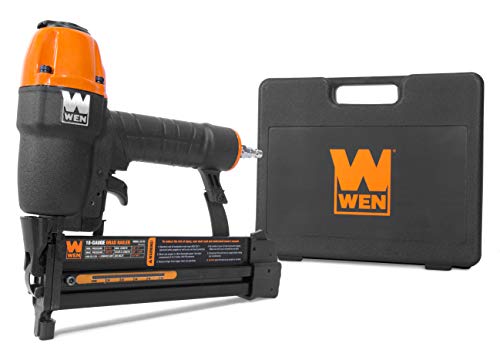
WEN 61722K 18-Gauge Pneumatic Brad Nailer and Stapler
Best for: Occasional trim work, crafts, and light-duty nailing on a tight budget
- Brand
- WEN
- Type
- Pneumatic brad nailer and crown stapler
- Power
- Pneumatic (60 to 100 PSI)
- Weight
- 3.2 lbs
- Warranty
- 2-year limited
$41.79Amazon price as of Oct 7, 6:59 PM EDTProduct prices and availability are accurate as of the date/time indicated and are subject to change. Any price and availability information displayed on Amazon.com at the time of purchase will apply to the purchase of this product.
What we like
- The lowest price on this list
- Fires both 18-gauge brads and 1/4" crown staples
- Tool-free depth adjustment
- Includes a hard-shell carrying case
Watch out for
- Requires an air compressor (not standalone)
- Less durable than pro-grade pneumatic nailers
- 2-year warranty is shorter than Metabo HPT's
The WEN 61722K is the cheapest functional brad nailer worth buying, and it doubles as a stapler. The same magazine takes 18-gauge brads up to 2" or 1/4" crown staples, so one tool covers trim, cabinet backs, and upholstery jobs. Depth adjustment is tool-free, and WEN includes a hard-shell carrying case.
It weighs 3.2 pounds, light enough for a full day of baseboard work. For occasional trim work, picture framing, or craft projects, you don't need a premium cordless model. Pair this with a small air compressor, and you have a capable brad nailing setup for less than the price of most cordless brad nailers alone.
The tradeoff is refinement. Jam clearing and depth consistency aren't as polished as on pro-grade tools. If you're doing professional trim work every day, invest in the Milwaukee or DeWalt. But for weekend projects and light-duty use, the WEN is hard to beat at this price.

Ryobi P320 ONE+ AirStrike 18-Gauge Cordless Brad Nailer
Best for: Budget-friendly cordless brad nailing for homeowners on the ONE+ platform
- Brand
- Ryobi
- Type
- Cordless brad nailer
- Power
- Cordless (ONE+ 18V battery, sold separately)
- Weight
- 5.0 lbs (bare tool)
- Warranty
- 3-year limited
$139.95Amazon price as of Oct 7, 6:59 PM EDTProduct prices and availability are accurate as of the date/time indicated and are subject to change. Any price and availability information displayed on Amazon.com at the time of purchase will apply to the purchase of this product.
What we like
- Most affordable cordless brad nailer on this list
- Works with the massive Ryobi ONE+ battery system
- LED work light for dim workspaces
- Tool-free depth adjustment and jam release
Watch out for
- Depth consistency is less precise than premium models
- Occasional misfires reported at low battery charge
- Heavier than pneumatic alternatives at 5 lbs
The Ryobi P320 is the most affordable cordless brad nailer worth buying. As a bare tool, it costs less than half the price of the Milwaukee or DeWalt options. And if you already own Ryobi ONE+ batteries from a drill or other tools, you're up and running immediately.
AirStrike technology eliminates the need for a compressor, and the tool-free depth adjustment is straightforward. The LED work light is a nice addition for working in dim spaces like closets or under cabinets. The 105-brad magazine holds nearly as many fasteners as the premium brands.
Where the Ryobi falls short is consistency. Based on user feedback, depth control is less precise than the Milwaukee, and the firing mechanism occasionally misfires at lower battery levels. For occasional home projects, these quirks are manageable. For daily professional use, spend the extra money on the Milwaukee 2746-20.
Pneumatic vs. Cordless: How to Choose the Best Nail Gun Platform
This is the biggest decision you'll make before buying a nail gun. Here's the honest breakdown.
Pneumatic nail guns connect to an air compressor via a hose. They've been the standard for decades and still offer advantages: more consistent driving power, lighter weight (since there's no battery onboard), and lower tool cost. A pneumatic brad nailer usually costs under $100, while a cordless version of the same gauge starts around $130 and goes past $300.
The downside is the compressor itself. You need a compressor with enough CFM to keep up with rapid nailing (at least 2.5 CFM at 90 PSI for most nailers). That's another $150 to $400 upfront. Plus, the hose limits your range and creates a tripping hazard on busy job sites.
Cordless nail guns run on rechargeable batteries and use either a flywheel mechanism or compressed nitrogen/air to drive nails. The best nail guns in the cordless category, from DeWalt, Milwaukee, and Metabo HPT, now perform nearly as well as pneumatic guns for most applications. They're ideal for jobs where dragging a compressor is impractical: rooftop work, fencing, exterior trim, or any site without convenient power.
The downside is cost and weight. Cordless nailers are heavier (the battery adds 1 to 2 pounds) and cost two to four times more than pneumatic equivalents. Battery life varies, but expect 500 to 1,200 nails per charge depending on nail size and battery capacity.
My recommendation: If you already own an air compressor, start with pneumatic nailers. You'll get better value. If you value portability or work in locations without power, cordless is worth the investment. Many professionals now run cordless for framing and pneumatic for finish work, getting the best of both worlds.
Common Questions
What size nail gun do I need for framing?
You need a framing nailer that drives nails from 2" to 3-1/2" in length. The best nail gun for framing uses 0.113" to 0.131" diameter nails (roughly 10 to 11 gauge equivalent). For most residential framing with 2x4 and 2x6 lumber, 3-1/4" or 3-1/2" nails are standard.
Can I use a finish nailer for framing?
No. Finish nails (15 or 16 gauge) are far too thin for structural framing. They don't provide the holding power needed to keep studs, joists, and rafters together. Always use a framing nailer for structural work and a finish nailer for trim only.
What's the difference between 15-gauge and 16-gauge finish nailers?
The 15-gauge nail is slightly thicker (0.072" vs. 0.0625") and has a larger head, giving it more holding power. It's better for hardwood trim and heavy baseboards. The 16-gauge leaves a smaller hole that's easier to fill and is better for softwood trim and lighter casings. For most home projects, 16-gauge is the more versatile choice.
Do I need a brad nailer if I already have a finish nailer?
It depends on your work. A finish nailer handles most trim jobs. But if you work with thin, delicate materials (shoe molding, small craft pieces, thin plywood panels), a brad nailer's thinner 18-gauge nail is far less likely to split the wood. Many carpenters carry both. Even the best nail gun in a heavier gauge can crack thin stock.
How many nails can a cordless nailer fire per charge?
This varies by model and nail size. Framing nailers typically deliver 300 to 700 nails per charge. Finish and brad nailers range from 500 to 1,200 nails per charge. Shorter nails use less energy, so you'll get more shots with 1" brads than with 2-1/2" finish nails.
Is a 21-degree or 30-degree framing nailer better?
The degree refers to the magazine angle. A 30-degree nailer has a more steeply angled magazine, which makes it easier to fit into tight spaces between studs and joists. A 21-degree nailer uses full round-head nails (often required by code in some regions). Check your local building codes, then choose accordingly. For most general framing, I think a 30-degree nail gun is the more versatile option.
Final Thoughts
The best nail gun is the one that matches your project scope. For framing, I'd pick the DeWalt DCN930B for its combination of power, fast follow-up shots, and versatility in a cordless package. For finish work, the DeWalt DCN660B (cordless) or Metabo HPT NT65MA4 (pneumatic) both excel at their price points. And for brad nailing, the Milwaukee 2746-20 sets the standard for cordless precision, while the WEN 61722K proves you don't need to spend much for a capable pneumatic tool.
Don't overthink the pneumatic vs. cordless debate. If you need mobility, go cordless. If you need value and already own a compressor, go pneumatic. In my opinion, many serious builders end up owning both, and that's the smartest approach.
Whatever you choose, buy the right type of nail gun first. A framing nailer can't do finish work, and a brad nailer can't frame a wall. The best nail gun setup for trim work, if I were starting fresh today, would be the DeWalt finish nailer paired with a quality miter saw. Nail the basics (literally), and the rest follows.
The bottom line
DeWalt DCN930B 20V MAX XR 30-Degree Framing Nailer is our best framing nailer.
Best for: Framing, sheathing, and deck building without a compressor
Affiliate Disclosure
This post contains affiliate links. As an Amazon Associate, HomeBuildLab earns from qualifying purchases at no additional cost to you. Learn more
Prices shown are from Amazon at the time indicated and may change. The price and availability on Amazon.com at the time of purchase apply.
Sam Hartwell
Sam Hartwell edits HomeBuildLab's tool reviews and home improvement guides. Every pick starts with manufacturer spec sheets, warranty terms, parts availability and owner feedback, then gets matched to a specific job and budget. Guides list the trade-offs plainly and get updated when models change or go out of stock.
Keep reading: Nailers & Compressors
All nailers & compressors guides → Comparison
Nailers & Compressors
Brad Nailer vs Finish Nailer: The Right Nailer for Your Trim Job
Brad nailer vs finish nailer: learn the key differences in gauge, holding power, and nail visibility so you pick the right tool for trim, molding, and cabinets.
Updated
 Top Picks
Nailers & Compressors
Best Brad Nailers for Trim and Finish Work: 7 Picks That Won't Split Your Wood
I compared the best brad nailers for trim, molding, and finish work. Find the right 18-gauge brad nailer for your project with honest reviews and buying advice.
Updated
 Buying Guide
Nailers & Compressors
What Size Air Compressor Do I Need? A Practical Sizing Guide
Find out what size air compressor you need based on CFM, PSI, and tank size. Includes a tool-by-tool chart and real sizing scenarios for home and garage.
Updated
 Comparison
Nailers & Compressors
Pancake vs Hot Dog Air Compressor: Which Tank Shape Actually Matters?
Pancake vs hot dog air compressor: I compare tank shape, portability, CFM, noise, and capacity so you can pick the right compressor for your projects.
Updated
 Top Picks
Nailers & Compressors
Best Air Compressors for Home Garage: Portable and Stationary Picks
I compared the best air compressors for home garages and workshops. From quiet trim models to 27-gallon tanks, find the right compressor for your needs.
Updated
The HomeBuildLab newsletter
New guides and tool deals worth knowing about
One short email when we publish or update a buying guide. No spam, unsubscribe anytime.