Best Rotary Tools in 2026: Dremel and the Alternatives Worth Buying
Looking for the best rotary tool in 2026? I compared 7 models from budget kits to pro picks and chose the best for carving, cutting, grinding, and polishing.
Reader-supported: we may earn a commission when you buy through links on this page, at no extra cost to you. How we research
We don't run a test lab. For each guide we compare manufacturer specs, warranty terms and owner reviews, then match models to specific jobs and budgets. We say when a pick is a trade-off, and every product has cons listed.
As an Amazon Associate, HomeBuildLab earns from qualifying purchases. Read our full affiliate disclosure.
Our top picks
Compare all 7 ↓- Best OverallDremel 4300-5/40
Serious hobbyists and frequent users who want top-tier power and the full Dremel accessory ecosystem
$129.00Amazon price as of Oct 7, 5:02 PM EDTProduct prices and availability are accurate as of the date/time indicated and are subject to change. Any price and availability information displayed on Amazon.com at the time of purchase will apply to the purchase of this product.
View on Amazon - Best ValueWEN 23103
Budget-conscious buyers who want a capable rotary tool with a massive accessory kit and flex shaft included
$20.64Amazon price as of Oct 7, 5:02 PM EDTProduct prices and availability are accurate as of the date/time indicated and are subject to change. Any price and availability information displayed on Amazon.com at the time of purchase will apply to the purchase of this product.
View on Amazon - Best for BeginnersDremel 3100-1/15
First-time rotary tool users who want a reliable brand, simple controls, and room to grow into Dremel's accessory ecosystem
$59.97Amazon price as of Oct 7, 5:02 PM EDTProduct prices and availability are accurate as of the date/time indicated and are subject to change. Any price and availability information displayed on Amazon.com at the time of purchase will apply to the purchase of this product.
View on Amazon

If you need the best rotary tool for detailed work, you have more options than ever. I have owned three different rotary tools over the years, and the differences between a good one and a cheap one are real. In my opinion, too many people default to Dremel without considering the competition. Dremel has been synonymous with rotary tools for decades, but "Dremel" is a brand, not a category. Several competitors now match or beat Dremel on specific features like accessory count, motor power, or price.
Here's the truth: most people overspend when shopping for the best rotary tool. A premium kit makes sense if you use one daily, but a budget tool with 100 accessories handles weekend carving, light grinding, and hobby projects just as well. The motor matters, the speed range matters, and the collet system matters. Everything else is marketing.
I compared seven rotary tools across corded and cordless options to find the best rotary tool at every price point. Whether you are engraving jewelry, sharpening garden tools, or cutting drywall for an outlet box, one of these tools fits your needs.
Quick Picks: Best Rotary Tools at a Glance
- Best Overall: Dremel 4300-5/40. The most powerful motor, a universal chuck, and a built-in pivot light. I'd pick this one for most people. Check price|Review
- Best Value: WEN 23103. A 1-amp motor with 100+ accessories and a flex shaft for under $30. Nothing else comes close at this price. Check price|Review
- Best for Beginners: Dremel 3100-1/15. Simple speed dial, lightweight, and backed by Dremel's ecosystem. Check price|Review
- Budget Pick: GOXAWEE 180-Piece Kit. 181 accessories for the price of a pizza dinner. Seriously. Check price|Review
- Best Cordless: Dremel 8240. 12V power that rivals corded tools, with 5,000 to 35,000 RPM. Check price|Review
- Best Lightweight Cordless: Dremel Lite 7760. Under 10 ounces for craft and hobby work. Check price|Review
- Best for Pros: Milwaukee M12 2460-20. Built for tradespeople who need a rotary tool that survives jobsite abuse. Check price|Review
Compare our picks
7 picks- Best OverallDremel 4300-5/40
Dremel · Corded · 1.81 lbs
Serious hobbyists and frequent users who want top-tier power and the full Dremel accessory ecosystem
$129.00Amazon price as of Oct 7, 5:02 PM EDTProduct prices and availability are accurate as of the date/time indicated and are subject to change. Any price and availability information displayed on Amazon.com at the time of purchase will apply to the purchase of this product.
View on Amazon - Best ValueWEN 23103
WEN · Corded · 1.5 lbs
Budget-conscious buyers who want a capable rotary tool with a massive accessory kit and flex shaft included
$20.64Amazon price as of Oct 7, 5:02 PM EDTProduct prices and availability are accurate as of the date/time indicated and are subject to change. Any price and availability information displayed on Amazon.com at the time of purchase will apply to the purchase of this product.
View on Amazon - Best for BeginnersDremel 3100-1/15
Dremel · Corded · 1.25 lbs (20 oz)
First-time rotary tool users who want a reliable brand, simple controls, and room to grow into Dremel's accessory ecosystem
$59.97Amazon price as of Oct 7, 5:02 PM EDTProduct prices and availability are accurate as of the date/time indicated and are subject to change. Any price and availability information displayed on Amazon.com at the time of purchase will apply to the purchase of this product.
View on Amazon - Budget PickGOXAWEE 180-Piece Rotary Tool Kit
GOXAWEE · Corded · 1.7 lbs
Crafters, hobbyists, and anyone who wants a huge accessory kit at the lowest possible price
$33.98Amazon price as of Oct 7, 5:02 PM EDTProduct prices and availability are accurate as of the date/time indicated and are subject to change. Any price and availability information displayed on Amazon.com at the time of purchase will apply to the purchase of this product.
View on Amazon - Best CordlessDremel 8240-5
Dremel · Cordless (12V Li-Ion) · 1.46 lbs (23.3 oz)
Users who want cordless freedom with corded-level power and full Dremel accessory compatibility
$79.00Amazon price as of Oct 7, 5:02 PM EDTProduct prices and availability are accurate as of the date/time indicated and are subject to change. Any price and availability information displayed on Amazon.com at the time of purchase will apply to the purchase of this product.
View on Amazon - Best Lightweight CordlessDremel Lite 7760
Dremel · Cordless (4V Li-Ion) · 0.6 lbs (9.5 oz)
Crafters, light engravers, and hobby users who want an ultra-light cordless tool for detail work
$49.99Amazon price as of Oct 7, 5:02 PM EDTProduct prices and availability are accurate as of the date/time indicated and are subject to change. Any price and availability information displayed on Amazon.com at the time of purchase will apply to the purchase of this product.
View on Amazon - Best for ProsMilwaukee M12 2460-20
Milwaukee · Cordless (12V M12 system) · 1.3 lbs (without battery)
Tradespeople and contractors who already own Milwaukee M12 batteries and need a durable jobsite rotary tool
$102.99Amazon price as of Oct 7, 5:02 PM EDTProduct prices and availability are accurate as of the date/time indicated and are subject to change. Any price and availability information displayed on Amazon.com at the time of purchase will apply to the purchase of this product.
View on Amazon
What Can You Do with a Rotary Tool?
A rotary tool is one of the most versatile tools you can own. The spinning bit (or accessory) handles tasks that no other single tool can match. Here is what you can do with one:
Carving and engraving. Wood, glass, metal, and even stone. Rotary tools with fine-point bits let you add custom details to furniture, signs, and craft projects. Keep the speed low (10,000 to 15,000 RPM) for control.
Cutting. Thin metal, plastic, drywall, tile, and PVC pipe. A cut-off wheel on a rotary tool reaches spots that a jigsaw or oscillating tool cannot. (For a full breakdown, see our rotary tool vs oscillating tool comparison.) Perfect for outlet boxes, trimming grout lines, or cutting bolts.
Grinding and sharpening. Aluminum oxide grinding stones reshape metal, remove rust, and sharpen lawnmower blades, axes, and garden shears. Rotary tools excel at tool maintenance.
Sanding and polishing. Small sanding drums and flap wheels get into curves, corners, and tight spaces that an orbital sander cannot reach. Polishing wheels with compound bring metals and plastics to a mirror finish.
Drilling. Tiny drill bits (1/32 inch and smaller) work for jewelry making, model building, and PCB boards. A full-size drill cannot touch this level of precision.
The key to all of these tasks is matching the RPM to the material. I learned this the hard way by melting plastic on my first rotary tool project. Soft materials like wood and plastic need lower speeds. Hard materials like metal and stone need higher speeds with less pressure.
Our Top Picks for Best Rotary Tool
Dremel 4300-5/40
Best for: Serious hobbyists and frequent users who want top-tier power and the full Dremel accessory ecosystem
- Brand
- Dremel
- Type
- Rotary tool
- Power
- Corded
- Weight
- 1.81 lbs
$129.00Amazon price as of Oct 7, 5:02 PM EDTProduct prices and availability are accurate as of the date/time indicated and are subject to change. Any price and availability information displayed on Amazon.com at the time of purchase will apply to the purchase of this product.
What we like
- 1.8-amp motor with electronic feedback for consistent speed under load
- Universal three-jaw chuck accepts all Dremel shank sizes without collet changes
- Pivot light rotates to illuminate hard-to-see work areas
- Advanced airflow system runs cooler and quieter than previous Dremel models
Watch out for
- 6-foot cord limits mobility in larger workshops
- Heavier than the Dremel 3100 or budget alternatives
- The 5/40 kit is a mid-range package; the 9/64 kit with 64 accessories costs more
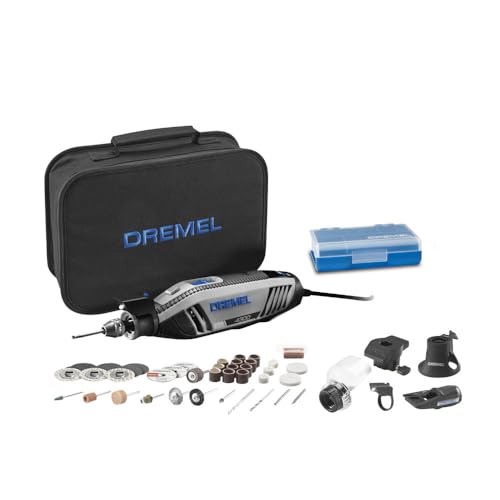
The Dremel 4300 is the strongest corded rotary tool Dremel makes, and I think it earns the best overall spot for good reason. The 1.8-amp motor delivers consistent torque across the full speed range, and electronic feedback keeps the RPM steady under load. That means the bit does not bog down when you push into hardwood or metal.
The feature that sets the 4300 apart is its universal three-jaw chuck. Older Dremel models use collets that only accept specific shank sizes. The 4300 takes 1/32-inch, 1/16-inch, 3/32-inch, and 1/8-inch shanks without swapping collets. This alone saves minutes of frustration on every project. The built-in pivot light illuminates your workpiece in tight spaces, and the slim ergonomic body is comfortable during extended sessions.
The 5/40 kit includes a sanding/grinding guide, a cutting shield, a garden tool sharpener, the multipurpose cutting attachment, and 40 accessories. It is everything you need in one box. The only downside is the 6-foot cord, which feels short in a larger workshop.

WEN 23103
Best for: Budget-conscious buyers who want a capable rotary tool with a massive accessory kit and flex shaft included
- Brand
- WEN
- Type
- Rotary tool
- Power
- Corded
- Weight
- 1.5 lbs
$20.64Amazon price as of Oct 7, 5:02 PM EDTProduct prices and availability are accurate as of the date/time indicated and are subject to change. Any price and availability information displayed on Amazon.com at the time of purchase will apply to the purchase of this product.
What we like
- Exceptional value with 100+ accessories, flex shaft, and carrying case for under $30
- 1-amp motor handles most common rotary tool tasks without issue
- Flex shaft included for fine detail work
- Lightweight at 1.5 lbs for comfortable extended use
Watch out for
- Speed range starts at 10,000 RPM (no low-speed option for delicate materials)
- Collet system is basic compared to keyless chucks
- Motor may struggle under heavy sustained load on hardwood or thick metal
The WEN 23103 is a strong contender for the best rotary tool under $30, and it punches far above its price. For a rock-bottom price, you get a 1-amp motor, a flex shaft attachment, 100+ accessories, and a carrying case. That is an absurd amount of value, and the tool itself is genuinely good for light to moderate work.
The speed range of 10,000 to 32,000 RPM covers most tasks, though you miss the low-end range (5,000 to 10,000 RPM) that the Dremel 4300 offers. For carving soft wood or sanding delicate materials, that lower range is nice to have. For grinding, cutting, and polishing, the WEN handles everything just fine. The included flex shaft is a real standout. It gives you pen-like grip for fine detail work, which many pricier kits sell as a separate add-on.
The 1/8-inch and 3/32-inch collets cover most standard accessories. Build quality is solid for the price, though the motor will not match a Dremel under heavy sustained load. If you are a hobbyist, crafter, or occasional user, I think the WEN 23103 is the best rotary tool value on the market.

Dremel 3100-1/15
Best for: First-time rotary tool users who want a reliable brand, simple controls, and room to grow into Dremel's accessory ecosystem
- Brand
- Dremel
- Type
- Rotary tool
- Power
- Corded
- Weight
- 1.25 lbs (20 oz)
$59.97Amazon price as of Oct 7, 5:02 PM EDTProduct prices and availability are accurate as of the date/time indicated and are subject to change. Any price and availability information displayed on Amazon.com at the time of purchase will apply to the purchase of this product.
What we like
- Full 5,000 to 35,000 RPM speed range, same as the premium 4300
- Lightweight (20 oz) and compact (7.5 inches) for easy handling
- Compatible with all Dremel accessories and attachments
- Recycled plastic housing is an environmental plus
Watch out for
- Only 15 accessories included. You will need to buy more separately.
- No built-in light like the 4300
- 1.2-amp motor will bog down faster than the 4300's 1.8-amp motor on heavy cuts
The Dremel 3100 is the replacement for the legendary Dremel 3000, and it is the best entry point into the Dremel ecosystem. The 1.2-amp motor is powerful enough for sanding, engraving, light cutting, and polishing. Five speed settings from 5,000 to 35,000 RPM give you the full range that budget alternatives lack.
At just 20 ounces and 7.5 inches long, the 3100 is noticeably lighter and shorter than the 4300. If you have never used a rotary tool before, the smaller size makes it easier to control. The 6-foot cord gives you enough reach for benchtop work. One nice touch: the housing is made from over 65% recycled plastic, which is a first for Dremel.
The 1/15 kit includes 15 accessories (grinding stones, sanding drums, cut-off wheels, a polishing wheel) and one attachment. That is enough to get started, but you will probably want more accessories within a week. Dremel's accessory catalog is enormous, so growing your collection is easy. If you want more accessories from the start, look at the 3100-2/60 kit.
GOXAWEE 180-Piece Rotary Tool Kit
Best for: Crafters, hobbyists, and anyone who wants a huge accessory kit at the lowest possible price
- Brand
- GOXAWEE
- Type
- Rotary tool
- Power
- Corded
- Weight
- 1.7 lbs
$33.98Amazon price as of Oct 7, 5:02 PM EDTProduct prices and availability are accurate as of the date/time indicated and are subject to change. Any price and availability information displayed on Amazon.com at the time of purchase will apply to the purchase of this product.
What we like
- 181 accessories, flex shaft, shield, and carrying case at a budget price
- Universal collet accepts 1/64-inch to 1/8-inch shanks
- 180W motor is stronger than many budget competitors
- Excellent starter kit for trying rotary tool work without a big investment
Watch out for
- Accessory quality is hit-or-miss; cut-off wheels and sanding discs wear quickly
- Motor runs hotter under sustained heavy use compared to Dremel
- Long-term durability is a question mark; this is not a buy-it-for-life tool
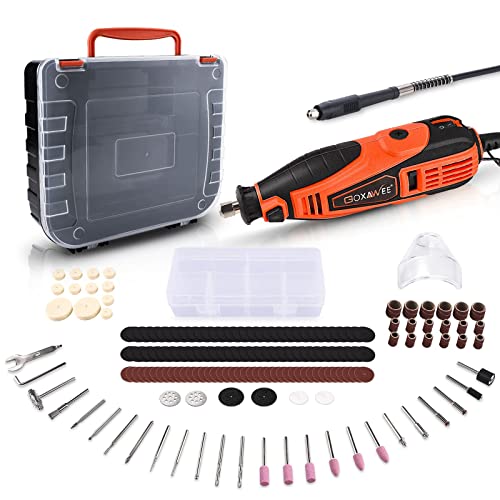
The GOXAWEE 180-piece kit is the budget king. For a budget price, you get the rotary tool, a flex shaft, a cutting shield, a drill locator, 181 accessories, and a carrying case. The accessory count alone makes this kit hard to ignore. You get sanding drums, grinding stones, cut-off wheels, diamond bits, polishing wheels, drill bits, and mandrels.
The 180W copper motor delivers variable speed from 8,000 to 35,000 RPM with five step settings. The universal three-jaw collet accepts 1/64-inch to 1/8-inch shanks, making it compatible with most Dremel-branded accessories too. The flex shaft holds like a pen and is genuinely useful for engraving, jewelry work, and detail carving.
Here is the honest trade-off, and I think this matters: the accessories are quantity over quality. Many of the cut-off wheels and sanding discs will wear out faster than name-brand equivalents. The motor also runs hotter than a Dremel under sustained heavy use. But for hobby work, crafts, and occasional projects, the GOXAWEE delivers more than enough performance. Replace the cheap bits with better ones as they wear out, and you still come out ahead on cost.

Dremel 8240-5
Best for: Users who want cordless freedom with corded-level power and full Dremel accessory compatibility
- Brand
- Dremel
- Type
- Rotary tool
- Power
- Cordless (12V Li-Ion)
- Weight
- 1.46 lbs (23.3 oz)
$79.00Amazon price as of Oct 7, 5:02 PM EDTProduct prices and availability are accurate as of the date/time indicated and are subject to change. Any price and availability information displayed on Amazon.com at the time of purchase will apply to the purchase of this product.
What we like
- 12V brushless motor matches corded tools at 5,000 to 35,000 RPM
- 360-degree grip zone and EZ Twist nose cap for comfortable, wrench-free use
- LED battery indicator and 2.0Ah battery for solid runtime
- Compatible with all Dremel accessories and attachments
Watch out for
- Only 5 accessories included; you need to buy more separately
- Costs nearly as much as the corded 4300-5/40 kit, which includes 40 accessories
- Battery replacement adds long-term cost
The Dremel 8240 is the best cordless rotary tool available, and in my opinion, it is the first battery model that truly rivals corded performance. The 12V brushless motor delivers the same 5,000 to 35,000 RPM range as the corded 4300, and the 2.0Ah battery provides enough runtime for most projects before needing a charge.
The 360-degree grip zone is a design highlight. Unlike the 4300's traditional barrel grip, the 8240 has a rubberized comfort zone that wraps the entire body. You can hold it at any angle without losing control. The EZ Twist nose cap lets you change accessories with one hand (no wrench needed), and the LED battery indicator keeps you from unexpected mid-project shutdowns.
The trade-off is accessory count. The 8240-5 kit only includes five accessories, which means you need to supply your own bits and attachments. If you already own Dremel accessories from a previous tool, that is not a problem. If you are starting from scratch, budget an extra $20 to $40 for an accessory set. The battery charges in about two hours, and replacement batteries are available but not cheap.

Dremel Lite 7760
Best for: Crafters, light engravers, and hobby users who want an ultra-light cordless tool for detail work
- Brand
- Dremel
- Type
- Rotary tool
- Power
- Cordless (4V Li-Ion)
- Weight
- 0.6 lbs (9.5 oz)
$49.99Amazon price as of Oct 7, 5:02 PM EDTProduct prices and availability are accurate as of the date/time indicated and are subject to change. Any price and availability information displayed on Amazon.com at the time of purchase will apply to the purchase of this product.
What we like
- Ultra-light at 9.5 ounces for fatigue-free detail work
- Very smooth motor with minimal vibration at all speeds
- USB charging for convenient power-ups
- EZ Twist nose cap for wrench-free accessory swaps
Watch out for
- 4V motor lacks power for heavy grinding, cutting metal, or dense hardwood
- Max 25,000 RPM limits performance on harder materials
- Small battery means shorter runtime than the 12V 8240
The Dremel Lite 7760 weighs just 9.5 ounces. That is lighter than most smartphones in a heavy case. If you do craft work, light engraving, or small polishing jobs, the Lite is the most comfortable rotary tool you can hold for extended periods.
The 4V motor is less powerful than the 8240's 12V, and the speed range tops out at 25,000 RPM instead of 35,000. You will feel the power difference on anything harder than softwood or thin plastic. But for its intended use (crafting, jewelry touch-ups, light sanding, etching glass), the Lite performs beautifully. What I like most about this tool is how smooth the motor runs at all speed settings, with almost no vibration.
The EZ Twist nose cap makes tool-free accessory changes quick, and USB charging means you can top off the battery anywhere. At its budget price, the Lite is an excellent second rotary tool for detail work, or a great starter for crafters who do not need heavy cutting or grinding power.
Milwaukee M12 2460-20
Best for: Tradespeople and contractors who already own Milwaukee M12 batteries and need a durable jobsite rotary tool
- Brand
- Milwaukee
- Type
- Rotary tool
- Power
- Cordless (12V M12 system)
- Weight
- 1.3 lbs (without battery)
$102.99Amazon price as of Oct 7, 5:02 PM EDTProduct prices and availability are accurate as of the date/time indicated and are subject to change. Any price and availability information displayed on Amazon.com at the time of purchase will apply to the purchase of this product.
What we like
- Integrates with the massive Milwaukee M12 battery platform
- Rugged build quality designed for jobsite durability
- 5,000 to 32,000 RPM covers most professional cutting and grinding tasks
- Bare tool pricing is competitive if you already own M12 batteries
Watch out for
- Battery and charger sold separately, which adds real cost if you are starting fresh
- 1/8-inch collet only; no smaller shank sizes without adapters
- Minimal included accessories (5 cutting wheels, mandrel, wrench)
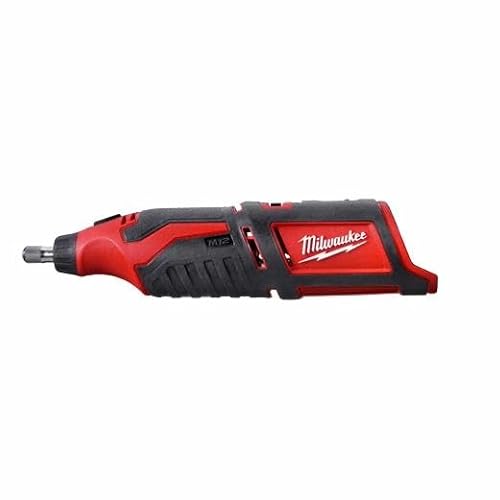
The Milwaukee M12 rotary tool is built for jobsite conditions, not craft tables. The 1/8-inch collet handles standard rotary accessories, and the 5,000 to 32,000 RPM range covers cutting, grinding, and deburring metal. If you are an electrician cutting conduit, a plumber deburring pipe, or a contractor cleaning up welds, this is the rotary tool built for your world.
The M12 platform is the real draw here, and it is why this tool makes the list of the best rotary tool options for professionals. If you already own Milwaukee M12 batteries (and millions of tradespeople do), the 2460-20 bare tool is an easy, reasonably priced add to your kit. The batteries swap between your drill, impact driver, and rotary tool. That ecosystem advantage is hard to overstate.
Build quality is a step above consumer-grade tools. The housing is thicker, the switch feels more robust, and the tool tolerates drops and rough handling. The trade-off is accessory variety. Milwaukee only includes five cutting wheels, a mandrel, and a wrench. You supply everything else. Also, the 1/8-inch collet does not accept smaller shank sizes without an adapter, which limits its use for fine detail work compared to Dremel's multi-collet systems.
Corded vs Cordless: Which Is the Best Rotary Tool Setup?
Choosing between corded and cordless comes down to how and where you work.
Corded rotary tools deliver unlimited runtime and consistent power. The Dremel 4300's 1.8-amp motor never fades, never needs recharging, and costs less per dollar of performance than cordless models. If your rotary tool lives on a workbench and you have an outlet nearby, corded is the practical choice. The WEN 23103 and GOXAWEE kit prove that corded tools can be incredibly affordable too.
Cordless rotary tools offer freedom of movement and work anywhere. The Dremel 8240 has closed the power gap significantly, matching corded RPM ranges. But battery life is still the limiting factor. A 2.0Ah battery lasts 30 to 60 minutes of active use depending on the speed and load. If you use a rotary tool for quick jobs (deburring a pipe, touching up an engraving, sharpening a blade), cordless is convenient. For extended sessions, you will want a backup battery or a corded tool.
The bottom line: If you own one rotary tool, make it corded. The best rotary tool for pure performance per dollar is still a corded model. If you want a second one for portability, add a cordless model. The Dremel 4300 (corded) and the Dremel 8240 (cordless) make an ideal pair.
Common Questions About Rotary Tools
What collet sizes do I need?
Most rotary tool accessories use 1/8-inch shanks. That is the standard. You will occasionally encounter 3/32-inch and 1/32-inch shanks for smaller bits used in engraving and jewelry work. Tools with a universal chuck (like the Dremel 4300 or GOXAWEE) accept all sizes. Tools with fixed collets (like the Milwaukee M12) may require adapters for smaller shanks.
Can I use Dremel accessories in non-Dremel tools?
Yes, in most cases. Any tool that accepts 1/8-inch shanks can use Dremel-branded accessories. The GOXAWEE and WEN both work with standard Dremel bits, wheels, and drums. Check your collet size before buying.
How fast should I run my rotary tool?
Match the speed to the task. Use 5,000 to 10,000 RPM for carving, engraving, and working with soft materials. Use 15,000 to 25,000 RPM for sanding, polishing, and general-purpose work. Use 25,000 to 35,000 RPM for cutting metal, grinding, and removing material quickly. When in doubt, start slow and increase speed until the tool cuts comfortably without burning the material.
Are budget rotary tools worth it?
For hobby and occasional use, absolutely. Finding the best rotary tool does not mean spending the most money. The WEN 23103 and GOXAWEE kit deliver real results for under $40. The motors are less powerful, the accessories wear faster, and the tools may not last as many years as a Dremel. But if you use a rotary tool a few times a month, a budget option pays for itself many times over. Upgrade to a Dremel 4300 or 8240 when (and if) you outgrow it.
What accessories should I buy first?
Even the best rotary tool is only as good as its accessories. If your kit does not include them, start with these: a set of cut-off wheels (you will go through many), a variety pack of sanding drums, a few aluminum oxide grinding stones, and a polishing wheel with compound. Diamond-tipped bits are worth adding if you work with glass, tile, or stone. A flex shaft attachment is also highly recommended for detail work.
Final Thoughts
After comparing every option on this list, I believe the best rotary tool for most people is the Dremel 4300-5/40. It has the strongest motor, the most versatile chuck system, and a solid accessory kit in the box. If budget is the priority, the WEN 23103 delivers an almost unbelievable amount of value for under $30. And if you need cordless freedom, the Dremel 8240 finally delivers battery-powered performance that does not compromise on speed or torque.
Rotary tools are the Swiss Army knives of the workshop. They carve, cut, grind, sand, polish, drill, and sharpen. If I could only recommend one best rotary tool to a beginner on a budget, I'd pick the WEN 23103. The value is just unbeatable. No matter which model you choose from this list, you are adding one of the most versatile tools you will ever own.
No matter your budget, the best rotary tool is the one that matches how you actually work. For more precision work, check out our guide to the best scroll saws for intricate curved cuts, or see our best jigsaw roundup if you need a tool that handles larger curved cutting tasks.
The bottom line
Dremel 4300-5/40 is our best overall.
Best for: Serious hobbyists and frequent users who want top-tier power and the full Dremel accessory ecosystem
Affiliate Disclosure
This post contains affiliate links. As an Amazon Associate, HomeBuildLab earns from qualifying purchases at no additional cost to you. Learn more
Prices shown are from Amazon at the time indicated and may change. The price and availability on Amazon.com at the time of purchase apply.
Sam Hartwell
Sam Hartwell edits HomeBuildLab's tool reviews and home improvement guides. Every pick starts with manufacturer spec sheets, warranty terms, parts availability and owner feedback, then gets matched to a specific job and budget. Guides list the trade-offs plainly and get updated when models change or go out of stock.
Keep reading: Grinders & Multi-Tools
All grinders & multi-tools guides → How-To
Grinders & Multi-Tools
What Is an Oscillating Tool Used For? 10 Jobs It Does Better Than Anything Else
What is an oscillating tool used for? From flush cuts to grout removal, here are 10 jobs where an oscillating multi-tool outperforms every other power tool.
Updated
 Comparison
Grinders & Multi-Tools
Rotary Tool vs Oscillating Tool: Same Aisle, Completely Different Jobs
Rotary tool vs oscillating tool: I compare motion type, precision, versatility, and best uses so you can pick the right multi-tool for your next project.
Updated
 Comparison
Grinders & Multi-Tools
Angle Grinder vs Oscillating Tool: Two Tools That Solve Completely Different Problems
Angle grinder vs oscillating tool: one grinds through steel, the other makes precision flush cuts. Learn which tool fits your next project and why it matters.
Updated
 Top Picks
Grinders & Multi-Tools
Best Oscillating Tools (Multi-Tools): 7 Picks for Cutting, Sanding, and Scraping
I compared 7 oscillating multi-tools from budget to pro. Find the best oscillating tool for cutting, sanding, and scraping with honest picks and specs.
Updated
 How-To
Grinders & Multi-Tools
How to Use an Angle Grinder Safely: A Practical Guide for Beginners
Learn how to use an angle grinder safely with our step-by-step guide. Covers PPE, disc types, basic techniques, and the mistakes that cause most injuries.
Updated
 How-To
Grinders & Multi-Tools
How to Solder: A Beginner's Guide to Strong, Clean Joints
Learn how to solder with this step-by-step beginner's guide. Covers tools, solder types, technique, and how to fix mistakes for clean, reliable joints.
Updated
The HomeBuildLab newsletter
New guides and tool deals worth knowing about
One short email when we publish or update a buying guide. No spam, unsubscribe anytime.