Best Belt Sanders in 2026: Raw Power for Fast, Flat Results
I compared the best belt sanders for 2026 across every price range and budget. Find the right 3x21 or 4x24 model for your workshop, with honest pros and cons.
Reader-supported: we may earn a commission when you buy through links on this page, at no extra cost to you. How we research
We don't run a test lab. For each guide we compare manufacturer specs, warranty terms and owner reviews, then match models to specific jobs and budgets. We say when a pick is a trade-off, and every product has cons listed.
As an Amazon Associate, HomeBuildLab earns from qualifying purchases. Read our full affiliate disclosure.
Our top picks
Compare all 7 ↓- Best OverallMakita 9903
Serious woodworkers who want a belt sander that lasts a lifetime
$399.00Amazon price as of Oct 7, 1:01 PM EDTProduct prices and availability are accurate as of the date/time indicated and are subject to change. Any price and availability information displayed on Amazon.com at the time of purchase will apply to the purchase of this product.
View on Amazon - Best for Heavy Stock RemovalMakita 9403
Large surfaces, flooring, deck prep, and heavy material removal
$419.00Amazon price as of Oct 7, 1:01 PM EDTProduct prices and availability are accurate as of the date/time indicated and are subject to change. Any price and availability information displayed on Amazon.com at the time of purchase will apply to the purchase of this product.
View on Amazon

A belt sander is the workhorse of any sanding operation. I reach for mine more than almost any other tool when I am prepping a project. When you need to strip paint, level rough lumber, or knock down a glue joint fast, no other power sander comes close. The best belt sander for your workshop depends on how much material you need to remove, how often you will use it, and whether portability matters to you.
Here is the truth: most people buy too much or too little. A cheap model with a weak motor will bog down under pressure and burn through belts. An overbuilt 4x24 beast might be overkill for occasional trim work. The sweet spot depends on your actual projects. I researched dozens of models, compared specs, dug through user feedback, and narrowed the field to seven picks that cover every budget and use case.
Whether you are flattening a tabletop, prepping a deck for refinish, or shaping a woodworking project, one of these tools will get the job done. If sanding is just part of a bigger toolkit you are building, you might also want to check out our best orbital sander picks for finish work.
Quick Picks: Best Belt Sanders at a Glance
- Best Overall: Makita 9903. Smooth variable speed, auto-tracking belt, and a reputation for lasting decades. I think this is the one most people should buy. Check price|Review
- Best for Heavy Stock Removal: Makita 9403. An 11-amp, 4x24 powerhouse that eats material for breakfast. Check price|Review
- Best Value: WEN 6321. A solid 3x21 model under $50 that punches above its price. Check price|Review
- Best Variable Speed Control: Metabo HPT SB8V2. Wide speed range (820 to 1,475 FPM) with a 9-amp motor and 5-year warranty. Check price|Review
- Best Cordless: DEWALT DCW220B. The only serious cordless option on the market, with 20V MAX XR power. Check price|Review
- Best Budget Pick: BLACK+DECKER DS321. The "Dragster" design gets close to edges, and the price is hard to beat. Check price|Review
- Best for Beginners: CRAFTSMAN CMEW213. Easy to handle, widely available, and backed by a brand most people already trust. Check price|Review
Compare our picks
7 picks- Best OverallMakita 9903
Makita · Corded · 9.5 lbs
Serious woodworkers who want a belt sander that lasts a lifetime
$399.00Amazon price as of Oct 7, 1:01 PM EDTProduct prices and availability are accurate as of the date/time indicated and are subject to change. Any price and availability information displayed on Amazon.com at the time of purchase will apply to the purchase of this product.
View on Amazon - Best for Heavy Stock RemovalMakita 9403
Makita · Corded · 12.6 lbs
Large surfaces, flooring, deck prep, and heavy material removal
$419.00Amazon price as of Oct 7, 1:01 PM EDTProduct prices and availability are accurate as of the date/time indicated and are subject to change. Any price and availability information displayed on Amazon.com at the time of purchase will apply to the purchase of this product.
View on Amazon - Best ValueWEN 6321
WEN · Corded · 6 lbs
Budget-conscious buyers who need a reliable sander for occasional use
Out of stock on Amazon right now
- Best Variable Speed ControlMetabo HPT SB8V2
Metabo HPT · Corded · 9.5 lbs
Versatile sanding across different materials and tasks
$132.05Amazon price as of Oct 7, 1:01 PM EDTProduct prices and availability are accurate as of the date/time indicated and are subject to change. Any price and availability information displayed on Amazon.com at the time of purchase will apply to the purchase of this product.
View on Amazon - Best CordlessDEWALT DCW220B
DEWALT · Cordless (20V MAX XR) · 8 lbs (bare tool)
Jobsite use, remote work, and users already on the DEWALT 20V platform
$227.95Amazon price as of Oct 7, 1:01 PM EDTProduct prices and availability are accurate as of the date/time indicated and are subject to change. Any price and availability information displayed on Amazon.com at the time of purchase will apply to the purchase of this product.
View on Amazon - Best Budget PickBLACK+DECKER DS321
BLACK+DECKER · Corded · 8.2 lbs
Edge sanding, getting into tight spots, and light general-purpose work
$59.99Amazon price as of Oct 7, 1:01 PM EDTProduct prices and availability are accurate as of the date/time indicated and are subject to change. Any price and availability information displayed on Amazon.com at the time of purchase will apply to the purchase of this product.
View on Amazon - Best for BeginnersCRAFTSMAN CMEW213
CRAFTSMAN · Corded · 7.5 lbs
First-time belt sander users who want a reliable, easy-to-use tool
$99.00Amazon price as of Oct 7, 1:01 PM EDTProduct prices and availability are accurate as of the date/time indicated and are subject to change. Any price and availability information displayed on Amazon.com at the time of purchase will apply to the purchase of this product.
View on Amazon
What to Look for in a Belt Sander
Before you pick a model, you need to understand the specs that actually matter. Here is what separates a good sander from one that will collect dust in your garage.
Belt Size: 3x21 vs 4x24
The two most common sizes are 3x21 inches and 4x24 inches. A 3x21 model is lighter, easier to control, and ideal for general-purpose sanding on furniture, doors, and trim. A 4x24 covers more surface area per pass and removes material faster, making it the better choice for large surfaces like tabletops, decks, and flooring.
If you only buy one, I would start with a 3x21. It is the more versatile size and replacement belts are cheaper and easier to find.
Speed (FPM)
Speed is measured in feet per minute (FPM). Higher speeds remove material faster, but they also generate more heat. For most woodworking tasks, 800 to 1,200 FPM is the sweet spot. Variable speed is a big advantage because it lets you dial down for delicate work on softwoods and crank up for heavy stock removal on hardwoods.
Motor Power (Amps)
More amps generally mean more sustained power under load. Budget models run 6 to 7 amps and are fine for light work. Mid-range options hit 8 to 9 amps and handle most tasks well. Heavy-duty 4x24 sanders pull 11 amps and can chew through material without bogging down.
Dust Collection
These tools throw a lot of dust. Every model on this list includes a dust bag, but the effectiveness varies. Models with a dedicated dust port (especially 2.25-inch ports) can connect to a shop vacuum for much better dust management. If you work indoors, this matters more than you think.
Weight and Ergonomics
A lighter sander is easier to control, especially for vertical or overhead work. But weight also helps the tool do its job. The sander's own mass provides downward pressure, so a heavier model requires less effort to push into the work. Expect 6 to 13 pounds depending on the size and motor.
Belt Tracking
Tracking keeps the sanding belt centered on the rollers. Manual tracking requires you to adjust a knob when the belt drifts. Auto-tracking (found on Makita models) corrects drift automatically, which saves time and prevents the belt from running off the edge. In my opinion, auto-tracking is one of those features you do not appreciate until you have spent ten minutes fiddling with a manual adjustment knob.
Best Belt Sanders: Our Top Picks

Makita 9903
Best for: Serious woodworkers who want a belt sander that lasts a lifetime
- Brand
- Makita
- Type
- Belt sander
- Power
- Corded
- Weight
- 9.5 lbs
$399.00Amazon price as of Oct 7, 1:01 PM EDTProduct prices and availability are accurate as of the date/time indicated and are subject to change. Any price and availability information displayed on Amazon.com at the time of purchase will apply to the purchase of this product.
What we like
- Auto-tracking belt eliminates manual adjustment hassle
- Variable speed from 690 to 1,440 FPM covers almost any task
- Electronic speed control maintains power under load
- Exceptionally quiet at 84 dB
Watch out for
- Premium price, well above budget 3x21 models
- At 9.5 lbs, heavier than budget 3x21 models
- Dust bag is adequate but not exceptional
The Makita 9903 is the model that professional woodworkers and contractors reach for again and again. it is the most consistently praised sander in its class. Its 8.8-amp motor delivers consistent power, and the variable speed dial lets you range from 690 to 1,440 FPM. That wide range means you can do everything from aggressive stock removal to gentler finish sanding with the same tool.
What I like most about the 9903 is its auto-tracking system. Instead of fiddling with a manual adjustment knob every time the belt drifts, the 9903 corrects itself. This sounds like a small thing until you have spent 20 minutes fighting a belt that keeps running off the edge. The electronic speed control maintains constant speed under load, so the motor does not slow down when you press into tough material.
The 9903 is not cheap, and that is its only real drawback. But this is a tool built to last for decades, not a few projects. If you are serious about woodworking or do any kind of professional finish work, the investment pays for itself. It also runs at just 84 dB, making it one of the quieter belt sanders in its class.

Makita 9403
Best for: Large surfaces, flooring, deck prep, and heavy material removal
- Brand
- Makita
- Type
- Belt sander
- Power
- Corded
- Weight
- 12.6 lbs
$419.00Amazon price as of Oct 7, 1:01 PM EDTProduct prices and availability are accurate as of the date/time indicated and are subject to change. Any price and availability information displayed on Amazon.com at the time of purchase will apply to the purchase of this product.
What we like
- 11-amp motor at 1,640 FPM removes material extremely fast
- 4x24 belt covers large surfaces quickly
- Electronic speed control prevents bogging under load
- Quiet operation at 84 dB
Watch out for
- Single speed (no variable control)
- Heavy at 12.6 lbs, limiting overhead or vertical use
- 4x24 belts cost more than 3x21 belts
When you need to remove a lot of material in a hurry, the Makita 9403 is the tool for the job. Its 11-amp motor drives a wide 4x24 belt at 1,640 FPM. That is faster than most 3x21 sanders at full speed, and the wider belt covers about 30% more surface area per pass. For sanding tabletops, stripping deck boards, or leveling rough lumber, I have not found anything in the handheld category that is faster.
The 9403 uses electronic speed control to maintain that 1,640 FPM even when you lean into the work. The trade-off is that this is a single-speed machine. You get one speed, and it is fast. For fine finish work, you will want a different tool. But for aggressive stock removal, the 9403 is purpose-built.
At 12.6 pounds, this is a heavy tool. That weight actually works in your favor on flat surfaces because the sander does the pressing for you. But do not plan on using it vertically or overhead for extended periods. Despite its power, the 9403 runs at just 84 dB, which is remarkably quiet for an 11-amp tool.
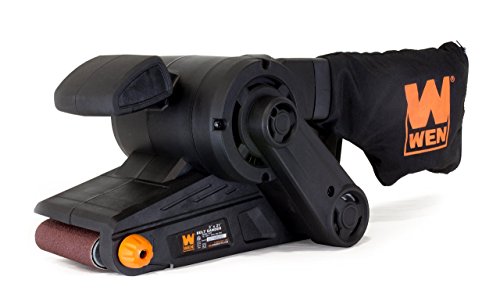
WEN 6321
Best for: Budget-conscious buyers who need a reliable sander for occasional use
- Brand
- WEN
- Type
- Belt sander
- Power
- Corded
- Weight
- 6 lbs
Currently out of stock on Amazon. Other sellers or a restock may be listed there.
What we like
- Outstanding value at under $50
- Lightweight at 6 lbs for easy handling
- Tool-free belt changes with release lever
- 2-year warranty
Watch out for
- Single speed at 820 FPM limits versatility
- Dust collection is basic
- Not built for heavy, all-day professional use
The WEN 6321 proves you do not need to spend hundreds to get started. At under $50, it is the cheapest option on this list, but it does not feel disposable. The 7-amp motor spins the belt at 820 FPM, which is plenty fast for stripping paint, smoothing rough lumber, and knocking down edges.
At just 6 pounds, the 6321 is the lightest sander I compared. That makes it easy to maneuver, especially for beginners who are still learning how much pressure to apply. The belt release lever makes swapping sandpaper quick, and the included dust bag catches a reasonable amount of debris.
The 820 FPM speed is fixed, and it is on the lower end of the spectrum. For aggressive hardwood removal, you will feel the motor working hard. But for light to moderate tasks around the house, the WEN 6321 delivers far more than its price suggests. It comes with a 2-year warranty, which is solid for a budget tool. If you are building a workshop on a budget and also need a cordless drill, the money you save here frees up cash for other tools.

Metabo HPT SB8V2
Best for: Versatile sanding across different materials and tasks
- Brand
- Metabo HPT
- Type
- Belt sander
- Power
- Corded
- Weight
- 9.5 lbs
$132.05Amazon price as of Oct 7, 1:01 PM EDTProduct prices and availability are accurate as of the date/time indicated and are subject to change. Any price and availability information displayed on Amazon.com at the time of purchase will apply to the purchase of this product.
What we like
- 9-amp motor is the most powerful 3x21 option on this list
- Wide variable speed range from 820 to 1,475 FPM
- Industry-leading 5-year warranty
- Soft-grip handles for comfortable extended use
Watch out for
- Heavier than budget 3x21 models at 9.5 lbs
- No auto-tracking belt system (manual adjustment only)
- Mid-range price may not appeal to occasional users
The Metabo HPT SB8V2 hits the sweet spot between the budget picks and the premium Makita 9903. Its 9-amp motor is the most powerful in the 3x21 category on this list, and the variable speed dial gives you a range from 820 to 1,475 FPM. I think this is the most versatile option here, flexible enough for everything from delicate softwood finishing to aggressive hardwood stripping.
Metabo HPT (formerly Hitachi) backs this sander with a 5-year warranty, which is the longest on our list. That kind of confidence from the manufacturer tells you something about the build quality. The soft-grip handles reduce fatigue during extended use, and the clear front cover gives you better visibility of the sanding area.
The SB8V2 weighs 9.5 pounds, which puts it on the heavier side for a 3x21 model. That extra weight partly comes from the more powerful motor, and it does help keep it planted during aggressive sanding. The dust bag works well for a bag-based system, though connecting a shop vacuum to the dust port is always a better option.

DEWALT DCW220B
Best for: Jobsite use, remote work, and users already on the DEWALT 20V platform
- Brand
- DEWALT
- Type
- Belt sander
- Power
- Cordless (20V MAX XR)
- Weight
- 8 lbs (bare tool)
$227.95Amazon price as of Oct 7, 1:01 PM EDTProduct prices and availability are accurate as of the date/time indicated and are subject to change. Any price and availability information displayed on Amazon.com at the time of purchase will apply to the purchase of this product.
What we like
- Cordless freedom with 20V MAX XR brushless motor
- Variable speed trigger plus 25-position speed dial
- AirLock dust collection with up to 95% efficiency
- Quick-release, tool-free belt changes
Watch out for
- Expensive for a bare tool (battery and charger not included)
- Lower top speed (1,050 FPM) than most corded models
- Battery adds weight and runtime is limited
The DEWALT DCW220B is the first cordless sander in this category worth taking seriously. Powered by DEWALT's 20V MAX XR brushless platform, it delivers up to 1,050 FPM with a variable trigger and a 25-position speed dial. That is less top-end speed than the corded models, but it is enough for most sanding tasks.
The big sell here is freedom from a cord. If you are sanding on a jobsite, out on a deck, or working in a space without convenient outlets, the DCW220B lets you work wherever you need to. The AirLock dust collection system claims up to 95% efficiency, which is impressive for any belt sander, corded or not. Quick-release belt changes make swapping grits fast between tasks.
The obvious trade-off is battery life and cost. At $200 to $300 for the bare tool (no battery or charger included), this is an expensive entry point. If you are already invested in DEWALT's 20V MAX battery system, the DCW220B makes a lot of sense. If not, a corded model will deliver more power for less money. I'd pick this only if you are already committed to the DEWALT 20V ecosystem. The 8-pound bare tool weight is manageable, though it will increase with a battery attached.

BLACK+DECKER DS321
Best for: Edge sanding, getting into tight spots, and light general-purpose work
- Brand
- BLACK+DECKER
- Type
- Belt sander
- Power
- Corded
- Weight
- 8.2 lbs
$59.99Amazon price as of Oct 7, 1:01 PM EDTProduct prices and availability are accurate as of the date/time indicated and are subject to change. Any price and availability information displayed on Amazon.com at the time of purchase will apply to the purchase of this product.
What we like
- Low-profile design sands flush against perpendicular surfaces
- 3-position adjustable handle for versatile grip options
- Retractable hood for maximum belt exposure
- Affordable budget price
Watch out for
- Single speed at 800 FPM
- Small dust bag fills quickly
- Heavier than expected at 8.2 lbs for its power class
The BLACK+DECKER DS321, also known as the "Dragster," is designed with one standout feature: a low-profile, flush front end that lets you sand right up to perpendicular surfaces. If you need to sand into a corner or flush against a wall, the DS321 does what most other sanders cannot.
The 7-amp motor delivers 800 FPM, which is comparable to other budget models. The 3-position adjustable handle gives you flexibility depending on the job: standard grip for flat surfaces, front grip for close-up work, and a side grip for edge sanding. A retractable hood exposes more of the belt, letting you get even closer to adjoining surfaces.
Priced in the budget tier, the DS321 is only slightly more expensive than the WEN 6321 but offers a more specialized design. It weighs 8.2 pounds, which is heavier than you might expect for a budget 3x21 model. The dust bag is small and fills up fast, so plan on emptying it frequently or connecting a vacuum. If you do a lot of edge work or need to sand flush against adjoining surfaces, the Dragster earns its place in your tool collection.

CRAFTSMAN CMEW213
Best for: First-time belt sander users who want a reliable, easy-to-use tool
- Brand
- CRAFTSMAN
- Type
- Belt sander
- Power
- Corded
- Weight
- 7.5 lbs
$99.00Amazon price as of Oct 7, 1:01 PM EDTProduct prices and availability are accurate as of the date/time indicated and are subject to change. Any price and availability information displayed on Amazon.com at the time of purchase will apply to the purchase of this product.
What we like
- Comfortable over-molded handle for extended use
- Tool-free belt release for quick changes
- Widely available with easy-to-find accessories
- Good balance of power and control for new users
Watch out for
- Single speed at 800 FPM
- No variable speed limits flexibility
- Not powerful enough for heavy professional workloads
The CRAFTSMAN CMEW213 is the sander I would recommend to someone who has never used one before. It is well-balanced, easy to control, and does not overwhelm you with features you do not need yet. The 7-amp motor puts out 800 FPM, which is enough power for most home improvement tasks without being so aggressive that it gouges the workpiece.
The over-molded handle provides a comfortable, secure grip, and the tool-free belt release makes swapping grits quick and straightforward. The angled belt design helps you sand close to adjoining surfaces, though not as aggressively as the BLACK+DECKER Dragster. CRAFTSMAN is widely available at Lowe's and other home centers, so finding replacement belts and accessories is never an issue.
At just under $100, the CMEW213 sits at the top of the budget range. It costs more than the WEN or BLACK+DECKER models, but the build quality and ergonomics feel like a step up. If you are building a workshop from scratch and plan to sand a few times a month for home projects, this is a solid starting point. Pair it with a table saw and a miter saw for a well-rounded woodworking setup.
Belt Sander vs Orbital Sander: When to Use Each
If you are trying to decide between a belt sander and an orbital sander, the answer is simple: they do different jobs. A belt model is for removing material quickly. An orbital is for smoothing surfaces to a fine finish. Most well-equipped workshops have both.
Use a belt model when you need to strip paint or finish, flatten a glued-up panel, level rough-sawn lumber, smooth large surfaces quickly, or knock down sharp edges. It removes material 3 to 5 times faster than an orbital.
Use an orbital when you need a smooth, swirl-free finish before staining or painting, when working on veneered surfaces, when sanding between coats of finish, or when doing light sanding on already-smooth surfaces.
The typical workflow is: belt sanding first for rough work (60 to 80 grit), then switch to an orbital for finishing (120 to 220 grit). Trying to do fine finish work with a belt model will leave visible scratches that show through paint and stain. Trying to do heavy removal with an orbital will take forever.
If you can only buy one, start with the orbital. Most home projects need more finishing than rough sanding. Add a belt sander when you find yourself wishing you could remove material faster.
Common Questions About Belt Sanders
Can a belt sander remove paint?
Yes, and it is one of the fastest ways to strip paint from flat surfaces. Use a 60 or 80 grit belt and keep the tool moving to avoid gouging. For curved or detailed surfaces, a chemical stripper or orbital sander is a better choice.
What grit belt should I start with?
For rough stock removal, start at 60 grit. For general smoothing, start at 80 grit. Work your way up through 100, 120, and 150 grit for progressively smoother results. Do not skip more than one grit step at a time, or the finer belt will take much longer to remove the scratches left by the coarser one.
Is a 3x21 or 4x24 better?
For most people, a 3x21 is the better choice. It is lighter, more maneuverable, and belts are cheaper. Choose a 4x24 only if you regularly work on large surfaces like tabletops, flooring, or deck boards where the wider belt saves significant time.
Do I need variable speed?
Variable speed is not essential, but it makes a noticeable difference. Slower speeds (600 to 800 FPM) are better for softwoods and finish work because they generate less heat. Higher speeds (1,200+ FPM) are better for hardwoods and heavy removal. If you work with different materials, variable speed is worth the extra cost.
How do I prevent gouging with a belt sander?
Keep the tool moving at all times. Never let it sit in one spot. Sand with the grain, not against it. Start with the sander off the surface, turn it on, then lower it onto the workpiece with the rear roller touching first. Apply even, light pressure and let the weight of the tool do most of the work.
Can I use one on a table saw top or workbench?
Yes, a belt sander is great for flattening workbenches and shop furniture. Use a long, straight edge to check for high spots, mark them with pencil, and sand until the pencil marks disappear. Work diagonally across the grain first, then finish by sanding with the grain.
Final Thoughts
The best belt sander for your workshop depends on what you are building and how often you sand. For most people, I think the Makita 9903 is the best overall pick because of its variable speed, auto-tracking belt, and bulletproof build quality. If that is more than your budget allows, the WEN 6321 delivers genuine value at under $50, and the Metabo HPT SB8V2 offers a strong middle ground with its 9-amp motor and 5-year warranty.
If heavy stock removal is your primary need, the Makita 9403 is in a class by itself with its 11-amp, 4x24 design. And if cordless freedom matters more than raw power, the DEWALT DCW220B is the only serious option in the category.
Whatever you choose, pair your new sander with an orbital sander for finish work and you will have your sanding workflow covered from rough to smooth. If I had to pick one sander for a beginner, I would actually start with an orbital, but a belt sander is one of those tools that makes you wonder how you ever lived without it once you start using one. For a deeper look at the differences, check out our belt sander vs orbital sander comparison.
The bottom line
Makita 9903 is our best overall.
Best for: Serious woodworkers who want a belt sander that lasts a lifetime
Affiliate Disclosure
This post contains affiliate links. As an Amazon Associate, HomeBuildLab earns from qualifying purchases at no additional cost to you. Learn more
Prices shown are from Amazon at the time indicated and may change. The price and availability on Amazon.com at the time of purchase apply.
Sam Hartwell
Sam Hartwell edits HomeBuildLab's tool reviews and home improvement guides. Every pick starts with manufacturer spec sheets, warranty terms, parts availability and owner feedback, then gets matched to a specific job and budget. Guides list the trade-offs plainly and get updated when models change or go out of stock.
Keep reading: Sanding & Finishing
All sanding & finishing guides → How-To
Sanding & Finishing
How to Sand Wood: A Step-by-Step Guide for Beginners
Learn how to sand wood the right way with this beginner guide. Grit progression, hand vs power sanding, mistakes to avoid, and pro tips for a flawless finish.
Updated
 Comparison
Sanding & Finishing
Belt Sander vs Orbital Sander: Two Sanders, Very Different Results
Belt sander vs orbital sander: I compare sanding motion, stock removal, finish quality, and price to help you pick the right sander for your next project.
Updated
 Top Picks
Sanding & Finishing
Best Orbital Sanders in 2026: Smooth Finishes Without the Arm Fatigue
Looking for the best orbital sander? I compared 7 top random orbit sanders on dust collection, vibration, and value so you can pick the right one for your shop.
Updated
 Comparison
Sanding & Finishing
HVLP vs Airless Paint Sprayer: Choosing the Right Spray Method
HVLP vs airless paint sprayer: I compare finish quality, speed, overspray, cost, and cleanup so you can pick the right sprayer for your next DIY project.
Updated
 How-To
Sanding & Finishing
How to Use a Router Table: Setup, Feed Direction, and Essential Techniques
Learn how to use a router table with my step-by-step guide. Covers setup, feed direction, edge profiling, joinery, and the safety rules that prevent kickback.
Updated
 How-To
Sanding & Finishing
How to Use a Paint Sprayer Indoors: Get Pro-Quality Walls Without the Mess
Learn how to use a paint sprayer indoors with pro tips on room prep, ventilation, spray technique, and cleanup. Get smooth, even walls faster than rolling.
Updated
The HomeBuildLab newsletter
New guides and tool deals worth knowing about
One short email when we publish or update a buying guide. No spam, unsubscribe anytime.